
In Lower Silesia, 14th-century Gothic parish churches stand alongside Baroque Cistercian abbeys, wooden Protestant churches built of clay and straw, and Orthodox cathedrals fitted out after the war inside former German walls. This layering is a subject in itself here: the region's architecture has changed worshippers more often than form.
Gothic parish churches and cathedrals - the oldest layer
In the Middle Ages Wrocław had two parish churches competing with each other in the scale of their construction. St Mary Magdalene's Cathedral took its present form in 1342-1362, with the Penitents' Bridge linking its two towers, torn apart by an ammunition explosion in May 1945 and not rebuilt until two decades later.
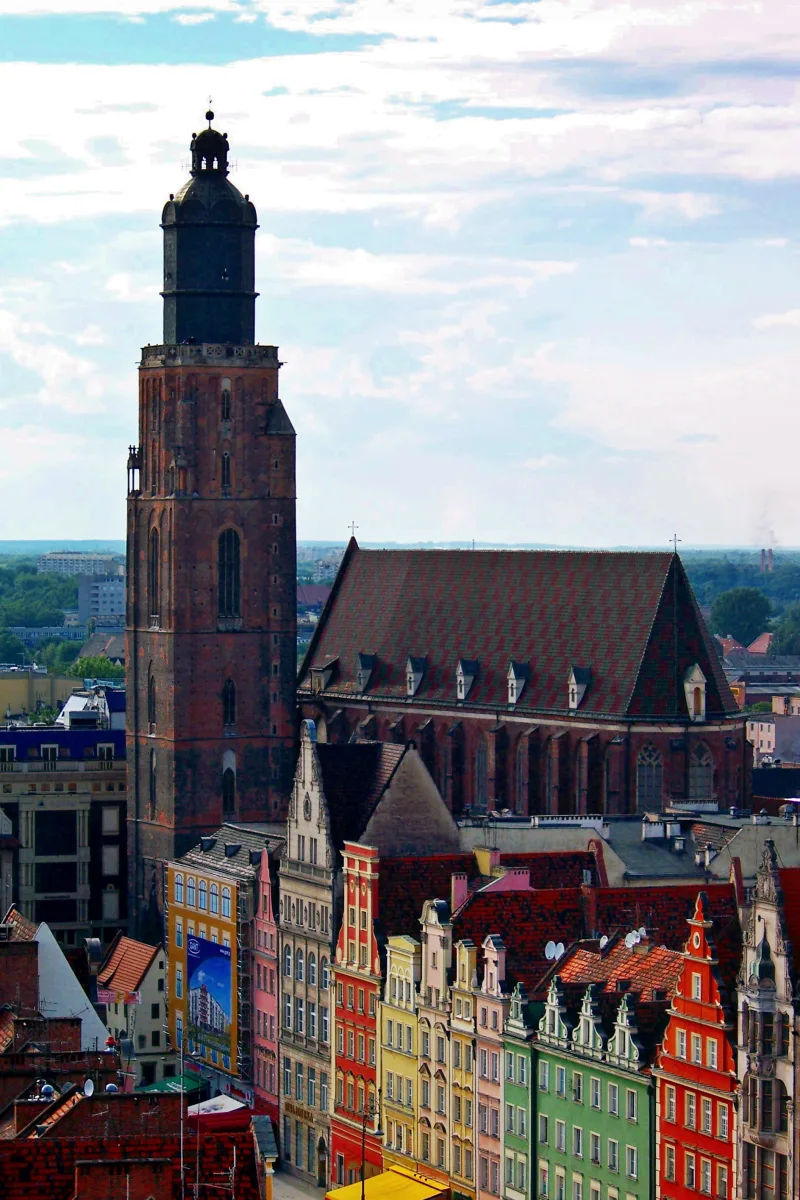
The second parish church, the Basilica of St Elizabeth of Hungary, originally had the tallest tower in Silesia, at 130.5 metres. After the spire collapsed in 1529 and fires in 1960, 1975 and 1976, the tower today stands at 91.46 metres, and since 1946 the church has served as a garrison church.
The Archcathedral of St John the Baptist on Ostrów Tumski (Cathedral Island) has a story of its own; it is already the fourth church on this site. During the siege of Wrocław in 1945 about 70 percent of the building was destroyed, and reconstruction was not finished until 1991; today it houses the largest organ in Poland, with 151 stops.
Next to the former castle of the Silesian Piasts stands the Collegiate Church of the Holy Cross and St Bartholomew, founded in 1288 as a votive offering after a dispute between Duke Henryk Probus and the bishop. The same type of Gothic parish church recurs outside Wrocław, too.
The Cathedral of St Stanislaus and St Wenceslaus in Świdnica now has the tallest tower in Silesia, at 101.21 metres, although it only became a cathedral in 2004, after centuries as a parish church.
The Cathedral of the Holy Apostles Peter and Paul in Legnica has been under construction since 1333, but owes its twin-tower appearance to a neo-Gothic rebuilding in 1892-1894.
Baroque Cistercian abbeys and sanctuaries
The Cistercians built on a different scale in Lower Silesia than the city parishes. The Cistercian Abbey in Lubiąż is the largest Cistercian abbey in the world, with a volume three times greater than the Royal Castle on Wawel Hill. After the destruction of the Thirty Years' War, Abbot Arnold Freiberger began a Baroque rebuilding in 1649, producing an abbot's palace with more than 300 rooms. In the crypt beneath the Gothic basilica lie the Silesian Piasts, including Bolesław the Tall, along with 98 mummified abbots.
The Cistercian Abbey in Krzeszów has a similar trajectory: Benedictines from 1242, Cistercians from Henryków from 1292, destruction in the Hussite Wars and the Thirty Years' War, and then a flowering under Abbot Bernard Rosa, who from 1660 turned Krzeszów into a centre known as the New Jerusalem. The Baroque basilica was built in 1728-1735; the monastery's founder, Bolko I the Strict, is buried in the chancel, and the abbey is a candidate for the UNESCO World Heritage List.
The layering shows up in a single place, too. The Shrine of St Hedwig in Trzebnica was founded in 1202 by Duke Henryk the Bearded as the first female religious community in Poland. The Romanesque church of 1208-1219 conceals a three-nave crypt from 1214; in 1268-1269 the Chapel of St Hedwig was added to it, the first building in Poland raised entirely in the Gothic style, and the Baroque rebuilding did not come until 1680-1785 - a Romanesque, a Gothic and a Baroque element all in one complex at once.
Churches of Peace - the wooden architecture of a Protestant compromise
After the Peace of Westphalia in 1648, Protestants in the Silesian lands under Catholic Habsburg rule were allowed to build just three churches, on condition that they were raised outside the city walls, from non-durable materials: wood, straw and clay. Hence the unusual architectural form. The Church of Peace in Świdnica was built in half-timbered construction, on a Greek-cross plan, in just ten months; it once held 7,500 people, which makes it the largest wooden Baroque church in Europe.
The Church of Peace in Jawor was built using the same method, to a design by the same architect, with four levels of galleries and paintings depicting biblical scenes. Both churches were added to the UNESCO World Heritage List in 2001, as the only two surviving buildings of this type in Poland.
Cathedrals and a church - the post-war layer inside former German walls
After 1945, some Gothic and Baroque churches changed worshippers once again, passing to the Orthodox and Greek Catholic communities settled in Lower Silesia as a result of post-war resettlement. The Cathedral of St Vincent and St James is a Gothic former Franciscan church, founded around 1240 by Duke Henryk the Pious, who was buried in the crypt beneath the still unfinished church after his death at the Battle of Legnica. In 1997 it was handed over to the Greek Catholic community, for whom it now serves as a cathedral.
The Cathedral of the Nativity of the Most Holy Mother of God was built at the turn of the 15th and 16th centuries as a Gothic filial church of Wrocław's parish church. Destroyed 70 percent during the war and rebuilt in 1959-1961, in 1963 it passed to the Polish Autocephalous Orthodox Church and today serves as the cathedral of the Wrocław-Szczecin diocese, with frescoes by Jerzy Nowosielski and two iconostases.
The Church of Saints Cyril and Methodius on Ostrów Tumski (Cathedral Island) has yet another layered history. It was built in 1686-1690 as the Roman Catholic Church of St Anne, modelled on the Roman church of Il Gesù, and regarded as Wrocław's first Baroque church. Until 1810 it belonged to the Augustinian monastery, and in May 1945 the university library's book collection, evacuated there, burned inside it. Since 1970 the building has belonged to the Polish Autocephalous Orthodox Church, and the liturgy is celebrated there in Polish, Church Slavonic and Ukrainian.
The White Stork Synagogue
The layering of Lower Silesia's places of worship also includes a history from outside Christianity. The White Stork Synagogue in Wrocław was built in 1827-1829 to a design by Carl Ferdinand Langhans, after years of dispute between the liberal and orthodox wings of the Jewish community. During Kristallnacht, on the night of 9 to 10 November 1938, the Nazis devastated the interior, but the closeness of neighbouring buildings saved the synagogue from burning down, unlike the much larger New Synagogue that once stood nearby. It was closed in 1966, and the community did not regain full ownership until 1996. Today it is an active place of worship and a centre of Jewish culture, with an ornate Aron ha-kodesh, the cabinet for the Torah scrolls, inside.
How to take in this layering in a single visit
The greatest density of layers is on Ostrów Tumski (Cathedral Island) in Wrocław: within a few hundred metres stand a Gothic cathedral, a Gothic collegiate church, a Greek Catholic cathedral and an Orthodox church side by side, so a single walk shows several chapters of the same story at once. Świdnica combines a Gothic cathedral with a Baroque, Protestant Church of Peace. Most of the buildings described here are active places of worship, so opening hours and the rules for visiting outside of services should be checked in advance on the website of the relevant parish or congregation.

Be the first! Add a comment.
You need to log in to add a comment.
Log in