
The Ossoliński National Institute in Lwów
The Ossoliński National Institute, known as the Ossolineum, was founded for the Polish nation in 1817 by Józef Maksymilian Ossoliński, and the institution opened in 1827 in Lwów. It was not just a library. From the start, the Institute combined three functions: a library, the Lubomirski Princes' Museum, attached in 1823, and its own publishing house, launched in 1827. In the era of the partitions, when Poland was not on the map, an institution gathering Polish manuscripts, early printed books and mementoes carried a significance that reached far beyond librarianship alone.
Before the Second World War the collection numbered more than 220,000 works, more than 6,000 manuscripts, more than 9,000 autographs, more than 2,000 documents and 3,000 maps. The library also held the largest complete collection in Poland of Polish 19th- and 20th-century press, material invaluable for studying the everyday life and politics of the old Polish Commonwealth and of the lands under partition.
The division of the collection after the war
After the war Lwów found itself within the borders of the Soviet Union, and the fate of the Ossolineum's collection was decided between 1944 and 1947, when the Soviet and Ukrainian sides divided it up. Around 150,000 early printed books, 19th- and 20th-century printed works and manuscripts went to Poland, only 15-20 per cent of the entire pre-war collection. The rest, including a large part of the Polish press collection, stayed in Lwów. The sources do not specify the exact criteria used to divide the material between the two sides, so it is hard today to reconstruct precisely why these particular items, and not others, were handed over to Poland.
What stayed in Lwów and how the two institutions cooperate today
The parts of the collection that never left Lwów are now held in today's Vasyl Stefanyk Library. Since 2003 the Wrocław Ossolineum has had access to the Polish materials kept there, and the two institutions have agreed on a mutual right to digitise them. This arrangement lets researchers use the Institute's entire former holdings, even though today they are physically split between two cities and two countries.
The manuscript of "Pan Tadeusz": a separate, turbulent history
The most famous item in the collection, the autograph manuscript of Adam Mickiewicz's "Pan Tadeusz", reached Wrocław by an entirely different route from the rest of the collection taken over after the war from the Soviet side. Władysław Mickiewicz, the poet's son, sold the manuscript in 1871 to Stanisław Tarnowski. After his death in 1917 the manuscript passed to his son Hieronim, and in 1929 it was bought by Zdzisław Tarnowski and added to the Tarnowski family's Dzików collection. In 1939 another family member, Artur Tarnowski, deposited the manuscript with the Ossoliński National Institute in Lwów, where a year later it was conserved and rebound.
Between 1944 and 1945 the Germans removed the manuscript from Lwów, taking it through Kraków deep into Germany, from where it eventually ended up in Zagrodno in Lower Silesia, where it was abandoned. The recovered manuscript was handed over to the Wrocław Ossolineum in 1947, but it formally became the institution's property only in 1999, when the city of Wrocław bought it from Jan Artur Tarnowski for 200,000 dollars. Alongside the autograph of "Pan Tadeusz", the collection also holds manuscripts by Juliusz Słowacki and Aleksander Fredro, which survived from the pre-war Lwów collection.
Today's headquarters
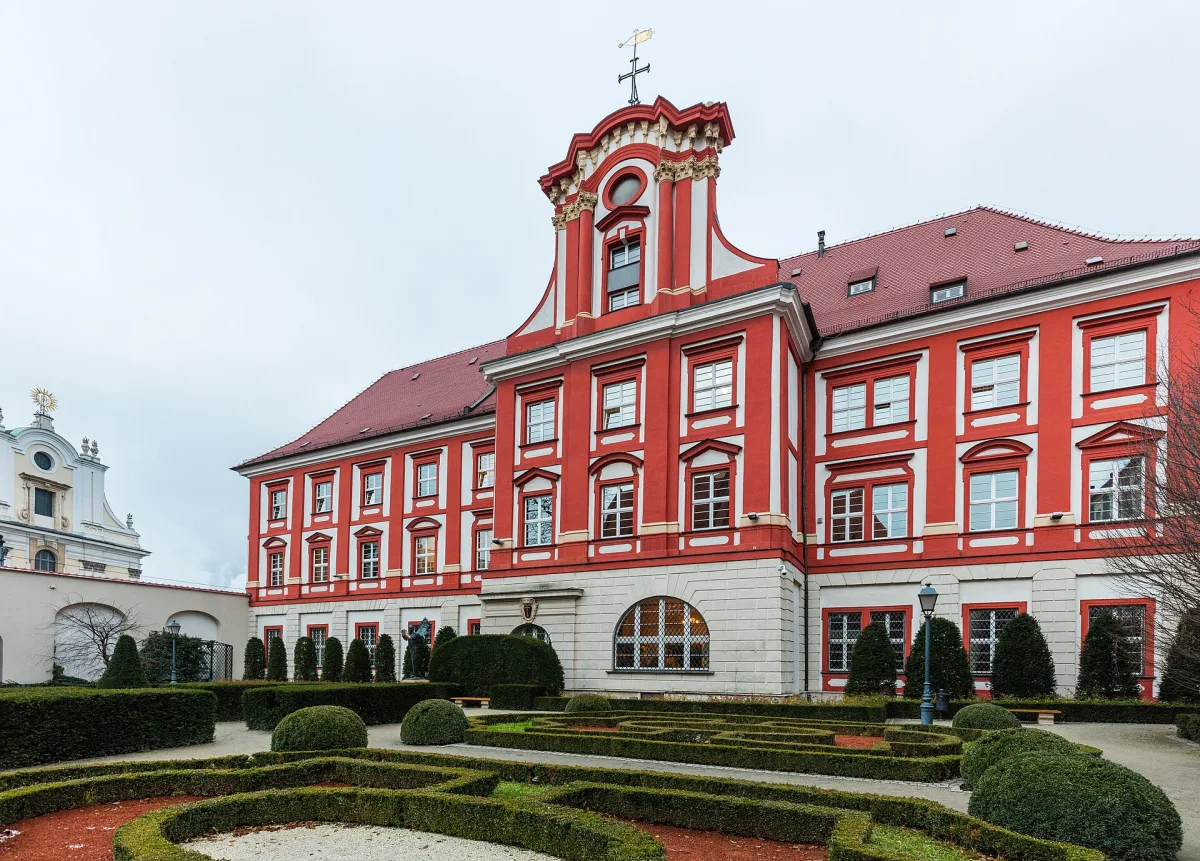
The Wrocław Ossolineum is housed at Szewska 37, in a former monastery complex from the turn of the 17th and 18th centuries, rebuilt after wartime destruction and handed over to the institution in 1947. In the courtyard between the library building and St Michael's Church stands the Ossolineum Garden, a baroque garden opened in 2007, with a monument to the poet Angelus Silesius, trimmed hedges and a fountain, a few hundred metres from Wrocław's Market Square.
The "Pan Tadeusz" Museum
Mickiewicz's manuscript has had its own, separate exhibition since 2016. The "Pan Tadeusz" Museum, a branch of the Ossolineum, opened to visitors on 23 April 2016 in the Pod Złotym Słońcem tenement house on Wrocław's Market Square. Across more than 1,500 square metres of exhibition space, alongside the manuscript itself, the museum displays manuscripts, coins, prints, paintings, sculptures and decorations, set against the wider historical and literary background of Polish Romanticism. So a collection that reached Wrocław in 1946 and 1947 under dramatic circumstances has, after decades, found a place in the very heart of the city, on the Market Square, where every visitor can see it.

Be the first! Add a comment.
You need to log in to add a comment.
Log in