
From Radomsko, through the underground, to Wrocław
Tadeusz Różewicz was born on 9 October 1921 in Radomsko, into the family of a court official. It was his older brother, Janusz, who introduced him to modernist literature and helped shape his first attempts at poetry. The war interrupted that path abruptly: from 1942 Różewicz was active in the Home Army under the pseudonym "Satyr", and from June 1943 to November 1944 he fought in partisan units, while also running the underground publication "Czyn Zbrojny" (Armed Action) and writing poems. His literary debut, the collection "Echa leśne" (Forest Echoes), appeared while he was still in the underground, in 1944.
After the war Różewicz settled in Kraków, where he studied art history and became involved with the Kraków Avant-garde circle. In the summer of 1949, with no prospect of a flat of his own, he moved to Gliwice. He finally settled in Wrocław in 1968 and lived there for the rest of his life; as sources indicate, the city became for him a place where he could work away from the current disputes of the literary circles centred in Warsaw and Kraków.
Poetry that broke with the pre-war language
The breakthrough in Różewicz's work came in the second half of the 1940s: the collections "Niepokój" (Anxiety, 1947) and "Czerwona rękawiczka" (The Red Glove, 1948) introduced a completely new shape for post-war Polish poetics. In place of traditional rhythm and rhyme came free verse and the so-called sentence verse, whose construction is described as cubist: sentences and images juxtaposed without a classic, flowing narrative. This poetry grew directly out of the experience of war: it expressed, as it has been put, the tragedy of the isolated individual lost in a post-war world dominated by the spectre of mass death. Różewicz's early work was sometimes described as expressionist and catastrophist, and some critics accused it of nihilism; in reality, however, it was a response to the experience of Auschwitz and total war, not an affirmation of despair for its own sake. This reckoning with traditional poetic form is why Różewicz is regarded today as one of the writers who reshaped the language of Polish poetry after 1945.
Theatre of the absurd, Polish style
Różewicz also wrote plays, and his 1960 play "Kartoteka" (The Card Index) is considered the first example of theatre of the absurd in Polish literature, with a protagonist lacking a clear identity and a construction that rejects a traditional, linear plot in favour of loosely connected scenes. Różewicz also worked with film, writing screenplays together with his brother Stanisław Różewicz, a director. His playwriting, like his poetry, was built on distrust of ready-made, earlier literary forms; this approach set the direction in which avant-garde drama developed in Poland for decades.
Wrocław as the poet's home
Różewicz lived in Wrocław continuously from 1968 until his death in 2014, so for almost half a century, longer than in any other city. On 7 October 1991 he received an honorary doctorate from the University of Wrocław, and in 1994 the honorary citizenship of Wrocław. Both honours confirm how strongly the city regarded him as one of its own writers.
Burial by the Wang Church in the Karkonosze
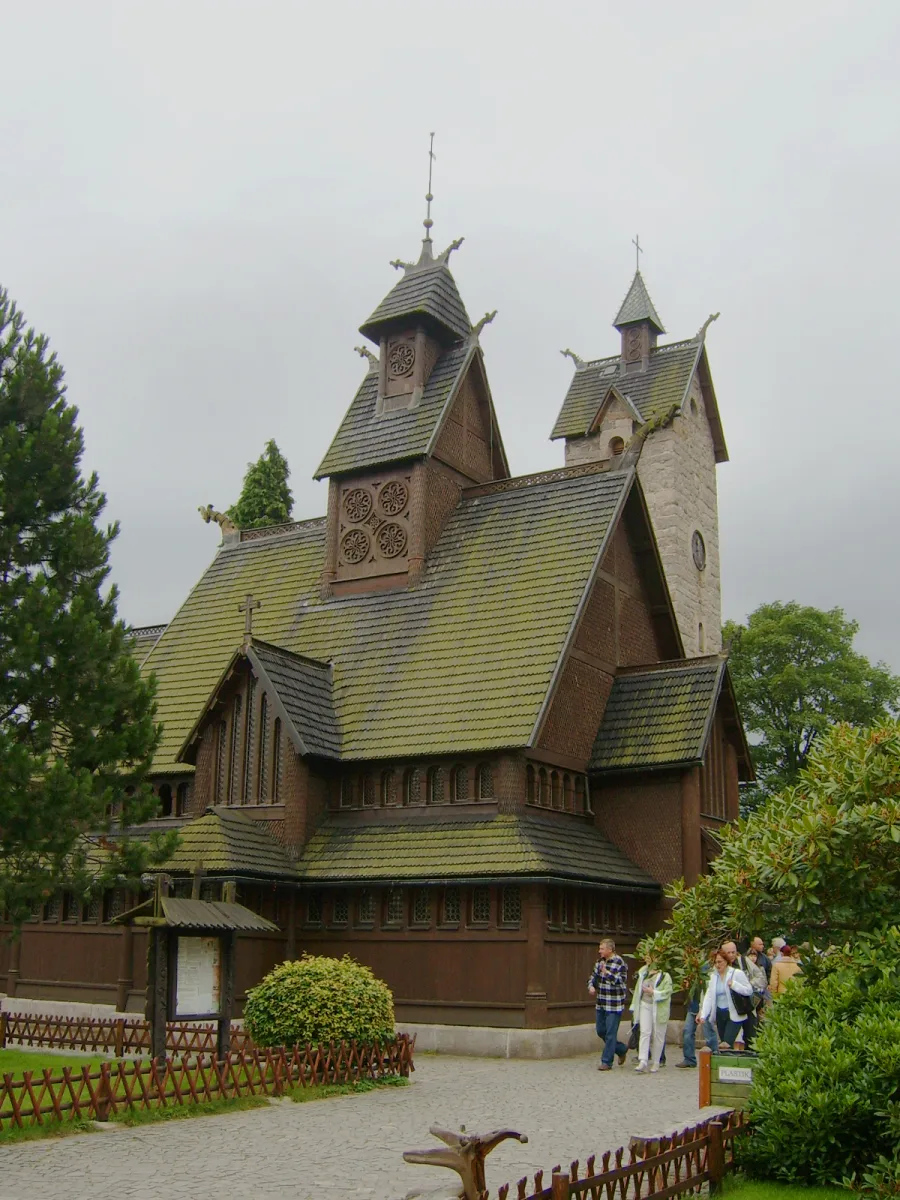
Tadeusz Różewicz died on 24 April 2014 in Wrocław, aged 92, of natural causes. In accordance with his wishes he was not buried in the city he had become one with over the decades, but in the cemetery by the Wang Church in Karpacz, a Norwegian stave church brought to the Karkonosze in the 19th century. Two independent sources agree that the funeral took place on 29 April 2014, and that the funeral service was conducted jointly by an Evangelical and a Catholic clergyman.
How the city remembers Różewicz today
To mark the hundredth anniversary of the poet's birth, the Sejm of the Republic of Poland declared 2021 the Year of Tadeusz Różewicz. In the same year, on 9 October, the Wrocław Pan Tadeusz Museum opened the permanent exhibition "Pan Tadeusz Różewicz" (a play on words: "Mr Tadeusz Różewicz" and the title of Mickiewicz's epic "Pan Tadeusz"), based on the archive donated by the poet to the Ossoliński National Institute, an institution with which Wrocław has been associated for decades, and whose Ossolineum Garden remains today one of the places of quiet in the city centre. The exhibition and the anniversary parliamentary resolution are today the main, lasting forms of commemorating the poet, who for nearly fifty years helped shape the literary image of post-war Wrocław.

Be the first! Add a comment.
You need to log in to add a comment.
Log in