
A community that had to rebuild itself from scratch
Wrocław's postwar Jewish community had little in common with the prewar community, which perished in the Holocaust or fled abroad from it. After 1945 the city was resettled by Jews from other parts of Poland and repatriates from the USSR, and the organisation that united them operated from 1946 to 1993 as the Congregation of the Mosaic Faith in Wrocław. It was only in 1993 that it was transformed into today's Jewish Religious Community.
The 1990s and 2000s were not financially easy for the community. On 27 August 2006, because of financial difficulties, the Wrocław community joined the Union of Jewish Religious Communities in Poland and for over a decade functioned as one of its branches, without full independence. It only regained independence in 2018. This episode explains why a community with almost eighty years of uninterrupted activity behind it is still sometimes described as reviving - its organisational structures long failed to keep up with the community's needs.
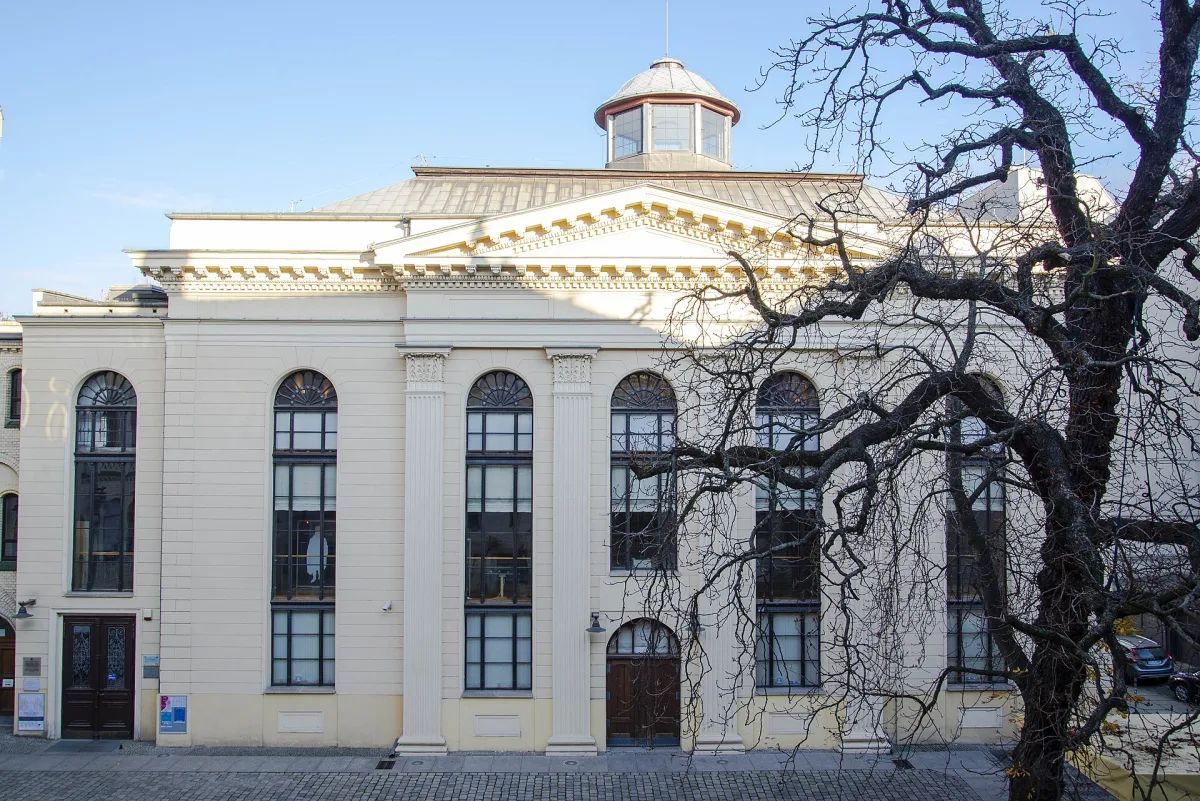
The Synagogue Under the White Stork - a building that survived everything
The Synagogue Under the White Stork was built in 1827-1829 to a design by Carl Ferdinand Langhans and for over a hundred years was the main place of prayer for Wrocław's Jews. On the night of 9 to 10 November 1938, Kristallnacht, Nazi stormtroopers devastated its interior and tore up the Torah scrolls kept there. The building itself was not set on fire only because it stood too close to neighbouring tenement houses.
The synagogue's fate after that night shows how far it drifted from its original function. In 1943-1945 the Germans set up a car repair workshop and storerooms inside it. After the war, in 1974, the building was taken over by the State Treasury and handed to the University of Wrocław. It was only returned to the Jewish community on 10 April 1996, after several decades during which it played no religious role at all.
The recovered building was in poor technical condition: the walls were damp and cracked, the plaster was falling away, and the classicist decorations were deteriorating. A full renovation of the interior and façade, including the construction of lifts for people with disabilities, was carried out in 2008-2009 for 2.5 million euro from EU funds and the Ministry of Culture. The work was carried out by a Wrocław firm specialising in the restoration of historic monuments, to a design by the Archikon studio, recreating, among other things, the stained-glass windows and the original interior decoration.
Today the synagogue plays a dual role: it is an active house of prayer for the most important holidays and the seat of the Centre for Jewish Culture and Education, which holds exhibitions, concerts, theatre performances and workshops inside it. The Centre, opened in 2005, is run by the Bente Kahan Foundation in cooperation with the Jewish Religious Community. It is there that you can see permanent exhibitions devoted to the history of Wrocław's Jews and the Holocaust.
The District of Four Temples - an idea thirty years old
The name District of Four Temples has only been in use since 1995, though it covers buildings much older than that. It describes a fragment of the Old Town between Kazimierza Wielkiego, św. Antoniego, Pawła Włodkowica and św. Mikołaja streets, where four temples of four different faiths stand a short distance from one another: the Orthodox Cathedral of the Nativity of the Most Holy Mother of God, the Roman Catholic Church of St Anthony of Padua, the Evangelical-Augsburg Church of Divine Providence and the Synagogue Under the White Stork. The distance from one temple to the next is at most three hundred metres.
The idea of promoting this area as a place symbolising religious tolerance was jointly initiated by clergy of three Christian denominations and Jerzy Kichler, an activist of the Jewish Religious Community. The District of Four Temples has never been, and is not, an administrative unit, but rather a tourist and cultural brand, today developed by the Foundation for the District of Mutual Respect of Four Faiths. The foundation organises themed walks, educational meetings for children and joint ecumenical prayers with representatives of all four communities.
Cultural life around the synagogue
Every year, usually in autumn, around the anniversary of Kristallnacht, the Days of Mutual Respect take place in the District of Four Temples - a series of meetings, lectures and events commemorating the victims of the Holocaust and recalling the shared history of the four faiths. This is one of the fixed events on the calendar of this place, alongside concerts and exhibitions held throughout the year in the Synagogue Under the White Stork.
The synagogue itself functions as an active cultural venue: it hosts concerts of Jewish music, theatre performances, history lectures and workshops for schools. The permanent exhibitions of the Centre for Jewish Culture and Education are devoted, among other things, to the reconstructed history of Wrocław's Jews and the fate of Holocaust survivors. For comparison, it is worth remembering that Wrocław had another, much larger temple - the New Synagogue, burned down on the same night of Kristallnacht and never rebuilt. Its foundations were only discovered in 2017, and today no trace of the former building remains above ground.
How many Wrocław Jews are there today
The Jewish Religious Community in Wrocław today numbers around three hundred members, according to data from 2024. It maintains two active synagogues: the one Under the White Stork for the most important holidays, and the Small Synagogue, where daily and Sabbath prayers are held. The Wrocław community used to also have branches in other towns of Lower Silesia - in Dzierżoniów, Żary and Wałbrzych, but all were closed between the late 1990s and 2010, when the local communities had shrunk to the point where there was no one left to run them.
The scale of today's community contrasts with what was happening in Lower Silesia immediately after the war, when the region was the largest concentration of Holocaust survivors in Poland, and tens of thousands of Jews lived in Wrocław and the surrounding area. Most of them left in successive waves of emigration in the 1940s, 1950s and 1960s. What remains is a small but still active community, which today has two functioning synagogues, a cultural foundation and a place in the city symbolically marked as the District of Four Temples.

Be the first! Add a comment.
You need to log in to add a comment.
Log in