
Wratislavia Cantans: the festival that began with oratorios
The Wratislavia Cantans festival was founded in 1966 on the initiative of conductor Andrzej Markowski as an oratorio and cantata festival. From the outset, its concerts have been held in the historic churches and museums of Wrocław, more rarely on a classical concert stage, which still sets it apart from typical philharmonic events today. Music meets architecture here: the interiors of the churches, their acoustics and history, become part of the programme, as important as the performers themselves.
In 1978, Tadeusz Strugała took over the festival's direction, and during his tenure countertenor competitions held at the Castle of the Silesian Piasts in Brzeg were added to the programme. This shows how Wratislavia Cantans grew over time to reach beyond Wrocław itself, seeking places with the right history and atmosphere for early music across the whole region.
Early and contemporary music under one banner
The National Forum of Music, which took over the organisation of Wratislavia Cantans, today runs several distinct festivals with very different profiles. The Academy of Early Music focuses on historical repertoire performed on period instruments, while Musica Polonica Nova goes in the opposite direction: it is a festival of premieres of works by Polish composers, held under the patronage of the Polish Composers' Union. It was founded in 1968, just two years after Wratislavia Cantans, and is held every two years, presenting music that is only just entering the concert circuit.
This contrast - masses and cantatas centuries old on one hand, premieres written specially for a given year on the other - is one of the features distinguishing Wrocław's festival scene. Few institutions in Poland run a festival of early music and a festival of the newest music side by side.
Jazz and electronic music
Jazztopad, organised by the National Forum of Music under the artistic direction of Piotr Turkiewicz since 2008, has a history of more than twenty years behind it and is among the more important jazz festivals in Europe. It has hosted, among others, Wayne Shorter, Kenny Wheeler, Herbie Hancock and Sonny Rollins, and since 2015 has also run a separate, annual edition in New York - a rare case of a festival from Lower Silesia having a permanent edition across the ocean. The programme favours projects created specially for the festival and musicians seeking a new language of improvisation, not only star concerts.
Musica Electronica Nova, an electronic music festival organised by the NFM since 2005, received the Wrocław Music Award as early as its first edition. It combines various strands of electronic and improvised music with theatre, dance and video art. Elżbieta Sikora held the artistic direction until 2017, and Pierre Jodlowski has held it since 2019. The festival is held irregularly, roughly every two years, and each time favours a different way of combining sound with image.
Concerts at the National Forum of Music and in historic interiors
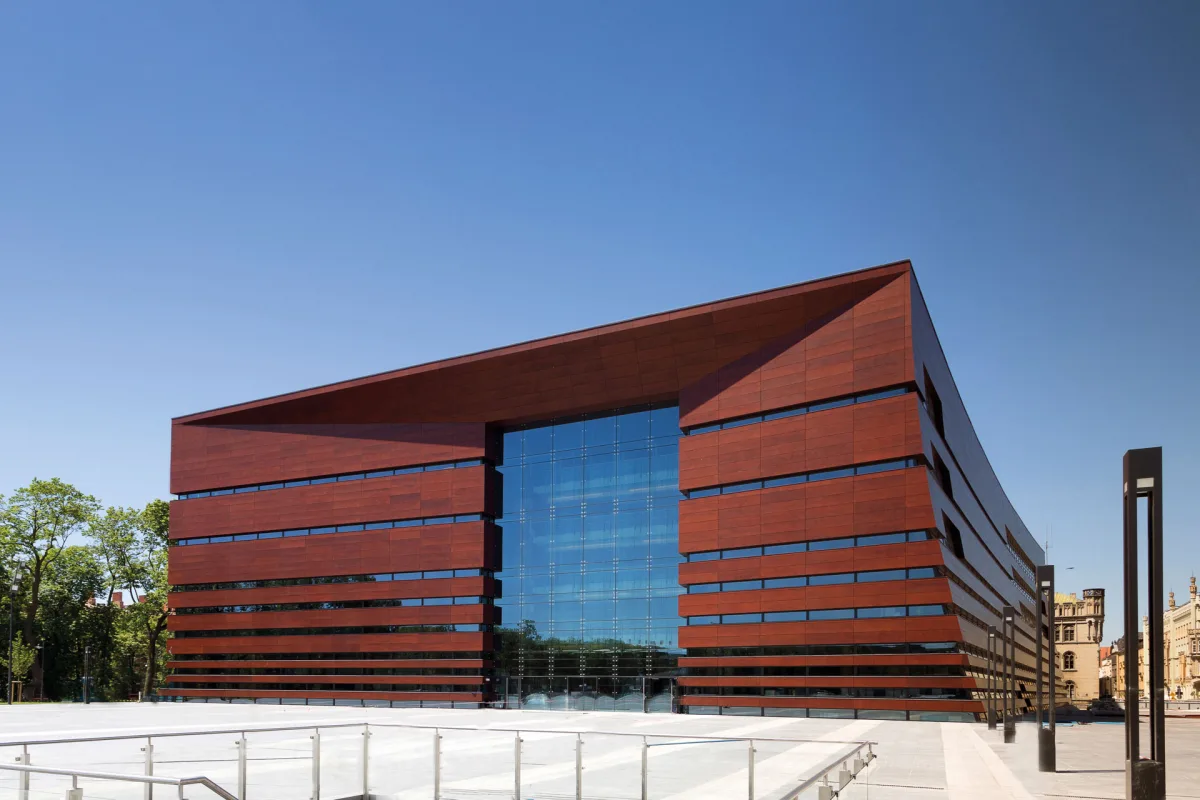
Some of these festivals take place in the hall of the National Forum of Music, and some - like Wratislavia Cantans or, in the past, the countertenor competitions in Brzeg - in churches, monasteries and historic interiors that were never conceived as concert halls. The building of the National Forum of Music itself, its history and acoustics, already have a separate description in a portal article about the region's philharmonics and concert halls, so here it is enough to note: it is in this hall that most festival concerts are held today, and its opening in 2016 gave Wrocław's festivals a permanent, large stage that they had not had before.
Alongside the NFM, the Centennial Hall also plays an important role in the city's concert life, used for larger, open-air events, as do the historic churches in the centre, including the Church of Our Lady on the Sand and the Church of the Holy Spirit, where the acoustics of the Gothic interiors have for decades attracted the organisers of early music concerts.
The city that became a festival venue
None of these festivals was created in Wrocław with the idea of building a city brand - Wratislavia Cantans grew out of the initiative of a single conductor, while Jazztopad and Musica Electronica Nova grew out of the programme of a single institution. It was only the sum of these separate initiatives, spread across different times of year and different musical genres, that added up to a city where some music festival is running almost all year round: concerts in historic interiors in spring and summer, jazz in autumn, while electronic and contemporary music appear cyclically, though not every year.
The opening of the National Forum of Music in 2016 brought these previously scattered events together under a single organisation and a single large hall, which made it easier for them to develop, but the roots of each festival reach back to separate, earlier histories - from the 1960s to the first decade of the 2000s.
Where to look further
The repertoire and profile of individual festivals change from year to year, so it is worth checking the detailed programme directly with the National Forum of Music. What remains constant, however, are their artistic profiles: oratorio and early music at Wratislavia Cantans and the Academy of Early Music, Polish premieres at Musica Polonica Nova, jazz at Jazztopad, and sound-and-image experiments at Musica Electronica Nova.

Be the first! Add a comment.
You need to log in to add a comment.
Log in