
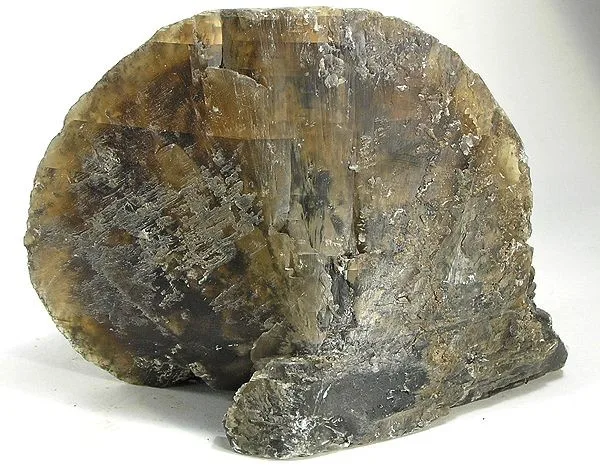
Copper that had been sought for a long time
Before geologists reached the deposit beneath Lubin, copper had long been mined in Lower Silesia. In the area between Bolesławiec and Złotoryja, even before 1945, low-grade deposits with a copper content of around 0.8-1.5 per cent were worked. Post-war geologists therefore knew the region had potential, but they were looking for something more: a deposit rich and extensive enough to justify building an entire industry around it. Work led by a team headed by the geologist Jan Wyżykowski turned towards the area between Lubin and Głogów, where earlier geological indications pointed to the presence of deep-lying deposits.
Drilling and the moment of discovery
On 23 March 1957, Wyżykowski's team struck a copper ore deposit near Sieroszowice, between Lubin and Głogów. The deposit lay deep underground, which for years made it hard to find; the earlier, shallower outcrops around Bolesławiec and Złotoryja gave a much weaker picture of what actually lay in the rock beneath this part of Lower Silesia. The 1957 discovery was a breakthrough: it showed that underground, between Lubin and Głogów, lay a deposit of an entirely different scale from anything previously known in the region.
The scale of the deposit and its significance for the country
The deposit discovered by Wyżykowski's team turned out to be one of the largest in the world and the largest single copper ore deposit in Europe. Industrial reserves are estimated at more than 320 million tonnes of copper ore and almost 17 million kilograms of silver. Thanks to this second raw material, mining in the region also became, over time, one of the world's more important sources of silver. For post-war Poland, rebuilding its industry practically from scratch, the discovery meant access to a raw material that had previously had to be imported from abroad for hard currency.
Building mines and towns from scratch
On the strength of the discovery, construction of the Lubin Mining Works, the first and oldest mine in Poland's copper basin, began on 1 January 1960. The mine was put into initial operation on 19 July 1968 and reached full production capacity in 1972. On 1 May 1961, the Lubin Mining Works then under construction was transformed into the Copper Mining and Smelting Combine, the predecessor of today's KGHM Polska Miedź. Mines in Lubin and Polkowice started up in 1968, joined in 1974 by the Rudna mine, launched on 17 July of that year; in its first year it extracted 1.9 million tonnes of ore, and by the 1980s its extraction capacity had risen to 11.3 million tonnes a year. The Sieroszowice mine began operating after 1978. Around the shafts and processing plants, housing had to be built almost from scratch for thousands of miners and their families. The Rudna Mining Works near Polkowice today has eleven shafts ranging from 900 to 1,244 metres deep and is among the deepest underground mines in the world.
How the area changed within a decade
In less than fifteen years after the discovery, between 1957 and the early 1970s, the previously agricultural region between Lubin and Głogów changed character. People poured into the towns from all over Poland, looking for work building mines, processing plants and housing estates. The growth of the copper industry brought with it the expansion of roads, railway lines and all the accompanying infrastructure, and the once-small county towns turned into some of the fastest-growing towns in post-war Poland.
Today's copper basin
The Legnica-Głogów Copper District is today an area covering 2,735.87 square kilometres and home to around 500,000 people, served by the A4 motorway, the S3 expressway, and a railway network linking Legnica, Lubin and Głogów, modernised in 2019. KGHM Polska Miedź operates three main mining divisions in the region. The history of the discovery itself and the figure of Jan Wyżykowski are presented at the Jan Wyżykowski Museum of the Lubin Region in Lubin, housed at the "Bolesław" shaft and named after him; visitors can see a reconstructed adit, mining machinery and copper minerals extracted in the region.

Be the first! Add a comment.
You need to log in to add a comment.
Log in