
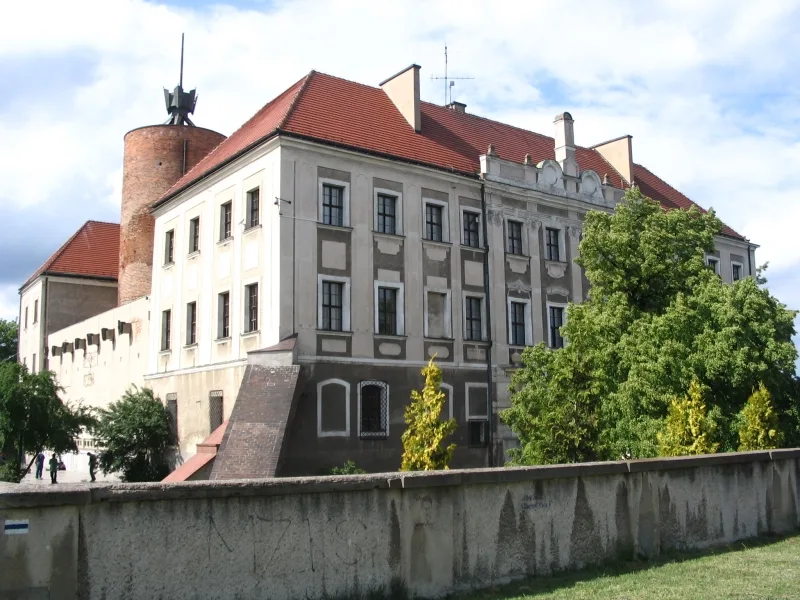
A city declared a fortress
In autumn 1944 Berlin decided that Głogów would become one of the points of resistance on the path of the Red Army's offensive towards the Reich. This decision was shaped by the city's location: the railway and road bridges over the Oder were among the last working crossings in this part of Silesia, and hulls of small submarines were being assembled at the local river shipyard. From autumn 1944 fortification works were carried out, and on 21 January 1945 Głogów was declared a closed city - Festung Glogau. The garrison, numbering 7,000 to 9,000 soldiers, was commanded by Colonel Jonas zu Eulenburg.
The course of the siege
The formal start of the siege fell on 11 February 1945. A day earlier, troops of the 3rd Guards Army under Colonel General Vasily Gordov had broken through the defences on the city's outskirts, and on 14 February they closed the ring of encirclement. From 22 February the fighting was already taking place on the streets, house by house. On 23 March the Germans blew up the railway bridge over the Oder, and a week later, on 30 March, air supply to the garrison ceased. That same day, at around 4.30 pm, zu Eulenburg issued his last order: the fortress is open, let everyone act according to their own judgement. After this, soldiers began destroying documents and weapons, and some tried to break through to the German lines. The official capitulation was announced on 1 April 1945. Sources give differing figures for the losses on both sides: Wikipedia, citing the study by Dolata and Jurga, gives around 750 killed and 1,500 wounded on the German side and around 3,500 killed, wounded and missing on the Soviet side, while other accounts put the combined total at 6,000-6,500 casualties. Throughout this time around a thousand civilians remained in the besieged city, struggling to survive in frost reaching minus 25 degrees, without water or electricity.
95 percent of the city in ruins
Historians Dolata and Jurga, in a 1977 study cited by the Polish Wikipedia, put the scale of destruction at around 95 percent of the built-up area. A more detailed breakdown of this figure is given by the tutajglogow.pl website: 88.5 percent of residential buildings, 74.3 percent of outbuildings and 83 percent of industrial buildings were destroyed. Whichever percentage figure is taken, the picture is the same - Głogów's old town, densely built up since the Middle Ages, ceased to exist almost entirely. The destruction also affected monuments that had survived earlier wars, including the 1109 siege, when the defenders of Głogów repelled the expedition of Emperor Henry V, and the period when the city was a Prussian fortress with the Star Fort, erected in 1747-1749 under Frederick the Great.
What survived
From the dense old town's former built-up area, the walls of the two most important buildings above all survived: the Castle of the Dukes of Głogów, built in the 13th century as the seat of the Piast rulers of the Duchy of Głogów, and the Town Hall, standing on the same spot since the end of the 13th century and rebuilt after successive fires up to the Renaissance period. Both buildings nevertheless required years of reconstruction, because the war had left them largely as walls without roofs or interiors. The bridge over the Oder from 1917 also survived, known today as the Bridge of Tolerance, linking the former Old Town with Ostrów Tumski.
Ruins, brick and postwar fate
The first Polish settlers, who arrived in Głogów in the summer of 1945, found only ruins and rubble. Bricks and other building materials were then hauled away from the rubble on a massive scale, among other things for the rebuilding of Warsaw, which - as tutajglogow.pl reports - delayed the reconstruction of Głogów itself by decades. For years the city remained largely an undeveloped field of ruins, and its economic turning point only came after the discovery, in 1957, by a team led by geologist Jan Wyżykowski, of copper deposits between Lubin and Głogów. The decision to build a copper smelter, begun in 1967, made it the city's largest industrial plant and gave impetus to its development, though this did not immediately translate into the reconstruction of the historic centre.
Years of rebuilding the old town
The reconstruction of the most important monuments only got properly under way in the 1980s and 1990s - that was when the Town Hall, the Castle of the Dukes of Głogów and the buildings of selected streets, such as Smolna, were raised from the ruins. The town hall tower, today the tallest in Silesia, was reconstructed in 1994-1995, and the full reconstruction of the entire Town Hall was completed in 2002, almost sixty years after the war. Work on further buildings continues to this day - the former Municipal Theatre is currently being reconstructed. According to Wikipedia, the reconstruction of Głogów has still not been completed, and its old town has never returned to its densely built-up prewar form.
What stands today where the old city used to be
On the site of the former Głogów old town, the Castle and Town Hall, rebuilt over successive decades, now stand, surrounded by the Monument to the Children of Głogów, erected in 1979 from residents' donations to mark the millennium of the Polish state. The rest of the former dense burgher housing, 95 percent destroyed, has never been fully recreated - the city, which for decades lived mainly off the copper industry, is only gradually filling the gap left by the former town centre. A walk through today's Głogów, past the Castle, Town Hall and bridge over the Oder, therefore shows both what has been restored and the scale of the losses the city still contends with today.

Be the first! Add a comment.
You need to log in to add a comment.
Log in