
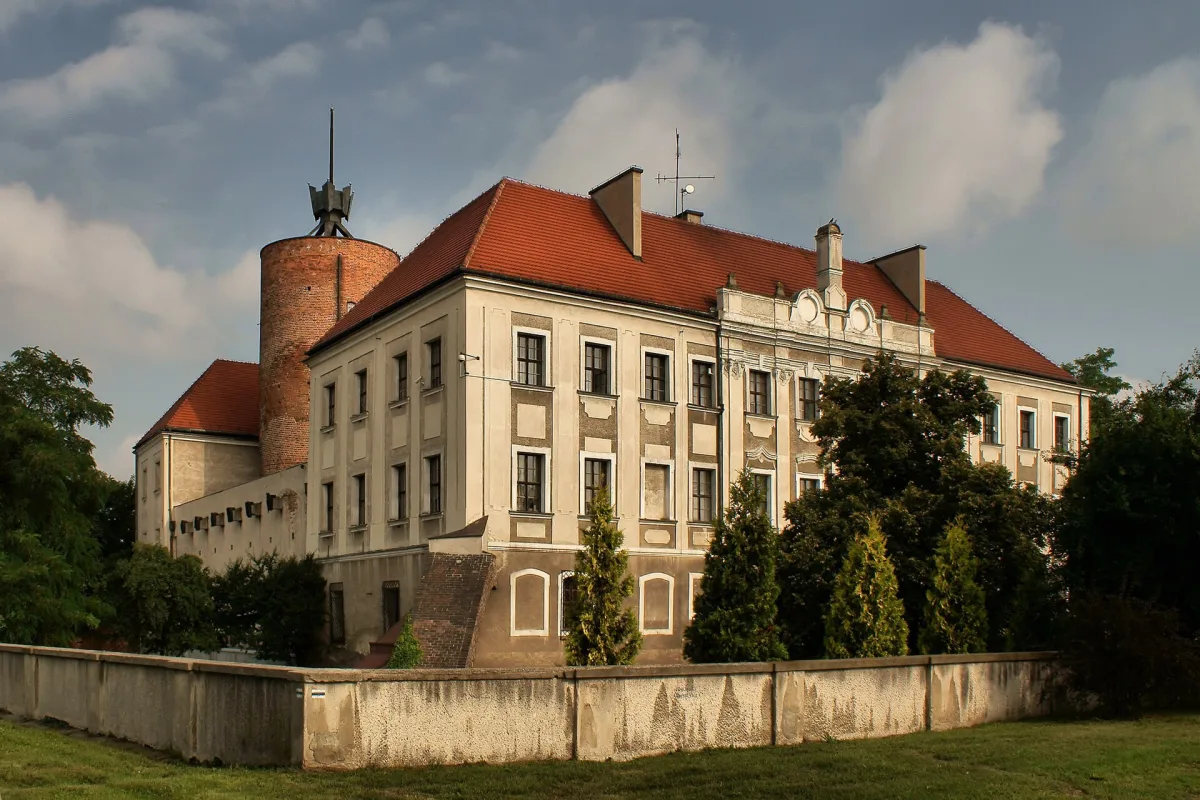
A city by the ford that had to defend itself
Głogów grew up where the Oder formed a convenient ford, and today it also splits into two branches flowing around Ostrów Tumski. This location, on the route linking Silesia with German lands, gave the city commercial importance, but it also made it a natural checkpoint - and so a natural target for any army wanting to cross this stretch of the Oder. The Castle of the Dukes of Głogów, built in the second half of the 13th century by Duke Konrad I of Głogów, guarded exactly this crossing. Over the following centuries Głogów remained a border and defensive city - regardless of who happened to rule it: the Piasts, Bohemia, the Habsburgs or, from the mid-18th century, Prussia.
The defence of 1109 and the account of the children on the siege engines
The oldest wartime episode connected with Głogów dates back to the time of Bolesław the Wrymouth. In 1109 the city was besieged by the troops of Emperor Henry V, and according to the chronicle account, the imperial soldiers tied children of Głogów burghers, previously taken as hostages, to the siege engines, hoping the defenders would not fire on their own children. This dramatic detail comes from the "Polish Chronicle" ("Kronika polska") by Gallus Anonymus, written in the 12th century - it is the source of this story, not the account of a direct witness, so it is worth reading as a record from an era when chronicles also served a propaganda function, not as a dry protocol. Despite the use of children as human shields, the defenders of Głogów did not surrender, and Emperor Henry V ultimately had to withdraw from Polish lands without achieving the goals of his expedition. The memory of this event still lives on in the city today - it is commemorated by the Monument to the Children of Głogów, erected in 1979 from residents' donations near the castle.
From city walls to an early modern fortress
Głogów's medieval fortifications were expanded in stages over the following centuries, and during the Thirty Years' War, in the mid-17th century, the city was transformed into a regular fortress, with early modern earth-and-brick fortifications built along today's Wały Chrobrego in the years 1657-1720. The real breakthrough, however, came with Prussia's takeover of Silesia as a result of the Silesian Wars in 1741. Frederick the Great, aware of the city's strategic position on the Oder, decided to rebuild it into a modern fortress along the lines of the fortification art of the time.
The Star Fort - the peak of Prussian military engineering
As part of this rebuilding, the Star Fort was erected in the years 1747-1749, designed by the leading Prussian military engineer Gerhard Cornelius van Wallrawe. It was originally called the Star Redoubt and had an earth-and-timber structure. The fort's name comes from the shape of its fortifications - the arms of the works form the plan of a regular star, which was not decorative but a solution that eliminated blind spots in the field of fire and allowed effective flanking defence, that is, firing on attackers from several directions at once. In the 19th century the fort was thoroughly rebuilt: brick barracks, storehouses and a semicircular parade ground were added, and in 1832 its name was changed to Fort Stern. By 1905 it had already lost its strategic importance, though in 1945 it still served as one of the points of resistance during the defence declared by Berlin as Festung Glogau.
Sieges of the Napoleonic Wars
The greatest test of Głogów's Prussian fortifications came with the Napoleonic Wars. In 1806 the city was besieged by French troops commanded by Jérôme Bonaparte, Napoleon's brother. After Głogów was captured, a French garrison was stationed there, which also included Polish units under the command of Jan Henryk Dąbrowski, and Napoleon Bonaparte himself visited the fortress three times. The situation reversed after Napoleon's defeat in the Russian campaign: from 1813 the city was besieged by Prussian and Russian troops, and the French garrison held out for over a year under the command of Jean Roger de Laplane, capitulating only on 10 April 1814, after Napoleon's final downfall. This was the longest recorded siege in the city's history, showing how effective the Głogów fortifications were at the time - even a garrison cut off from supplies held the fortress for many months.
The demolition of the fortifications and what remained of them
Fortress status long limited Głogów's development, because fortress law did not allow free construction around the walls. The situation only changed towards the end of the 19th century: in 1873 the city began expanding beyond the old fortification perimeter, and in 1902 a large part of the fortifications, which had already lost their military significance in the face of the development of long-range artillery, was officially demolished. This did not mean the end of Głogów's fortifications, however - in the second half of the 19th century further defensive structures were built, including blockhouses from the 1860s and 1880s and artillery towers, such as the Turm Reduit tower, preserved to this day on Ostrów Tumski, guarding the city from the river side.
Today, after the centuries-long history of the fortress, you can see fragments from different eras: a 17th-century moat and two bastions, remnants of the medieval city walls and 19th-century defensive buildings along the Oder. The Star Fort itself, in Piastowski Park, is currently undergoing a renovation worth almost 3.5 million złoty, supported by the KGHM Foundation, and visitors now have access to its moat, caponier, and posterns, that is, underground passages linking the various parts of the fortifications, as well as former shelters. What has survived makes it possible today to trace, in one place, almost three hundred years of the development of European fortification art - from Frederick the Great's baroque works to 19th-century brick-and-concrete fortifications.

Be the first! Add a comment.
You need to log in to add a comment.
Log in