
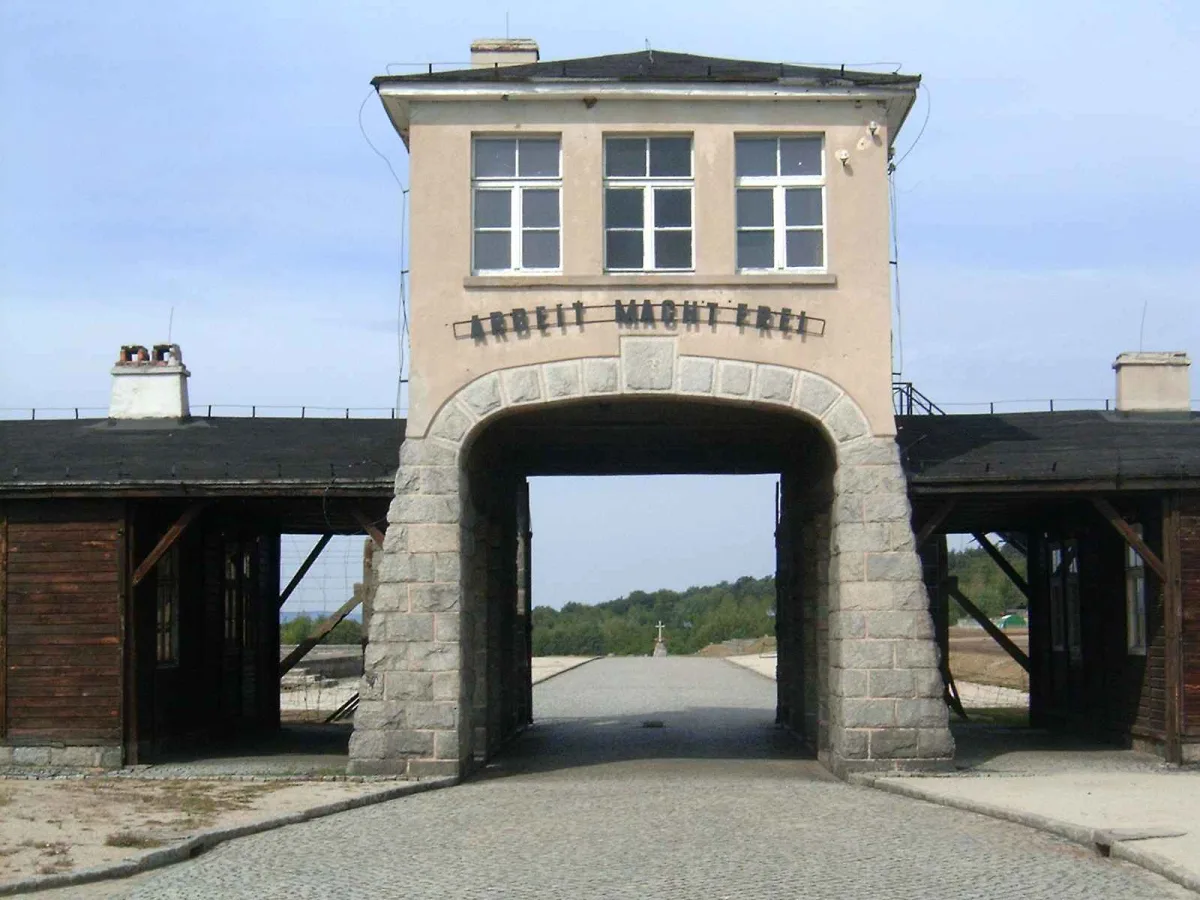
The quarry that became a camp
The Gross-Rosen concentration camp was established in the summer of 1940 next to the village of Rogoźnica (German: Groß-Rosen) in Lower Silesia, several dozen kilometres south-west of Wrocław. The first transport of a hundred prisoners, including 98 Poles, arrived on site on 2 August 1940. The prisoners were put to work in the nearby granite quarry, operated by the SS-owned company Deutsche Erd- und Steinwerke (DEST). Until 1 May 1941, Gross-Rosen was formally a subcamp of Sachsenhausen; only afterwards did it gain the status of an independent concentration camp.
The choice of location was no accident. The SS established concentration camps wherever they could supply cheap forced labour for its own economic enterprises, and the granite deposits at Rogoźnica were suitable for producing paving setts and stone elements for the Third Reich's construction projects.
Work in the quarry
The main occupation of prisoners in the main camp was quarrying and processing granite. Work was carried out in twelve-hour shifts, with insufficient food, no clothing suited to the season, and virtually no medical care. Prisoners carried blocks of stone, pulled wagons and performed the heaviest physical labour under the constant watch of SS men and kapos. These conditions, described in museum materials as murderous, resulted in high mortality already in the camp's first years.
The quarry was an integral part of the camp system: prisoners lived in barracks near the pit, and the walk to and from work was itself a means of destroying them. Today the historic quarry can be visited; the site was bought back from a private owner between 2004 and 2005, and formally handed over to the museum on 22 September 2005.
Who was sent to Gross-Rosen
In total, around 125,000 prisoners passed through the entire Gross-Rosen complex, meaning the main camp and its numerous subcamps. The most numerous national groups were Jews, Poles and citizens of the former Soviet Union, but the camp and its subcamps held people of more than a dozen nationalities: French, Belgian, Italian, Czech, and even Chinese prisoners working in one of the Wrocław subcamps. Prisoners included prisoners of war, people detained for resistance activity, and, from 1944, as the network of subcamps expanded, also Jews deported en masse from various European countries and sent directly to forced labour in the German arms industry.
The number of victims of the entire Gross-Rosen complex is estimated at around 40,000. Sources are not fully in agreement here: some tallies give this figure as the total number of those who died or were murdered across all camps in the system, while others treat it as a general estimate without a precise breakdown between the main camp and individual subcamps. The discrepancy stems from the incompleteness of the camp documentation, a large part of which the Germans destroyed during the evacuation.
Evacuation and liberation
As the Eastern Front approached at the turn of 1944 and 1945, the SS began evacuating the main camp and most of its subcamps. Prisoners were marched on foot or transported by rail further into Germany, towards camps such as Bergen-Belsen, Flossenbürg and Mauthausen. These marches took place in winter, in extremely harsh conditions, and claimed further victims among prisoners who were already exhausted; the full, detailed history of these evacuations is a subject for a separate account.
The main camp at Rogoźnica was liberated by the Red Army on 14 February 1945. By then it held only a small fraction of its former prisoner population; most of those able to march had already been led away, and those who remained on site were mainly the sick and exhausted, who had either not been evacuated in time or had not been evacuated at all.
The museum and memorial site today
The site of the former main camp is now home to the Gross-Rosen Museum in Rogoźnica, established in 1983. The institution runs a permanent exhibition devoted to the history of the camp and its network of subcamps, looks after the surviving elements of the camp infrastructure, and cares for the historic granite quarry, open to visitors since 2005. It is one of the few places in Lower Silesia where you can see, side by side, both the site of the former camp and the place where prisoners were forced to work.
The museum also carries out educational and documentation work covering the entire Gross-Rosen system, including more than a hundred subcamps scattered across Lower Silesia, the Sudetes and today's Lubusz region; this branching network of subcamps, its ties to the arms industry and underground construction projects, is covered in a separate article.

Be the first! Add a comment.
You need to log in to add a comment.
Log in