
Why the Subcamp Network Grew So Large
By 1944 the Gross-Rosen concentration camp in Rogoźnica had grown into a network of over a hundred subcamps scattered across Lower Silesia, the Sudetes and what is today the Lubusz region. The year 1944 was decisive, when the German arms industry, facing losses on the front and intensifying air raids on western Germany, began moving production on a mass scale to areas considered safer, including Silesia. Instead of transporting forced labourers to one large camp, the SS began placing prisoners directly at factories, in barracks on the premises or in their immediate vicinity. This eliminated the cost and time of transport, while at the same time tying the prisoners' fate directly to the needs of a specific company.
The subcamps served very different branches of industry: aviation (production of aircraft and propeller parts), arms (ammunition, guns, fuses), metalworking (bearings, wagons, machine parts), textiles (fabrics, uniforms, parachutes), and construction, including the building of fortifications and roads. Companies that made use of prisoner labour included the Krupp concern, Kugelfischer, Rheinmetall-Borsig, Dynamit AG, and the PAFAWAG and DOLMEL rolling-stock works in Wrocław.
The Largest Subcamp: Fünfteichen in Today's Jelcz
The largest Gross-Rosen subcamp was AL Fünfteichen, established on the site of today's Jelcz-Laskowice (then Miłoszyce). It held at least 6,000 men of various nationalities, mainly Poles, Jews and Frenchmen, working for the Krupp arms concern on the production of 75 and 155 millimetre guns. An estimated 2,000 prisoners died in the camp. The scale of this single subcamp shows just how far the Gross-Rosen system extended beyond the parent camp in Rogoźnica - in terms of prisoner numbers, Fünfteichen exceeded more than one standalone concentration camp of the period.
Subcamps in Towns: Wrocław, Bolków, Kamienna Góra
Several Gross-Rosen subcamps operated within the boundaries of today's Wrocław. AL Breslau I, at the DOLMEL works, held around 2,000 men producing parts for aircraft and tractor engines, evacuated on 25 January 1945. AL Breslau II, at the PAFAWAG works, held between 800 and 1,200 prisoners, including thirteen Chinese, assembling freight wagons - it was evacuated on the same day as AL Breslau I.
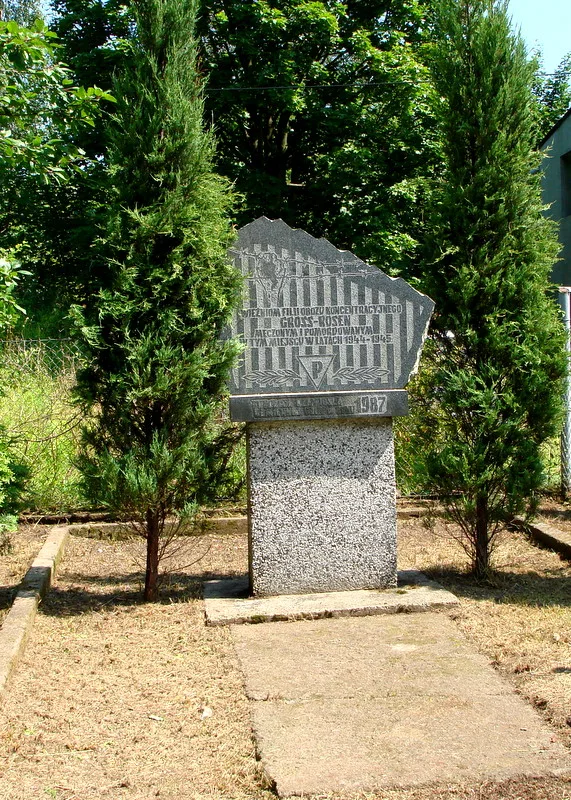
In Bolków (AL Bolkenhain), more than 800 men were held, mostly Jews from Poland and Hungary, working on the production of aircraft parts for Vereinigte Deutsche Metallwerke - around 200 people died there. In Kamienna Góra, AL Landeshut (Arbeitslager Landeshut) operated, holding around 1,600 men of over a dozen nationalities, producing ball bearings for the Kugelfischer company. The camp operated for exactly 292 days, from 16 July 1944 to 8 May 1945, and more than 200 victims' bodies were exhumed there after the war. Their memory is preserved today by two sites in the town: a grave in the municipal cemetery and a monument on the slope of Góra Parkowa, known as the Symbolic Grave of the Victims of the Gross-Rosen Camp.
Women's Subcamps
Gross-Rosen also ran a network of women's subcamps, to which mainly Jewish women deported from various European countries were sent, including some transports coming directly from Auschwitz. FAL Breslau-Hundsfeld in Wrocław held around 1,500 female prisoners from Poland, Hungary, the Netherlands and Romania, working on the assembly of artillery sights for the firm Rheinmetall-Borsig. At FAL Grünberg (today's Zielona Góra), around a thousand women, mainly from Poland and Czechia, sewed uniform fabric, coats and parachutes - the subcamp was evacuated on 29 January 1945.
FAL Ludwigsdorf near Kłodzko held around 600 Jewish women from Poland, Hungary and the Netherlands, employed at the Dynamit AG ammunition factory - mortality in this camp was very high, estimated at around 300 victims. Similar subcamps also operated beyond today's Polish border, among others in Chrastava and Poříčí in what is today the Czech Republic, where a further roughly 2,000 women in total were held, working in the ammunition and textile industries.
Kłodzko Fortress as a Camp Subcamp
Kłodzko Fortress served as a subcamp of the Gross-Rosen concentration camp from 1940 to 1943. Prisoners of war and inmates of many nationalities were held there, among others Russians, Frenchmen, Italians, Belgians, Czechs, Finns and Britons. This is an example of how the camp network made use of existing military and defensive infrastructure alongside newly built barracks at factories.
What Remains Today
Little remains of most Gross-Rosen subcamps - the barracks were dismantled after the war, and the sites reverted to civilian production or residential development. What remains permanently in the landscape of Lower Silesia are above all sites of memory: symbolic graves, plaques and monuments erected in the towns where subcamps operated, such as the monument in Kamienna Góra mentioned above. More about the parent camp itself in Rogoźnica, its founding and today's museum can be read in a separate article.
A separate, still physically visible legacy are the underground structures of the Riese complex in the Owl Mountains, where more than a dozen Gross-Rosen subcamps, including Dörnhau, Wolfsberg, Falkenberg and Wüstewaltersdorf, supplied labour for driving tunnels under hills and castles for a wartime purpose still not fully known today. Prisoners of these camps, almost exclusively Jews from various European countries, performed the heaviest and most dangerous work in the entire Gross-Rosen system. Some of these tunnels can be visited today, among others as part of the Riese Włodarz complex and the Mysterious Underground City of Osówka in the Głuszyca municipality.

Be the first! Add a comment.
You need to log in to add a comment.
Log in