
The stronghold on the Oder and the first churches
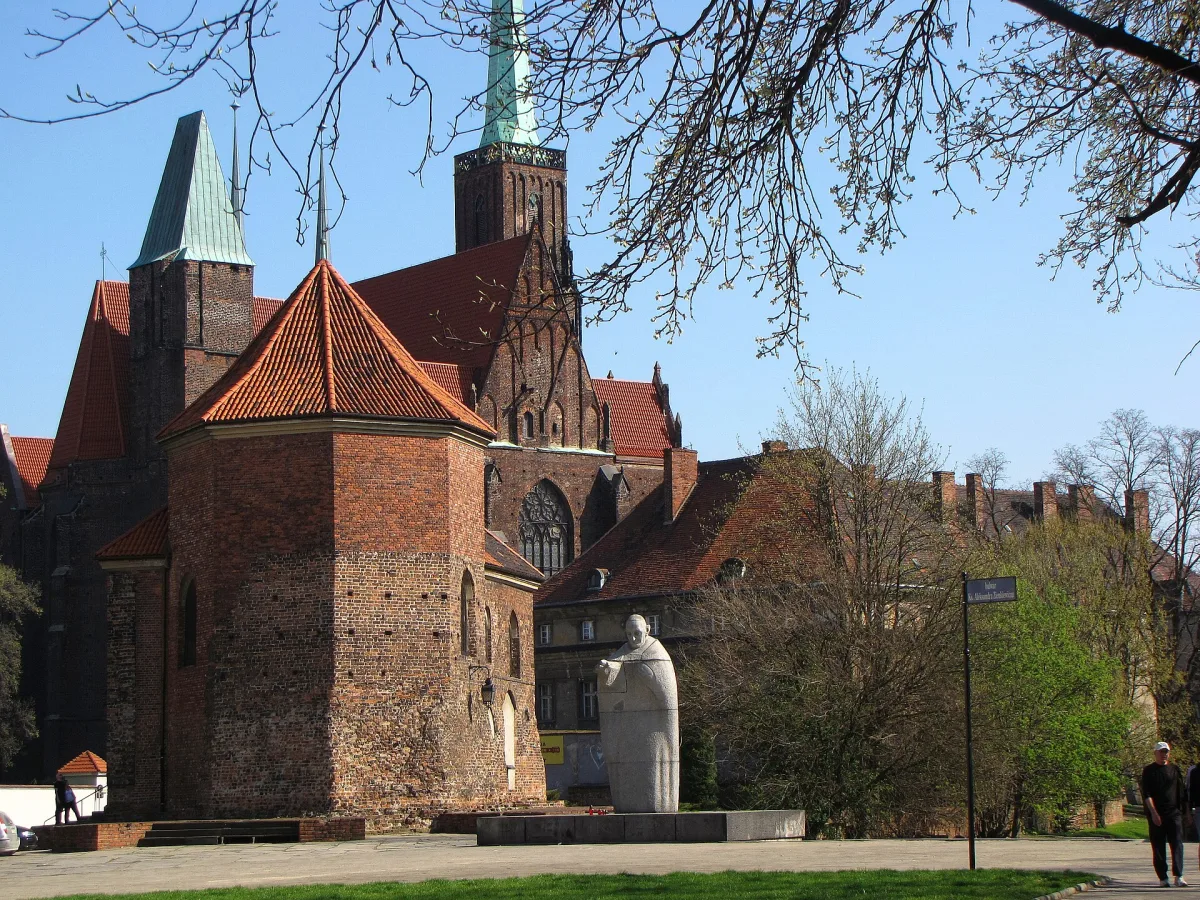
Wrocław did not begin on the Market Square but several hundred metres away, on an island in the Oder. A stronghold on this site was founded by Duke Mieszko I around 985, surrounding the settlement with a rampart reinforced by a palisade. Traces of that structure, transformed over the following centuries into a residence of the Piast dukes, are hidden today beneath the Castle on Ostrów Tumski: of the whole complex, only a few, mostly inaccessible fragments survive.
In the year 1000, at the Congress of Gniezno, Emperor Otto III and Duke Bolesław the Brave established a bishopric in Wrocław. From that moment Ostrów Tumski developed as a church district, separated from the rest of the city. On the site of earlier, wooden churches there eventually rose the Archcathedral of St John the Baptist, the fourth sacred building erected on this same spot. The first, pre-Romanesque church from the 10th century lay several metres below today's nave level.
A similar pedigree belongs to the Church of St Mary on the Sand on the neighbouring island: it was founded in the first half of the 12th century by the count palatine Piotr Włost, his wife Duchess Maria and their son Świętosław, with construction completed before 1148. The same Piotr Włostowic, before 1149, also built a stone chapel of St Martin on Ostrów Tumski, along with a Benedictine abbey.
The Mongol invasion and the town's founding around the Market Square
In 1241 the city was burned by a Mongol army. Its rebuilding was combined with a reform of its legal status: in 1242 Wrocław received a town charter under German (Magdeburg) law, and with it the Market Square was laid out - today one of the largest old-town squares in Europe. The square itself had been created a little earlier, around 1232, on the initiative of Duke Henry the Bearded, and its boundaries were given legal regulation in 1261 by dukes Henry III and Władysław. Originally it measured 600 by 480 feet, today about 204 by 170 metres and 3.64 hectares, divided into 36 plots.
Next to the main market square, in that same year of 1242, the smaller Solny Square was laid out, measuring 84.5 by 94 metres. Unlike the Market Square, it was never built up, and its former names, the Polish Market and the Salt Market, recall the salt trade once conducted there.
The town's parish church then became the St Mary Magdalene's Cathedral in Wrocław, today a church of the Polish Catholic Church by the Market Square. Its predecessor, a Romanesque building completed in 1232, was destroyed by the Mongol invasion nine years later. A new church in the transitional style was built in 1242-1248, and after a fire in May 1342 it was rebuilt in Gothic style.
A town hall that grew over two and a half centuries
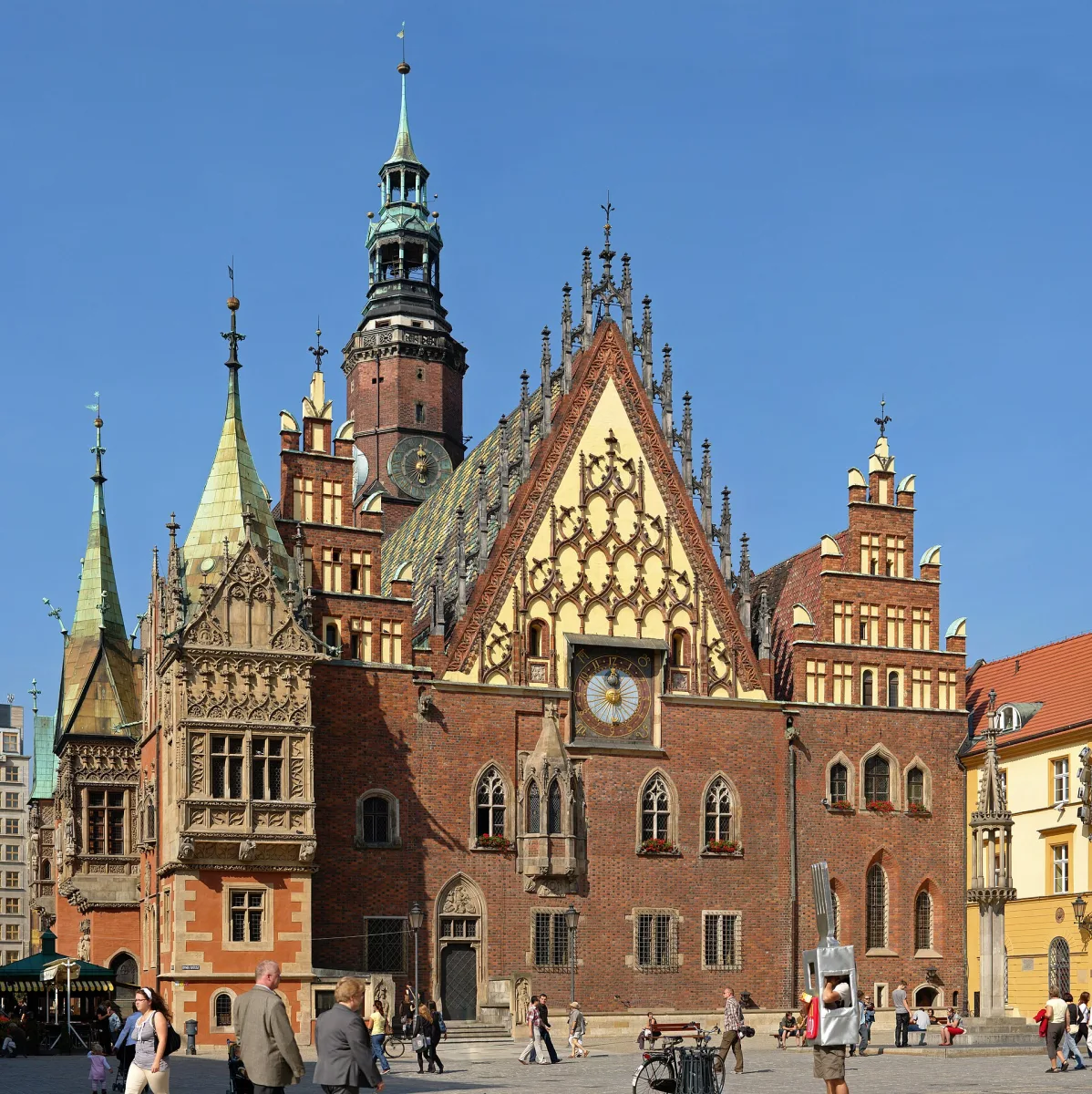
The city authorities needed their own seat, so before the end of the 13th century construction began on the Town Hall in the south-eastern corner of the Market Square. The oldest part of the building was built before 1299, further wings were added up to 1504, and the whole was not finished until the 16th century, so construction took about 250 years in total. On the town hall tower hangs the oldest surviving clock bell in Poland, cast in 1368, and in 1580 the facade was decorated with an astronomical clock.
Wrocław changed hands several times during this period: in 1348 it formally came within the borders of the Bohemian Crown under Charles IV, and in 1523 the city adopted the Reformation, which for centuries shaped the fate of more than one church, including St Mary Magdalene's by the Market Square.
A Counter-Reformation trace from the end of the 17th century can be seen on Cathedral Square: in 1694, on the initiative of the Jesuits, the Statue of the Virgin Mary with Child was erected there, the oldest surviving monument in the city.
The academy and a Prussian residence
Emperor Leopold I founded a college in Wrocław called the Leopoldine Academy, the seed of today's university, under a privilege dated 21 October 1702. Its grand hall, the Aula Leopoldina, was built in 1728-1732 to a design by Christophorus Tausch; the stuccowork was made by Albrecht Siegwitz, and the frescoes were painted by Johann Christoph Handke.
Today the hall can be visited as part of the Museum of the University of Wrocław, which is housed in the same main building above the Oder and holds mementoes from several centuries of the university's existence.
After 1763, when the city was taken over by Frederick II's Prussia, Wrocław became a third royal residence alongside Berlin and Königsberg. In 1807 the city surrendered to Napoleon's forces, and in 1811 the University of Wrocław was formally established, continuing the tradition of the Viadrina University from Frankfurt an der Oder.
The 19th-century expansion
The 19th century brought the city new, prestigious investments. In 1842 the first rail connection opened, to Oława. When the existing town hall could no longer serve the growing administration, the New Town Hall was built beside the Market Square in 1860-1864, to a design by Friedrich August Stüler, a neo-Gothic building which remains the seat of the city's mayor and council to this day.
Other cultural institutions also date from the same century. Art collections gathered from 1815 in the Royal Museum of Art and Antiquities became in time the basis of today's National Museum in Wrocław.
The present structure of the Tumski Bridge also dates from this same period, erected in 1889 on the site where crossings over the Oder had existed since the 12th century, marking the boundary between municipal and church jurisdiction.
The Centennial Exhibition and the 20th century
A hundred years after the Prussian King Frederick William III's appeal for resistance against Napoleon, the architect Max Berg built the Centennial Hall in 1911-1913, an exhibition and sports hall with a reinforced-concrete dome 67 metres in diameter, at the time the largest structure of its kind in the world. The building opened on 20 May 1913, and in 2006 it was added to the UNESCO World Heritage List.
Destruction and rebuilding after 1945
In August 1944 the German authorities declared Wrocław a fortress, Festung Breslau. On the night of 19 to 20 January 1945, in temperatures reaching minus 20 degrees, civilians were forcibly evacuated; around 90,000 of them died of cold, exhaustion and disease. The Red Army closed the siege of the city on 13 February 1945, and the act of surrender was signed on 6 May 1945 by General Hermann Niehoff. About 70 percent of the built-up area was destroyed or damaged, leaving 18 million cubic metres of rubble after the war.
The rebuilding was carried out largely by new residents, resettled after 1945 from the Eastern Borderlands. The archcathedral, about 70 percent destroyed, was reconsecrated in 1951 by Primate Stefan Wyszyński. The Panorama of the Battle of Racławice also came to the city, a huge painting created in 1893-1894 by Jan Styka and Wojciech Kossak for Lwów: after the war it was brought to Wrocław in 1946, though visitors had to wait until 14 June 1985 for it to open to the public. Today it takes only a few dozen minutes to walk from Ostrów Tumski, through the Market Square, to the Panorama building - and pass through a thousand years of the city's history.

Be the first! Add a comment.
You need to log in to add a comment.
Log in