
The shoemaker of the Lower Market
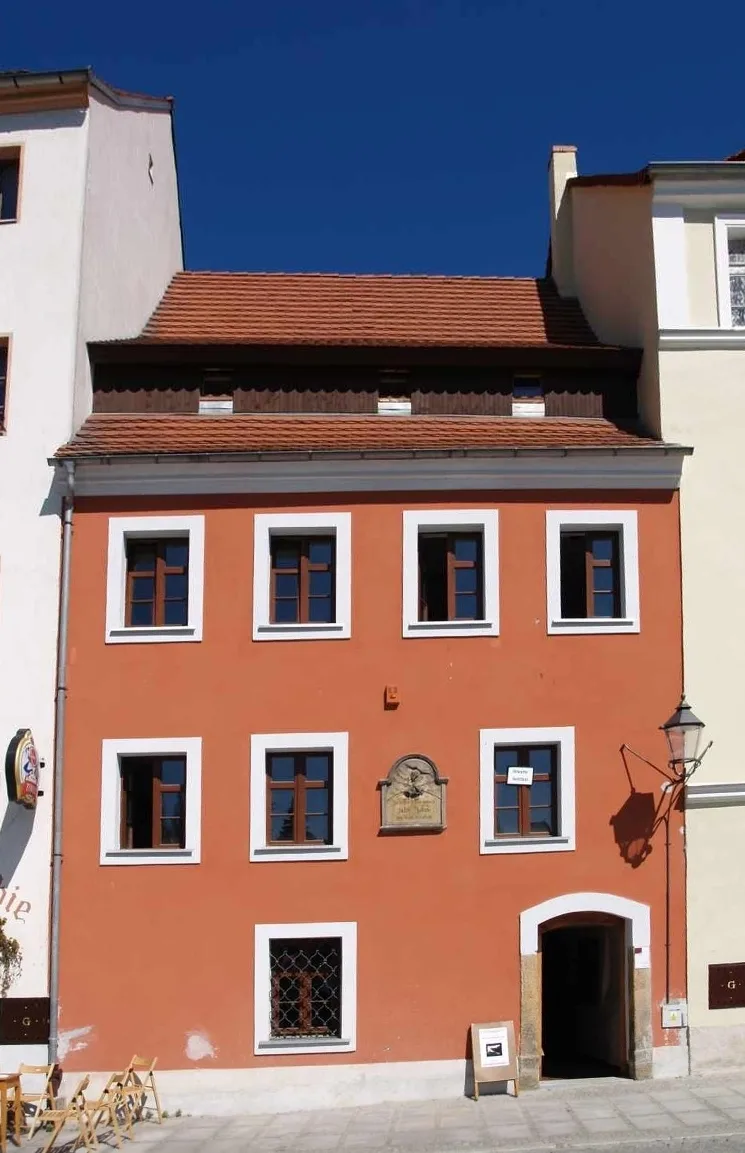
Jacob Böhme was born in 1575 in Stary Zawidów near Zgorzelec, into a peasant family. He came to the town as a shoemaker's apprentice, and in 1599 he bought his own shoemaker's stall on the Lower Market and was entered into the register of citizens of Görlitz, as Zgorzelec was then called. In time he also began trading in leather, which gave him more free time than working at the bench. He had no philosophical or theological education - he attended the town's parish school and read the Bible and a few religious writings available to him, but he worked out the rest of his thinking entirely on his own, without any academic background. It is precisely this lack of formal education that makes his later career as a writer so unusual: a craftsman from a provincial town began writing texts that German philosophers would be commenting on several hundred years later.
Light on a pewter jug
According to the account he later wrote himself, he had a decisive experience in 1600 while working in his workshop. His attention was caught by the play of light reflected off a pewter vessel. Böhme described this as a moment in which he felt he understood the nature of all things and perceived the presence of God in every creature, even in the simplest, seemingly insignificant objects. For the next twelve years he did not write these thoughts down, but simply carried them within himself. A second, stronger mystical experience took place in 1610, and it was this one that prompted him to take up the pen. In 1612, over a few months between New Year and Whitsun, he wrote a manuscript several hundred pages long, which he titled "Aurora" (German: "Morgenröte im Aufgang").
"Aurora" and the dispute with the clergy
"Aurora" was not a scholarly treatise in the modern sense, but an attempt to describe the nature of God, good and evil in language accessible to the ordinary reader, in German rather than the Latin used by scholars at the time. This is one of the reasons why historians of philosophy call Böhme the first philosopher to write in German. The manuscript began circulating in copies among the citizens of Zgorzelec before it reached the local pastor, Gregor Richter, an orthodox Lutheran. Richter judged the shoemaker's writings to be heretical and denounced him publicly from the pulpit. Böhme had to pass an examination on his knowledge of the articles of faith before the town council, which he in fact passed without difficulty, but he was nonetheless banned from further writing and publishing.
Breaking the ban and the final years
Böhme observed the ban for several years. The situation changed in 1618, with the outbreak of the Thirty Years' War, a religious and political conflict that engulfed most of Europe. Böhme decided that under these circumstances the ban on speaking out had lost its meaning, and he returned to writing. Between 1618 and 1624 he produced eight extensive works developing his vision of spirituality, among them "The Way to Christ", which for a long time was one of the most widely read religious books in Germany. Richter intervened again and brought about another hearing before the town council. This time no grounds were found to punish Böhme, but he was advised to leave the town for a while. In 1624 he stayed in Dresden, where he presented his views at the court of the Elector of Saxony. He died shortly after returning to Zgorzelec, in the night of 16-17 November 1624.
Influence on European philosophy
Despite their difficult, image-laden language, Böhme's writings reached successive generations of thinkers. He inspired German Romantics, among them Ludwig Tieck and Novalis, as well as the English poet and painter William Blake. Among philosophers, his concepts were developed further by Friedrich Schelling, Franz von Baader, Arthur Schopenhauer and Georg Wilhelm Friedrich Hegel, who called Böhme the first German philosopher. Hegel valued him in particular for his way of thinking about the world as a process of opposites that interpenetrate and cancel each other out, a thought which - in a different, secular form - later became one of the foundations of Hegelian dialectics. Traces of Böhme's influence can also be seen in the work of Adam Mickiewicz, among others in the third part of "Forefathers' Eve". Böhme also influenced religious movements outside academic philosophy, particularly the Quakers in England.
Traces of Böhme in present-day Zgorzelec
The house where Böhme lived stood on what was then Rabengasse, today ulica Daszyńskiego 12, in the Nyskie Przedmieście district. The building has survived and today serves as a cultural centre devoted to him: the Jacob Böhme House. The town is also home to the Jacob-Böhme-Akademie, an institution that keeps the philosopher's memory alive on both sides of the Lusatian Neisse, in Zgorzelec and neighbouring Görlitz in Germany. The shoemaker-philosopher still attracts attention far beyond the region: in 2006 the American actor Nicolas Cage came to Zgorzelec, declaring his interest in Böhme's thought and wanting to see the places connected with his life. For a town that for centuries was above all a centre of trade and craft, the figure of a shoemaker who became one of the reference points of European philosophy remains one of the most unusual chapters in its local history.

Be the first! Add a comment.
You need to log in to add a comment.
Log in