
Where the survivors came from, and why they ended up here
In the summer of 1940 the Germans established the Gross-Rosen concentration camp in the area of present-day Rogoźnica, and by 1944 had expanded it into a network of more than a hundred subcamps scattered across Lower Silesia and the Sudetes. Several of them operated alongside textile factories in Dzierżoniów and Bielawa, including the Dierig works. Prisoners, brought from the ghettos of the General Government and from other European countries, worked in the same factory halls that stood untouched by military action after liberation.
The camps in Bielawa were liberated on 8 May 1945. About 3,000 people of Jewish origin had been held in them, but immediately after liberation only around 70 remained in the town; most set off in search of family and their former life. What drew them back, along with further waves of survivors from other parts of Poland, was precisely this same functioning infrastructure: working textile factories, undamaged flats left behind by displaced Germans, and the proximity of the border with Czechoslovakia, through which routes for illegal emigration ran. The headquarters of the Provincial Jewish Committee for Lower Silesia was initially placed in Dzierżoniów itself, where it operated until February 1946, before moving to Wrocław.
From February to July 1946, more than 136,000 Jews arrived in Poland in 203 repatriation transports from the USSR, and around 75,000 of them ended up in Lower Silesia, settling in 42 towns across the region. Dzierżoniów and Bielawa, thanks to Jewish committees already formed there and to vacant housing, became some of the main destinations of this wave.
The scale of the phenomenon in numbers
The pace at which these two towns grew set them apart from the rest of the region. In Bielawa the number of residents of Jewish origin rose from about 70 people right after liberation to nearly 5,000 just a few months later. In Dzierżoniów more than 2,500 Jews lived there in May 1945, and by July 1946 the figure was already nearly 12,000, with the peak of settlement coming in November 1946, when the town's Jewish population reached 17,800. Dzierżoniów was at that time, after Wrocław, the second-largest Jewish concentration in Lower Silesia, and counting Bielawa together with it, this micro-region became the most densely settled place for Holocaust survivors in post-war Poland.
In the second half of the 1940s between 90,000 and 100,000 Jews lived across the whole of Lower Silesia, close to two fifths of all those who survived the war within the country's borders. This was the largest such area of settlement in post-war Poland, and Dzierżoniów and Bielawa formed its most densely populated part.
Work cooperatives as the foundation of a new life
Economic reconstruction went hand in hand with demographic growth. At the peak of settlement, work cooperatives in Dzierżoniów and Bielawa were the basis of support for entire families. Cooperatives founded in Bielawa included the Bristle and Brush-Making Cooperative, producing brooms and brushes, the "Elektromet" Invalids' Cooperative, and a leather goods cooperative operating under the names "Odrodzenie" and "Uniwersal". Alongside the urban cooperatives, farms organised on the kibbutz model were also set up, where young people prepared for agricultural work, some with emigration to Palestine in mind, others simply as a way of earning a living in the new reality.
The cooperative model suited the authorities, who wanted to see Jews as a "productive" workforce, and it suited the survivors themselves, for whom working together within a familiar group gave a sense of stability after years of chaos.
Schools and organisations
In Dzierżoniów a Jewish school, a kindergarten, a nursery and boarding and half-boarding facilities operated, with Yiddish or Hebrew serving as the language of instruction. Alongside the primary schools there were kindergartens, nurseries, boarding houses and half-boarding houses, as well as, though only for a year, a Jewish Home for Mothers and Children. From August 1945 the Janusz Korczak Jewish Children's Home operated in nearby Pieszyce, one of the institutions caring for children who had survived the Holocaust alone, without their parents.
Organisational life was dense: a branch of the Society for the Protection of the Health of the Jewish Population (TOZ) operated, along with the Committee for Aid to Jews from Concentration Camps, a WIZO circle of Zionist women running language courses, and ORT, an organisation dealing with vocational training. From 1950, as the authorities began centralising Jewish life in Poland, the umbrella role was taken over by the Social and Cultural Society of Jews.
The everyday life of a community being rebuilt
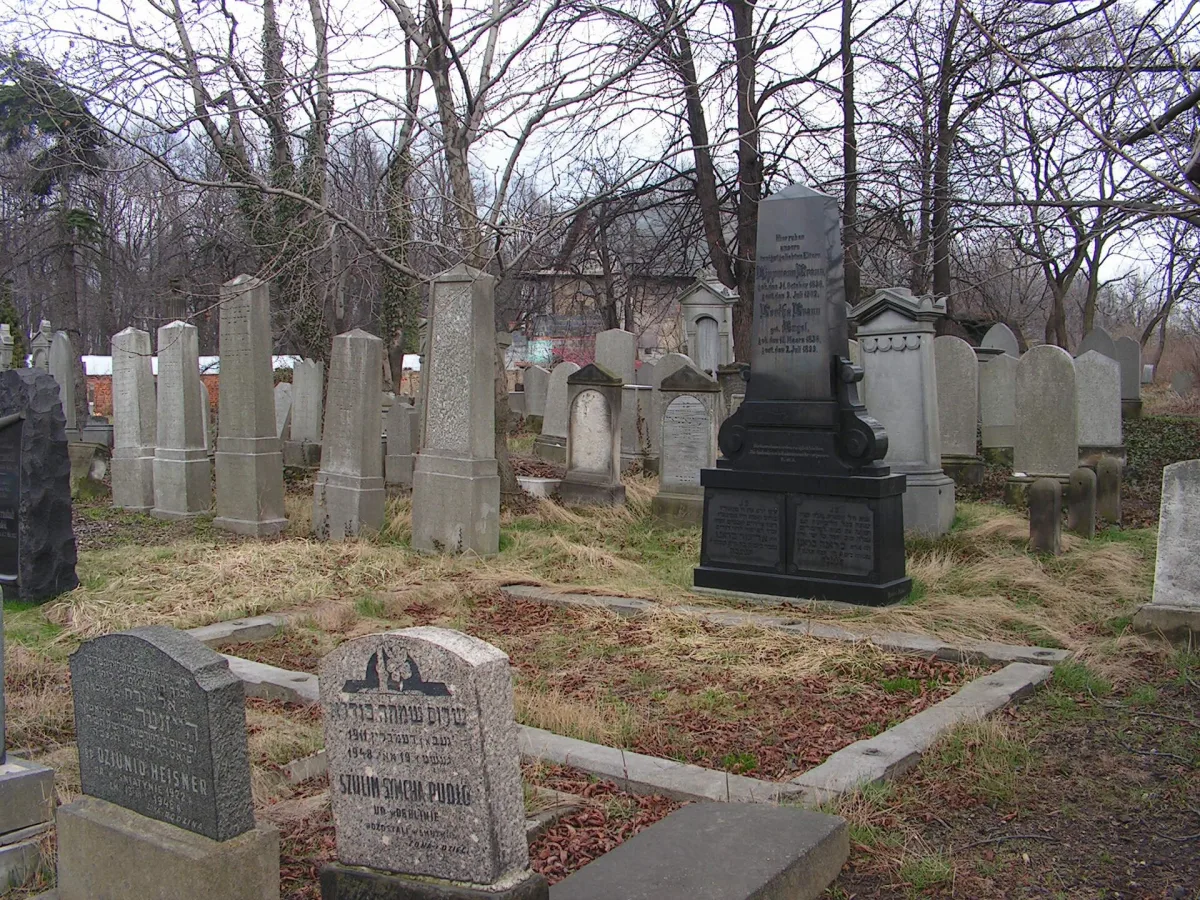
A Jewish Cultural Centre and a small-scale Jewish musical theatre operated in Dzierżoniów, and young people played in the "Start" and "Spójnia" sports clubs and trained in a folk dance ensemble. Religious life centred on the synagogue built in Dzierżoniów in 1875: the building survived Kristallnacht and the war, and after 1945 was returned to the Jewish community together with a mikveh, a religious school, a rabbi's flat and a kosher kitchen. The local Jewish cemetery, founded in 1825, also survived, with around 250 preserved gravestones, the oldest from 1838; today this is one of the few material traces of that period, alongside the Jewish cemetery in Dzierżoniów and the similar, smaller Jewish cemetery in Bielawa.
Everyday life was nonetheless far from idyllic. The vast majority of residents in both towns were people who had lost their closest family in the Holocaust, and many had spent the war deep inside the USSR, returning with almost nothing. Life was therefore organised from scratch, making use of flats, factories and equipment left behind by the Germans, while at the same time trying, amid the chaos of the post-war months, to keep at least a trace of Jewish tradition and language alive.
Why this community eventually disappeared
The first serious blow came as early as the summer of 1946. The Kielce pogrom of 4 July 1946 caused panic among Jews across Poland, including in Lower Silesia: over the following three months around 70,000 people left the country, some legally, some across the unguarded border. Illegal emigration from Lower Silesia alone involved more than 50,000 people in the second half of the 1940s, of whom between 10,000 and 15,000 were smuggled across the Czech border.
A further, decisive wave was triggered by a decision of the authorities. On 2 September 1949 the Jewish newspaper "Dos Naje Lebn" published on its front page a statement from the Ministry of Public Administration granting consent to emigrate to Israel; after this, almost everyone who still wanted to leave Poland registered to do so. By the mid-1950s, after these successive waves, the largest Jewish communities in Lower Silesia numbered only a few thousand people each, in Legnica, Wrocław and Wałbrzych, rather than in Dzierżoniów or Bielawa, which lost their standing fastest of all. The last clear wave of departures was triggered by the anti-Zionist campaign of March 1968, when around 20,000 people left Lower Silesia alone.
Today, what remains of this chapter in the region's history are mainly cemeteries and individual buildings: in Dzierżoniów and Bielawa there are no longer any active communities or institutions of the kind that, briefly, in the second half of the 1940s, made this the largest Jewish town in post-war Poland.

Be the first! Add a comment.
You need to log in to add a comment.
Log in