
A City Cut Off from Supplies
For the first weeks of the siege of Wrocław, which began in February 1945, the defenders had an airfield at their disposal at Gądów Mały, on the western outskirts of the city. This was the one responsible for deliveries of ammunition and food and for evacuating the wounded. The trouble was that the Red Army was drawing closer to this airfield with every passing day, until it finally captured it on 1 April 1945. Before that happened, the command of Festung Breslau was looking for a backup site for take-offs and landings, one that would lie deeper within the defence lines, out of reach of a quick ground attack.
The choice fell on the very centre of the city: a strip of land along the former Kaiserstrasse, between the Grunwaldzki Bridge and the Szczytnicki Bridge, in the area of today's Grunwaldzki Square. On 23 February 1945 the Gauleiter Karl Hanke gave the order to demolish the buildings standing there, so that a makeshift runway could be built in their place.
A District Razed to the Ground
The runway required the demolition of all the buildings along the chosen line, including at least three churches. Among them was the Evangelical Church of Martin Luther, which had the tallest tower in the whole of Wrocław, over ninety metres high. Work began in the last week of February and proceeded at whatever pace the defenders' increasingly difficult situation dictated.
As for the exact dimensions of the strip, sources differ. Polish-language studies give a width of around 300 metres and a length of around 1,500 metres. The English Wikipedia, citing a post-war damage report, speaks of a strip 200 to 400 metres wide and around two kilometres long. Whichever version is taken, this meant an area equivalent to a sizeable part of the city-centre district, cut out of dense, pre-war built-up area.
Who Demolished the Buildings
Forced labourers were assigned to the demolition work, including people described in the sources as foreign forced labourers, as well as the German civilian population who remained in the city. Children as young as ten were also put to the heaviest work. The demolition took place under fire from Soviet aircraft, which attacked the people working in the open.
One of the available sources contains a footnote citing 10 to 15 thousand fatalities "during the demolitions," some of them resulting from air attacks. This footnote refers jointly to the work at both of Wrocław's field airfields - the one at Gądów Mały and the one by Kaiserstrasse - without dividing the number of victims between the two construction sites. It is therefore impossible to say definitively how many of these deaths belong solely to the demolitions in the city centre.
How Many Times the Airfield Was Actually Used
The effort put into building the runway in the very centre of the besieged city stands in contrast to how rarely it was actually used. According to one study devoted to today's Grunwaldzki Square, only two aircraft in total took off from the makeshift airfield by Kaiserstrasse: a Junkers Ju 52 transport plane, which on 10 April 1945 was used to evacuate the wounded, and a small Fieseler Storch aircraft, in which, in the early hours of 6 May 1945, just before the garrison's capitulation, Karl Hanke fled the city. This same episode is confirmed by other sources devoted to Hanke himself, according to which his plane later crashed near Mirosławice after its fuel tank was damaged.
Other accounts state more generally that the airfield "served deliveries and the evacuation of the wounded until April," suggesting more frequent use, without giving a specific number of flights. Comparing these accounts reveals a clear discrepancy: from a picture of an airfield used only sparingly, just twice, to a picture of a steady, if modest, air link between the besieged city and the outside world. The scale of the destruction suffered simply to build this strip at all argues for taking the first, more sparing version seriously.
What Is There Today
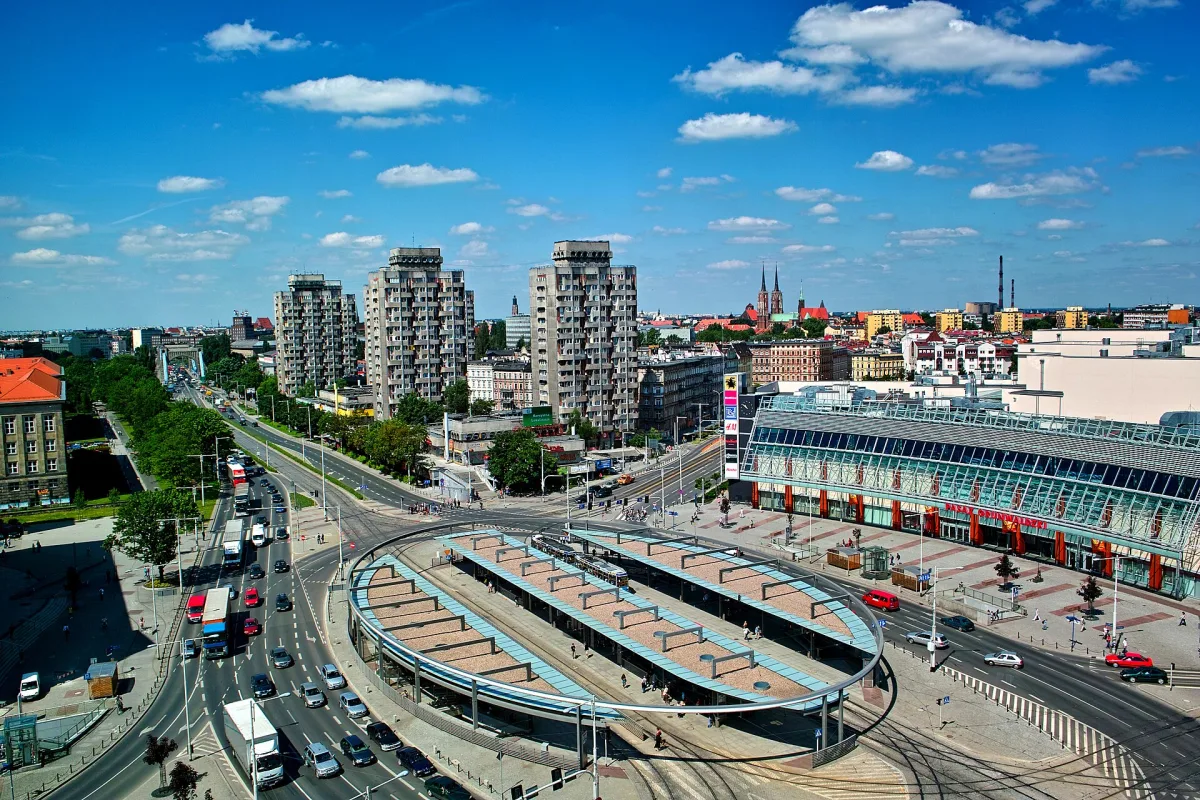
After the war ended, the site of the former runway and the adjoining ruins served for a time as the city's largest marketplace, where goods including items from former German property were sold. From the 1950s the area of today's Grunwaldzki Square began to be systematically built up with university buildings: the halls of the Wrocław University of Technology, the former Academy of Agriculture and the University of Wrocław were erected here. In 1967-1975 a housing estate was added, with six sixteen-storey tower blocks designed by the architect Jadwiga Grabowska-Hawrylak, known among residents by the colloquial name "Bunkrowce."
Since 2006-2008 the central crossroads of this area has functioned as Reagan Roundabout, elliptical in shape, with a covered public-transport interchange and the Pasaż Grunwaldzki shopping centre. Of the former runway and the buildings demolished for it in 1945, no visible trace remains today in the landscape of the square, apart from the memory of this episode itself, preserved in historical studies devoted to the siege of the city.

Be the first! Add a comment.
You need to log in to add a comment.
Log in