
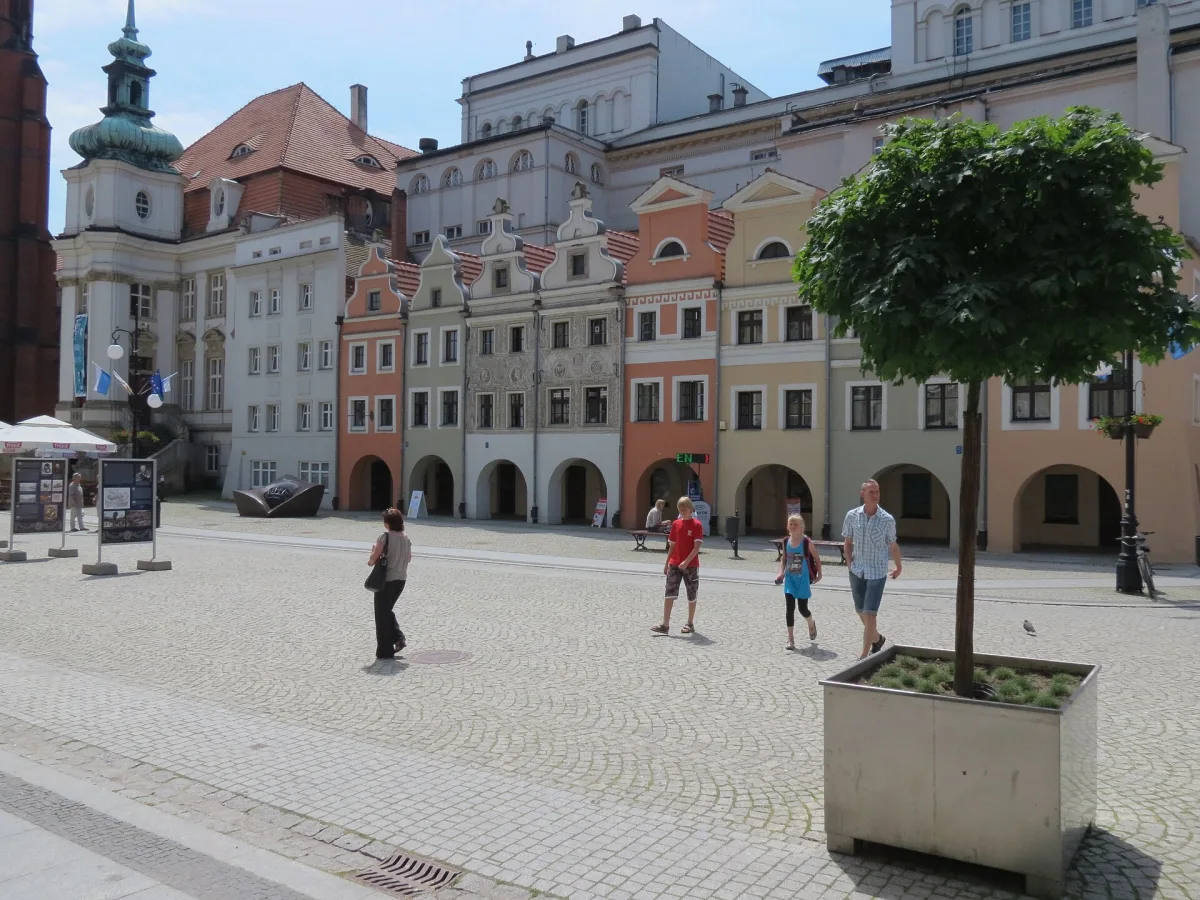
Where the Soviet Military Command in Legnica Came From
The Red Army took Legnica on 9 February 1945. The city, still the German Liegnitz at the time, remained under complete military control for the first months after its capture - it served as a hospital and logistics base for the front, before the front moved further west. Legnica was not a random choice as the seat of a large command: it lay close to the border with the German Democratic Republic and Czechoslovakia, had well-preserved railway and barracks infrastructure left over from the pre-war German garrison, and its location made it easier to communicate with units stationed across the whole post-war Soviet zone in Central Europe.
It was here, after 1945, that the headquarters of the Northern Group of Forces of the Soviet Army was based, responsible for overseeing Soviet units stationed in Poland, along with the command of the 4th Air Army. This made Legnica one of the largest Soviet garrisons outside the borders of the Soviet Union and gave the city the nickname Little Moscow - a term used both among residents and in historical studies.
The City Divided into Zones
The presence of the army meant a physical division of the city. About 1,200 buildings, or more than 30 per cent of Legnica's pre-war built-up area, were placed at the exclusive disposal of the Soviet army - in some periods estimates put as much as a third of the city's area under military control. The largest and most closed-off complex was the so-called Kwadrat (Square), covering 39 hectares in the Tarninów district. The area was surrounded by a two-metre wall, and inside, besides barracks and staff buildings, it had its own banks, cinemas, cafés and shops - infrastructure that let it function independently of the rest of the city. The Kwadrat also contained a representative building known as Dom Prijoma, which served the command's representative functions.
For the residents of Legnica this meant that whole parts of the city - including part of the old town-centre built-up area - were physically out of reach for them. Entering areas occupied by the military required a pass, and for the first post-war years real power over key municipal infrastructure (the power plant, the gasworks, the waterworks) remained in Soviet hands regardless, despite the formal establishment of Polish city administration as early as May 1945. As one resident of those years recalled, in Legnica it felt as though it was the Soviet army, not the Polish authorities, that was the city's true master.
The Everyday Life of Two Neighbouring Worlds
For nearly half a century Legnica functioned as a city split into two overlapping worlds. On one side ran the ordinary life of a Polish city - with its administration, schools and workplaces. On the other operated a closed garrison with its own infrastructure, often better supplied than its surroundings. Between these two worlds there were points of contact: some Legnica residents worked for the Soviet military complexes, providing services or taking jobs directly serving the garrison, and the army was also a customer of the city's utilities and some municipal services. This neighbourly relationship was not, however, one between equal sides - it was dictated by the army's dominance, which controlled the key resources and areas, while the Poles remained the subordinate party.
The tensions this arrangement bred were already making themselves felt in the first post-war decade. The first larger, collective protest by Legnica residents against the presence of Soviet troops took place in 1956 by the Monument of Gratitude to the Red Army - against the backdrop of the nationwide events of that year. Over the following decades, however, the garrison's presence remained a lasting, in practice unquestionable, part of the city's life, woven into the realities of the People's Republic of Poland and the alliance within the Warsaw Pact.
The Scale of the Garrison
For almost half a century, tens of thousands of Soviet soldiers were stationed in Legnica at various periods, making the city one of the largest Soviet garrisons in Poland. The headquarters of the Northern Group of Forces itself oversaw the whole of the Soviet military presence in Poland, which further raised the city's standing within the command structure. The scale of the areas taken over - more than 1,200 buildings and nearly a third of the pre-war built-up area - set Legnica apart from other Polish cities with Soviet garrisons, where the army usually occupied separate barracks rather than such large swathes of the urban fabric.
The Withdrawal of the Troops and What Was Left Behind
The process of withdrawing Soviet, and from 1991 Russian, troops from Poland began after the political changes at the turn of the 1980s and 1990s. In Legnica it ended in September 1993: according to some sources the last soldiers left the city on 16 September, according to others on 17 September of that year. Either way, it was the end of a military presence lasting nearly half a century - from 1945 to 1993, that is, 48 years.
After the garrison's withdrawal the city faced the task of developing the large, abandoned post-Soviet areas, including the former Kwadrat in Tarninów. Developing these areas - renovations, adapting buildings for new uses, servicing the land - absorbed tens of millions of złoty over the following years. Traces of the garrison's half-century presence are still visible in Legnica today: in the distinctive architecture of the former military complexes, in the structure of some districts shaped around areas once closed off to residents, and in the memory of the generation that grew up in a city divided into two parts. This period is recalled today, among other things, by a feature on the city of Legnica's own portal, "In the Footsteps of Little Moscow" (Polish: "Śladami Małej Moskwy"), devoted to places connected with the former garrison.

Be the first! Add a comment.
You need to log in to add a comment.
Log in