
The first line and its builders
The railway came to Lower Silesia through private capital, not state initiative. Construction of the first major line was undertaken by the Upper Silesian Railway (Oberschlesische Eisenbahn AG), a private company that in time became one of the largest railway enterprises in Europe, before Prussia took over management of the lines in 1857, with full integration into the state railway completed in 1883. The project dated back to 1816 and was intended from the start mainly to serve coal transport, with passenger transport as an addition.
The first section of the Wrocław - Mysłowice route, between Wrocław and Oława, opened on 22 May 1842. The history of Wrocław's own station gives a slightly different date: construction of the Świebodzki station began in April 1842 to a design by engineer Cochius, and the first train did not leave the station until 28 October 1843. It is possible that the first test run took place on provisional infrastructure, with regular passenger traffic starting only a year later - the sources do not state this unambiguously.
The pace of expansion and what drove it
From the opening of the first section, the network grew at a pace hard to imagine today. The Wrocław - Mysłowice line was extended stage by stage: it reached Brzeg on 3 August 1842, Opole on 29 May 1843, Gliwice on 2 October 1845, and Mysłowice on 3 October 1846, completing a route of about 196.3 kilometres in total. The driver of this expansion was coal - transporting the raw material from the mining basins to industrial centres and on to the rest of Germany paid off well enough that new sections were built almost without a break.
The same driving force - coal and industry, and in time also mountain tourism - pushed railway construction deep into the Sudetes throughout the second half of the 19th century and the first decade of the 20th. Lines were built to Kowary, linked to Jelenia Góra in 1882, and to Kamienna Góra from 1905, speeding up the transport of iron ore from the works there. The urban infrastructure itself also grew: when, at the turn of the 19th and 20th centuries, traffic through Wrocław's railway junction became too heavy for the existing tracks, the railway viaduct was built in 1896-1901 - 4 steel viaducts and as many as 67 brick, vaulted spans along a length of 620 metres, carrying three tracks of different lines over the streets of today's Powstańców Śląskich district.
Stations as showcases of their cities
The Prussians built their stations on a scale that today brings to mind public buildings more than ordinary service buildings. Wrocław Główny station was designed by architect Wilhelm Grapow in the English neo-Gothic style, using brick. Construction began on 10 September 1855, employed around 250 bricklayers, and the official opening took place on 12 October 1857. The original platform hall was about 200 metres long and has survived to this day, making Wrocław's station one of the few in Poland with an original platform hall predating the era of electric railways.
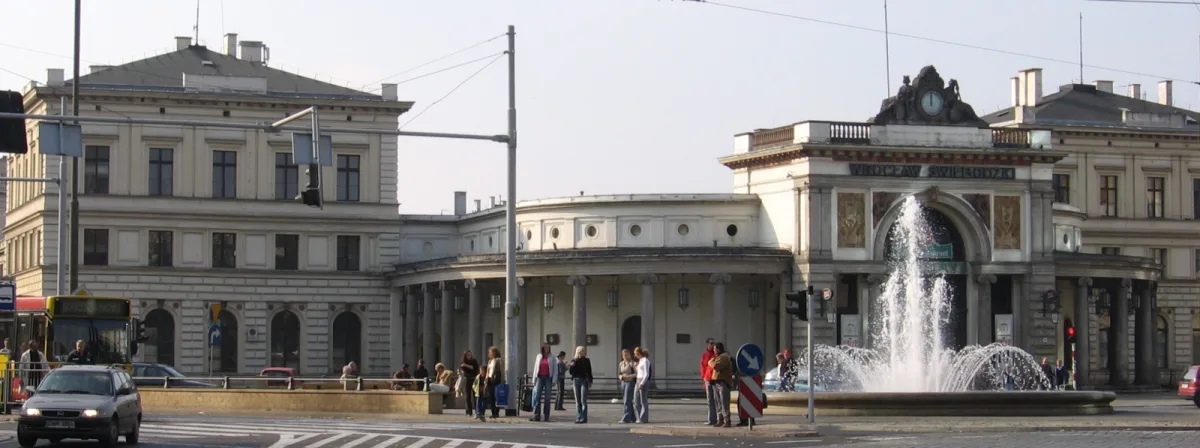
The older Świebodzki station underwent a thorough rebuilding in 1868-1874, resulting in a new late-Classicist facade designed by Walther Kyllmann, Adolf Heyden and Carl Lüdecke. Above the main entrance were placed allegorical sculptures representing Silesia and Pomerania - symbolism that had nothing to do with the building's transport function and everything to do with the prestige the region was meant to project. Train traffic there was suspended in 1991, but the building has kept its tracks, platforms and points, and today serves other purposes.
Mountain railways and their engineering
Running tracks through the Sudetes and their foothills required structures the lowland part of the region had never seen. The oldest of the large constructions of this type is the stone railway bridge in Zgorzelec over the Lusatian Neisse, built of granite in 1844-1847 to a design by Gustav Kießler - 475 metres long, with 35 spans and two tracks, still counted today among the four longest stone bridges in Poland. A similar scale is reached by the railway viaduct in Żytawa (Zittau), built in 1853-1859 over the same river, further west - 741 metres long and 18 metres high, though single-track.
Decades later, when the line from Kłodzko towards Wałbrzych was under construction, engineers had to deal with the deep valley of the Woliborka stream. The railway viaduct in Nowa Ruda, built there in 1879-1880 and known to locals as the Black Bridge, rose 36 metres above the water and, at the time it was built, was the highest railway bridge in what was then Germany. On the same line, near Jugów, stands the viaduct in Zdrojowisko, opened together with the first section of the Kłodzko - Nowa Ruda route on 15 October 1879. The youngest of this group, the railway viaduct in Lewin Kłodzki on the line to Kudowa-Zdrój, was built only in 1903-1905, by Italian engineers brought in specially for the task by the Prussian state railways.
The density of the network before 1945 and its shrinking
At its peak, Lower Silesia had a dense railway network, reaching about 2,300 kilometres - passenger rail then served practically every larger town and village in the region. This did not survive the following decades. Closures began with unelectrified and secondary lines, gathering pace especially from 1988, and by around 2000 only half of the network's original length remained in passenger service. Among the causes cited are ageing infrastructure, inefficient diesel rolling stock and the growth in private car ownership - nationwide, passenger rail journeys fell from 1,093 million passengers in 1980 to 309 million in 2001.
The effects of this process are still visible on the ground today. The railway bridge in Bielawa Dolna near Pieńsk, built back in 1870, today carries traffic on only one of its two original tracks, with reduced speed and load limits. The Nowa Ruda viaduct lost one of its two steel spans in 1993, removed to reduce the load on the structure. The Zgorzelec bridge did survive to the present day, but on 7 May 1945 retreating German troops blew up part of it, destroying some of its piers, before the crossing was rebuilt. Wrocław's railway viaduct, too, although it still carries passenger traffic, is today in poor technical condition.
What remains of this network
Despite demolitions and closures, a large part of the 19th-century infrastructure still stands in the landscape, partly in use, partly as a lasting trace of an era when the railway was the region's most important investment. The fullest overview of this history is offered by the Museum of Railways in Silesia in Jaworzyna Śląska, housed in a historic, 19-bay roundhouse from 1906-1907, with the largest collection of railway rolling stock in Poland, gathered on a site of over 2.5 hectares.
The viaducts and bridges themselves - in Zgorzelec, Żytawa, Nowa Ruda, Zdrojowisko, Lewin Kłodzki and Bielawa Dolna - mostly still carry rail traffic, though often limited to a single track and lower speeds than in the era when they were built. Wrocław Główny and Świebodzki stations, despite their different functions today, remain the clearest evidence of how seriously the railway was taken at the time it was built.

Be the first! Add a comment.
You need to log in to add a comment.
Log in