
A Welsh aristocrat who ended up in Silesia
Mary Theresa Olivia Cornwallis-West was born on 28 June 1873 at Ruthin Castle in North Wales, into the family of Colonel William Cornwallis West and Mary Fitzpatrick. Her ancestors were said to include even the English king Edward III. The family was not wealthy - towards the end of the 1870s the Wests moved to London for financial reasons, and young Daisy studied, among other things, singing in Florence.
In April 1891, at a London ball, she met Prince Hans Heinrich XV of Hochberg, the owner of Książ Castle and one of the richest men in Germany at the time. The engagement followed after four months, and the wedding took place on 8 December 1891 at St Margaret's Church in London. Daisy then took the title of Countess of the Holy Roman Empire of the German Nation. The couple's first child died in February 1893 after two weeks of life; later came sons: Hans Heinrich XVII (born 2 February 1900), Alexander, known in the family as Lexel, and Bolko (born 23 September 1910).
Rebuilding Książ into a residence fit for its age
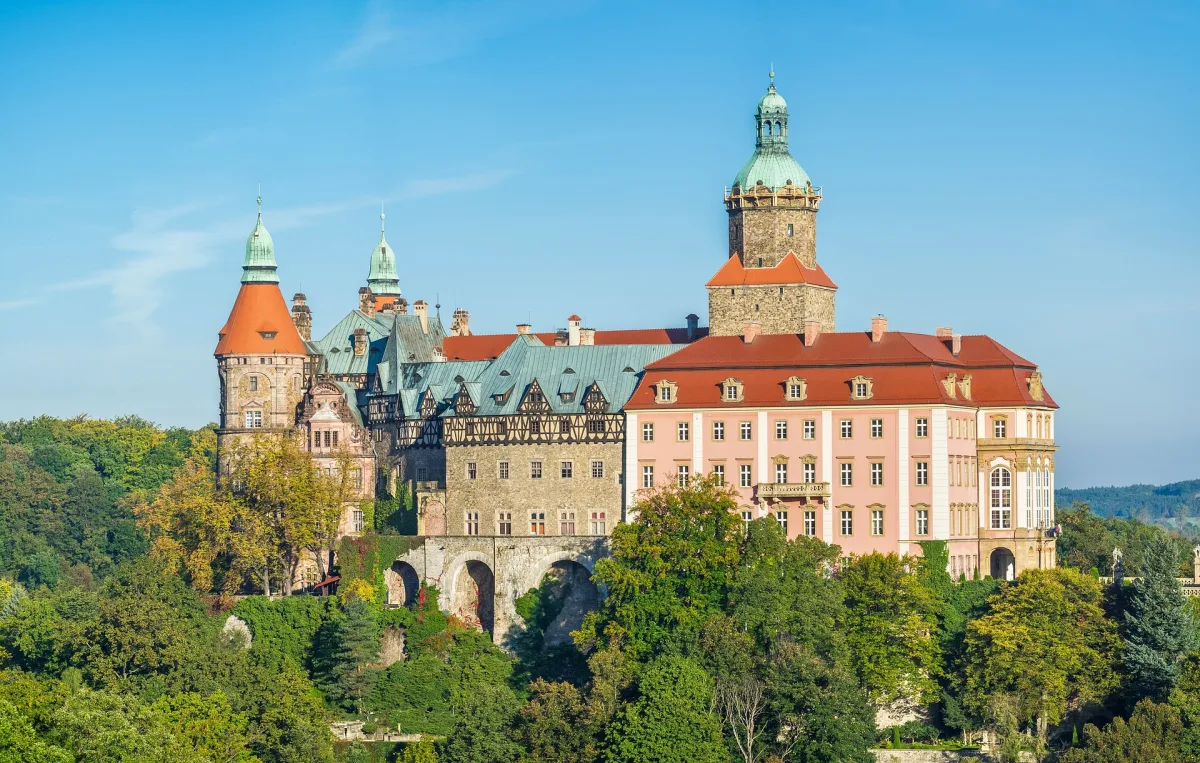
During Daisy and Hans Heinrich XV's marriage, the castle underwent the second great rebuilding in the history of the Hochberg family, carried out between 1909 and 1923. A new wing was added, the terraces with fountains were modernised, and an eclectic facade with two cylindrical towers was built. The castle's main tower, 47 metres high and topped with a spherical dome, which still dominates the Pełcznica valley today, was also built during this period. Even before the First World War, a winter garden for Prince Heinrich XV, today's Palm House, was erected on the Lubiechów estate, and a Japanese garden was laid out. From the windows and terraces of the rebuilt Książ there was a view, among other things, of Stary Książ, a romantic ruin serving as a viewpoint for the main residence.
The Hochberg estate covered extensive land in today's Pełcznica gorge below Książ, together with farms and stables such as today's Lubiechów Stable.
Hospitals, milk for children and the first school for the disabled
Daisy von Pless was not limited to the representative role of the lady of the castle. In 1906, on her initiative, one of the region's first schools for disabled children was opened in Wałbrzych. She also organised a network of so-called milk stations, where mothers from the surrounding working-class families could receive free, pasteurised milk for infants.
After the outbreak of the First World War she joined the Red Cross. She worked at a hospital in Tempelhof near Berlin, and set up field hospitals for wounded soldiers on her own estates - at Książ itself and at the spa hotel in Szczawno. She also served as a nurse at an Austrian military hospital in Üsküb (today Skopje) and on the western front in Lorraine, seeing at close hand the effects of a war she later described in her memoirs as a catastrophe for the whole of Europe.
Memoirs as a testimony of an era
After separating from her husband, Daisy began writing memoirs of her life in the German aristocracy at the turn of the 19th and 20th centuries. The first volume, published in 1928 under the title "Princess Daisy of Pless by Herself", became a bestseller in Britain. The second volume appeared in 1931 (its Polish translation, titled "Lepiej przemilczeć", was published only in 2013), and in 1934 she published a further part titled "What I Left Unsaid". The princess's memoirs are today one of the more important sources for the history of Książ and the Silesian aristocracy of that period - they describe everyday court life, family relationships, and also political events seen through the eyes of a woman observing the European elites at close hand before the First World War.
Divorce, illness and the last years in poverty
Daisy and Hans Heinrich XV's marriage had been falling apart for years, and in December 1922, after more than thirty years, it formally ended. A court in Berlin ruled that the princess kept her titles, allowances and residences at La Napoule on the French Riviera and in Munich, but lost the right to custody of her children.
In April 1935 Daisy returned to Lower Silesia. She was already suffering from multiple sclerosis and moved about in a wheelchair, cared for by her maid Dolly Crowther. Little remained of the wealth and standing she had held as the mistress of Książ - she struggled with financial problems and earned extra money by appearing in press advertisements for Dearborn face cream. According to the available accounts, in 1941 she left the castle and spent her last years in a rented villa on a street in today's Wałbrzych, far from the residence she had considered her true home for decades. She died on 28 June 1943, a day after her seventieth birthday. She was buried in the Hochberg family mausoleum, but two years later Red Army soldiers plundered the tomb, and in the 1980s the burial ground was levelled and a housing estate was built in its place. The princess's present resting place is not known - it is thought her remains may have been moved to the Protestant cemetery in Wałbrzych's Szczawienko district.
The pearl necklace and the legend of the treasure
Among the stories circulating about Princess Daisy, the best known concerns jewellery. Her husband gave her a seven-metre pearl necklace as a gift, one of the symbols of the Hochberg family's wealth. After the divorce the pearls were divided into smaller parts and sold, and the money raised was supposedly meant to help rescue her youngest son, Bolko, from the Gestapo. Around this story, and around the mysterious tunnels dug beneath the castle during the Second World War, a broader legend of Książ's lost treasure grew over time, popular among tour guides. The sources do not confirm that Daisy herself hid valuables in the castle before fleeing - this is a thread found in oral accounts, not a documented event.
The same family of legends includes the story of the White Lady, said by some guides to wander the corridors of Książ at night. Popular collections of trivia link her to Princess Daisy, but written sources on the castle's ghosts - including the memoirs of her son, Prince Hansel - describe other, clearly named figures, not a White Lady identified with Daisy. This thread therefore remains a legend without confirmation in the sources, not an established fact.
Her memory today
Daisy von Pless remains today the best-known resident of Książ Castle and one of the more important figures in the history of Wałbrzych. In 2023, on the 150th anniversary of her birth, the princess's apartments were opened to visitors at the castle, furnished in the spirit of the era in which she lived there. Her life story, from London salons through managing one of the largest estates in Silesia to her last years in poverty in a decaying villa in Wałbrzych, remains one of the most frequently retold stories of the region. Traces of her times can also be seen today on Zamkowa Góra and in the Pełcznica gorge, a destination for tourists walking near Książ.

Be the first! Add a comment.
You need to log in to add a comment.
Log in