
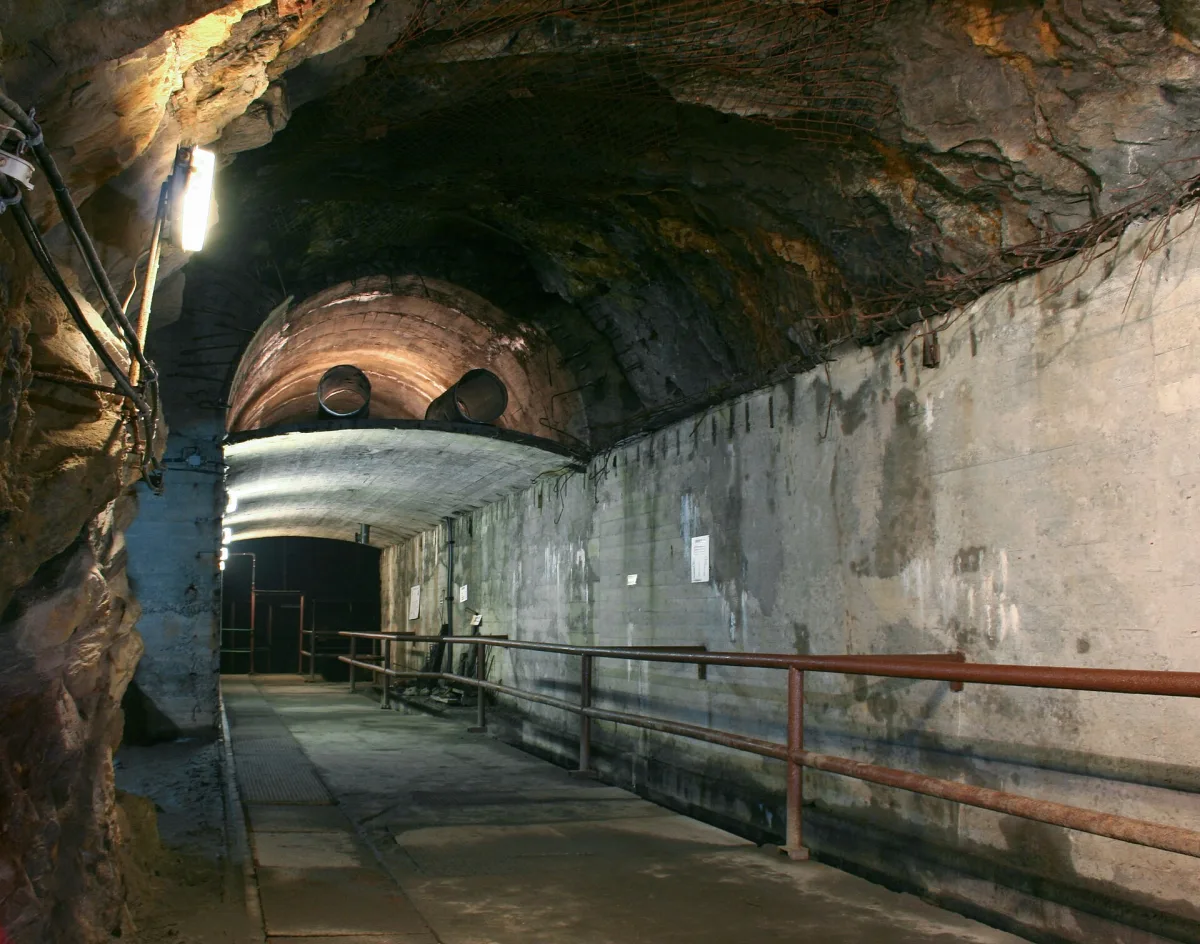
The largest construction project of the Third Reich in the Owl Mountains
Riese, German for "Giant", is the code name for the largest mining and construction undertaking carried out by Germany during the Second World War. Work began in mid-1943 and continued until 1945, covering an area of several dozen square kilometres in the Owl Mountains and the surroundings of Książ Castle near Wałbrzych. Formal supervision of the construction was taken over by the Organisation Todt at the turn of March and April 1944.
The scale of the works was enormous: as part of the complex, around 257,000 cubic metres of reinforced concrete were laid, 213,000 cubic metres of tunnels were bored, 58 kilometres of roads with six bridges were built, along with 100 kilometres of water supply network. The whole complex consisted of nine sites: Książ, Rzeczka, Jugowice, Włodarz, Osówka, Soboń, Sokolec-Gontowa, Wielka Sowa and Moszna. None of them was completed, because the Eastern Front reached Lower Silesia before the works could be closed out.
The builders and the human cost
Above and below ground worked prisoners sent to the thirteen Riese subcamps, administratively subordinate to the Gross-Rosen concentration camp, and its camp hospital. German documents speak of the involvement of up to almost 30,000 prisoners in the construction; other estimates put the figure at a minimum of a dozen or so thousand, most of them brought in from Auschwitz-Birkenau, including Jews who had survived the liquidation of the Łódź Ghetto.
Boring the galleries was the hardest and most dangerous work in the whole complex, with frequent fatal accidents. On top of physical exhaustion and hunger came the risk of a tunnel collapsing. At least 4,775 prisoners died in the Riese complex itself, and counting those who also died in the first weeks after the war as a result of their bodies having been worn down, the figure reaches 4,929.
The only confirmed purpose: a headquarters under Książ Castle
Among all the questions raised by the history of Riese, there is one answer that documents confirm beyond doubt. Książ Castle and its immediate surroundings were to be rebuilt as one of Adolf Hitler's headquarters. Beneath the castle itself, two levels of chambers were dug, at depths of 15 and 53 metres. This is the only fully documented purpose of the construction within the whole project. The rest of the complex, nine sites scattered across the mountains, remains a matter of hypotheses rather than established fact.
Hypotheses that have never been proven
The most frequently repeated hypothesis is that of an underground armaments factory, meant to produce V1 or V2 rocket weapons after the above-ground plants were destroyed by Allied bombing raids. A second hypothesis links Riese to the nearby uranium deposits of the Sudetes and connects the complex with German attempts to build an atomic bomb. A third speaks of storage for goods looted during the war. None of these versions has been confirmed by documents from the period. This is an important distinction: it is known for certain that the Germans were building something enormous and kept under strict secrecy, but it is not known exactly what was meant to be built in these underground spaces apart from the headquarters under Książ.
Where legends like the Bell come from
The most fantastical of the stories circulating around Riese concerns a secret weapon codenamed Die Glocke, or the Bell, described in some post-war publications as a device with extraordinary, almost physically implausible properties. The legend arose after the war and has no confirmation in any surviving German documents. A similar mechanism lies behind the story, circulating around the region, of a golden train allegedly hidden in one of the railway tunnels in the Owl Mountains, though that is a separate story, covered elsewhere on this portal. Both legends share the same background: the strict secrecy with which the Germans surrounded the whole region in the last years of the war encouraged post-war speculation, and the lack of full construction documentation allows these legends to be kept alive to this day.
The state of research and what can be visited today
According to researchers' estimates, around half of the complex's underground corridors have still not been found, and exploration is carried out, among other ways, through ventilation shafts. Four parts of the complex have been made accessible to visitors: Rzeczka, where a museum has operated since 1995, Włodarz, Osówka, and the chambers beneath Książ Castle, opened to tourists in 2018. The Riese Underground Complex Włodarz is today the largest tourist-accessible site of the whole project, with a network of corridors crossing at right angles and a flooded section that is toured by boat. At the Mysterious Underground City of Osówka, the trails lead through galleries and chambers built using the same method, allowing visitors to see the scale of the works up close.
The history of the prisoners who built Riese, and the wider context of the whole Gross-Rosen camp system, is documented at the Gross-Rosen Museum in Rogoźnica, to which all thirteen subcamps of the complex administratively belonged.

Be the first! Add a comment.
You need to log in to add a comment.
Log in