
A hydrotherapy spa taken over by a brother-in-law
Before a tuberculosis sanatorium was established in Sokołowsko, formerly Görbersdorf, the village was already treating patients. In 1849, Marianna von Colomb opened a hydrotherapy establishment here run according to the method of Vincenz Priessnitz, based on cold baths and compresses. The establishment ran into financial trouble, and in 1854 it was taken over by von Colomb's brother-in-law, the physician Hermann Brehmer. A year later, in 1855, Brehmer opened a facility of an entirely different kind here: a sanatorium devoted solely to treating tuberculosis using the climate-and-diet method. The heritage register links this period to the building of today's Grunwald sanatorium, dated to 1853, and to the village's urban layout of 1854, which shows that the settlement developed together with the medical facility.
Why this particular valley
Sokołowsko lies in the Suche Mountains, part of the Kamienne Mountains, in stream valleys at an altitude of around 540 to 590 metres above sea level. Brehmer chose this location for its microclimate: the valley floor is sheltered from wind, wind speeds here are minimal, and at the same time the area has abundant rainfall. Combined with mountain air and moderate altitude, this created conditions that physicians of the time considered beneficial for the lungs.
Treatment by air and diet instead of water
Brehmer's method departed from Priessnitz's hydrotherapy. Patients were kept for long hours in the fresh air, in calm surroundings and on an appropriate diet, without medication, since none existed for tuberculosis at the time - antibiotics only appeared in the 20th century. The climate-and-diet treatment consisted of measured exercise, rest on deckchairs and regular meals under a doctor's supervision. Research into this method was continued at the turn of the 1870s and 1880s by Alfred Sokołowski, after whom the village received its Polish name after the war.
What kind of first this was
Historical sources speak of a priority wider than merely European: Brehmer's sanatorium is described as the world's first specialised medical facility for tuberculosis patients based on the climate-and-diet method. This is an important qualification of the category - hydrotherapy spas already existed before, such as Marianna von Colomb's establishment before 1854, but none of them was conceived solely as a lung-disease clinic based on a stay in a mountain climate. Görbersdorf was therefore the first in this narrow category, new to the medicine of the time - and for this reason it is sometimes called the first such centre in Europe, though historical records speak more precisely of a world-first.
The Silesian Davos
The fame of Görbersdorf reached Switzerland. In 1868, a tuberculosis treatment centre was established in Davos, modelled directly on Brehmer's Silesian facility - Alexander Spengler worked there, whose treatment later became the background for Thomas Mann's "The Magic Mountain". Over time it was Sokołowsko that came to be called the "Silesian Davos", although chronologically the relationship was the reverse: it was the Swiss resort that imitated the Silesian one, not the other way round.
Spa guests from across Europe
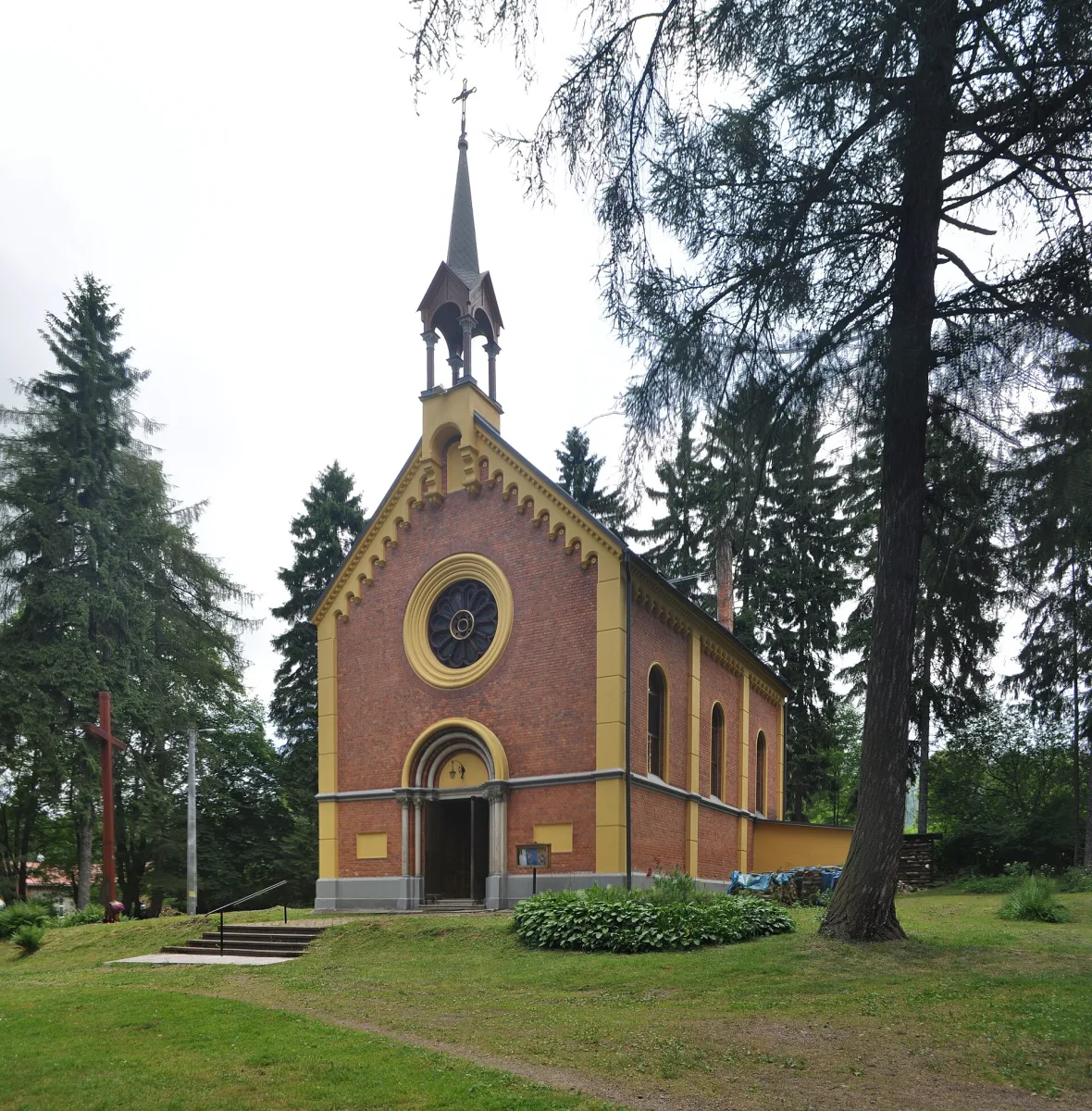
At its peak, in 1887, 730 patients were staying in Görbersdorf at the same time, more than the local population. A year later the settlement already had its own post office and telephone connection. Guests from across Europe flocked to the spa, building villas and guesthouses there; a Russian Orthodox chapel was even erected for patients from Russia. Scandinavian guests brought with them a fashion for skiing, and a ski jump was built in 1930. Among the patients was Tytus Chałubiński, whose stay is thought to have influenced his later interest in Zakopane as a health resort. On 22 October 1911, the Hungarian art historian Leó Popper died here.
Decline and fire
After the Second World War, the establishment, renamed the Grunwald sanatorium, continued to operate as a public centre for treating lung diseases and, later, dementia-related conditions too. The post-war expulsion of the German-speaking population, however, broke the cosmopolitan character of the resort, which had previously attracted guests from across Europe. As antibiotics developed, the need for months-long climate stays also declined, and the buildings of the former spa began to fall into ruin. In 2005, the building of Brehmer's original sanatorium burned down.
A cultural centre where the clinic once stood
Since 2007, the ruins have been rebuilt by the In Situ Foundation for Contemporary Art, which runs the International Cultural Laboratory here, along with the Krzysztof Kieślowski Archive - the director who spent time in Sokołowsko in his youth. Every September, the "Hommage à Kieślowski" film and cultural festival is held. In Sokołowsko itself it is also worth seeing the Church of Our Lady Queen of the World from 1884, built as a Protestant church from the donations of the spa guests of the time, on land given by the physician Theodor Römpler. The surrounding hills offer views over the valley: the Friedenstein viewpoint stands on Włostowa, one of the peaks surrounding the settlement.

Be the first! Add a comment.
You need to log in to add a comment.
Log in