
Why the line was built through the mountains
At the turn of the 19th and 20th centuries, the Prussian railway authorities were building a network of connections in Lower Silesia intended to link the scattered towns of the Sudetes while also serving the growing tourist traffic in the mountains. That is how the Owl Mountains Railway (Kolej Sowiogórska) came about, opened in stages between 1900 and 1903, although earthworks on it began as early as 12 September 1899. The roughly 62-kilometre route was to connect Dzierżoniów with Nowa Ruda and Radków, running along the eastern edge of the Owl Mountains through Bielawa and Srebrna Góra.
The line had a dual purpose. On one hand it was built with tourists in mind - the scenic route surrounded by mountains was meant to be an attraction in itself, and the stations in successive towns opened the region up to summer visitors. On the other hand, the railway had real economic significance: it carried coal from the mines in Słupiec and Nowa Ruda to Dzierżoniów, thereby linking the mining basin with the rest of Lower Silesia's rail network. A similar purpose, though without the tourist element, lay behind the construction of the Wałbrzych - Jedlina-Zdrój - Kłodzko line, running through the Mały Wołowiec massif in the Czarny Range (Góry Czarne), part of the Wałbrzych Mountains.
Construction - difficult terrain and two tunnels under Mały Wołowiec
The most difficult section of the Owl Mountains Railway was the stretch between Srebrna Góra and Wolibórz. There, the builders had to cut four deep trenches through solid rock and erect two brick viaducts - the Żdanów viaduct, 23.8 metres high, and the Srebrna Góra viaduct, reaching 28 metres, with a combined length of 260 metres. These works, carried out in spring 1901, employed around 300 workers brought in from abroad - Croats, Czechs, Poles, Ukrainians and Italians.
In parallel, on the Wałbrzych - Kłodzko line, engineers had to deal with a different obstacle: the Mały Wołowiec massif. The first tunnel under this mountain, 1,560 metres long, was built between 1876 and 1879 and opened on 15 October 1880. When, towards the end of the 19th century, traffic on the line grew to the point where a single track was no longer enough, it was decided to build a second, parallel tunnel. Work on it - according to available sources, which differ slightly on this point regarding the exact dates - lasted from either 1907 or 1909 to either 1911 or 1912. The new tunnel, 41 metres longer than the first, was given its own ventilation shafts running up to the top of the mountain.
Engineering records of the section
The second tunnel under Mały Wołowiec, measuring 1,601 metres, is today the longest railway tunnel in Poland - one of the few such clear-cut infrastructure records that the region around Wałbrzych can offer. The very fact that two almost parallel tunnels, each over a kilometre and a half long, were bored just a few dozen metres apart shows the scale of the investment the Prussian railways put into this part of the network.
On the Owl Mountains Railway, the record was instead set by the way the steep climb near Srebrna Góra was overcome. Along a 6.6-kilometre stretch a third rail, a double-strip Abt-system rack rail, was laid - the only solution of its kind in Silesia. Trains there negotiated a gradient of up to 60-64 per mille, travelling at an average speed of 9.6 kilometres per hour and hauling trains weighing up to 125 tonnes. This technical solution, rare across the whole region, required special locomotives adapted to running on a rack rail.
Passenger and freight traffic through the decades
In the first years of the Owl Mountains Railway's operation, most of the income came from tourist traffic rather than freight transport of coal. This arrangement proved fragile: after the First World War, tourist traffic collapsed sharply, while the costs of maintaining the complicated infrastructure - including the rack-rail section - remained high. The line never became particularly profitable, even though formally it was in the black for most of its history.
The situation was different on the line through the tunnels under Mały Wołowiec, which, as part of the main Wałbrzych - Kłodzko route, handled steady freight and passenger traffic throughout the 20th century, using both parallel tunnels at once. The tunnels were also said to have served as a shelter for special trains during the Second World War - one of the reasons why the whole region around Wałbrzych still attracts seekers of wartime infrastructure today, although in the case of these particular tunnels it was not a matter of secret facilities on the scale of the Riese complex, but simply the use of an already existing railway line.
Closure of the line and the state of the track bed
The Owl Mountains Railway did not survive the Great Depression. Traffic on the mountain section was suspended on 12 October 1931, and a year later, on 11 May 1932, the remaining, southern part of the route was also closed. Between 1933 and 1934 the tracks were dismantled, leaving mainly embankments, cuttings and both viaducts - the Żdanów and Srebrna Góra ones - which still stand today as abandoned, decaying structures. Attempts to reactivate the line came in 1938, after the Sudetes were incorporated into the Reich, but came to nothing, and after the war the subject was never revisited.
The line through the tunnels under Mały Wołowiec had a different fate. Traffic on it continued for much longer, and the older of the two tunnels was not taken out of service until the late 1990s, once it became clear that a single working tunnel was enough to handle the reduced traffic. The younger, longer tunnel remained in operation and underwent renovation between 2018 and 2020.
Today's use of the route by tourists
The former route of the Owl Mountains Railway, though without tracks, lives on today as a walking and cycling trail running along the old embankment, with views of both surviving viaducts. The railway is also still remembered today under the colloquial name Sowa (Owl), from the German Eule - a name that has survived in regional memory longer than the line itself. Since 29 April 2019, the Srebrna Góra - Bielawa Zachodnia section has been taken over by the Lower Silesian regional authorities, which has opened the way for further work on preserving this route as a tourist trail.
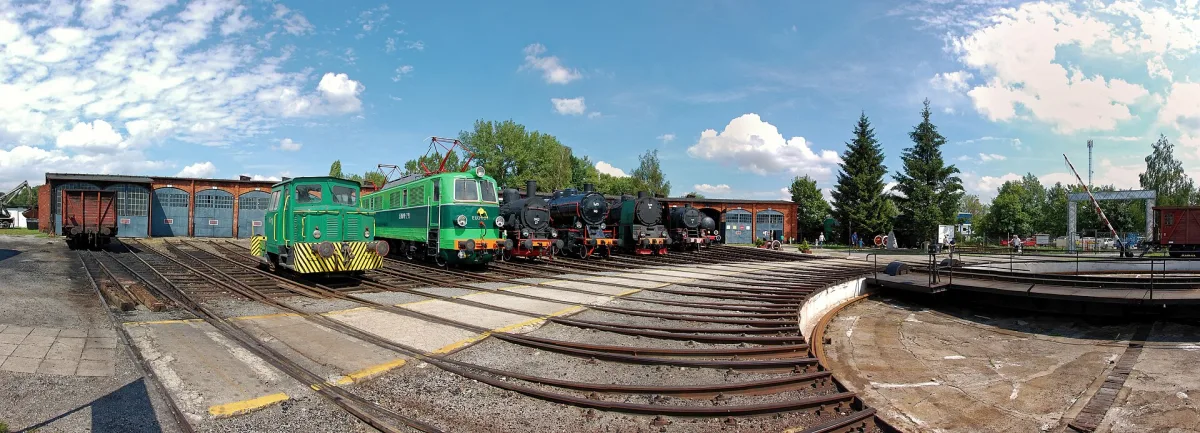
Near the tunnels under Mały Wołowiec, in the nearby village of Świerki, there is the Museum by the Tunnel (Muzeum Przy Tunelu) - a private collection of pre-war and post-war memorabilia, founded by Mieczysław Bojko, after whom the institution is named. It is one of the few places whose name directly refers to its proximity to the tunnels and allows a glimpse into the everyday life of people living alongside this particular railway line. The full history of the region's railways, including period rolling stock, can also be explored at the Museum of Railways in Silesia in Jaworzyna Śląska, housed in a historic roundhouse from 1906-1907.

Be the first! Add a comment.
You need to log in to add a comment.
Log in