
The city after the surrender
Wrocław surrendered on 6 May 1945, four days after the fall of Berlin. The act of unconditional surrender was signed by General Hermann Niehoff at the Villa Colonia in the Krzyki district. The scale of the destruction depends on the source: the Polish Wikipedia gives around 70 per cent of buildings destroyed or damaged, a report by the Saxon administration from August 1945 estimated the losses at 80-90 per cent, and other accounts put the figure at only half the city. All sources agree on one thing, however: the city was left with around 18 million cubic metres of rubble. The Polish city president Bolesław Drobner reached Wrocław on 10 May 1945, four days after the surrender, and found the city in ruins.
Clearing the rubble and salvaging brick
Clearing the rubble from the city took years. It involved cleaning up destroyed houses, as well as the deliberate demolition of buildings that, in theory, could still have been rebuilt, in order to salvage brick and other building materials from them. This strategy, described in the Polish Wikipedia, deepened the degradation of the surviving urban fabric: a building that had survived the war could disappear afterwards, taken apart for raw material. Many Silesian cities of the period met a similar fate; in nearby Głogów, brick was carried straight out of the ruins for the reconstruction of Warsaw, a fact documented separately. In Wrocław, decisions about what to demolish and what to save were made gradually, as the city filled up with new residents and new authorities.
Settlers, displaced people and the dispute over heritage
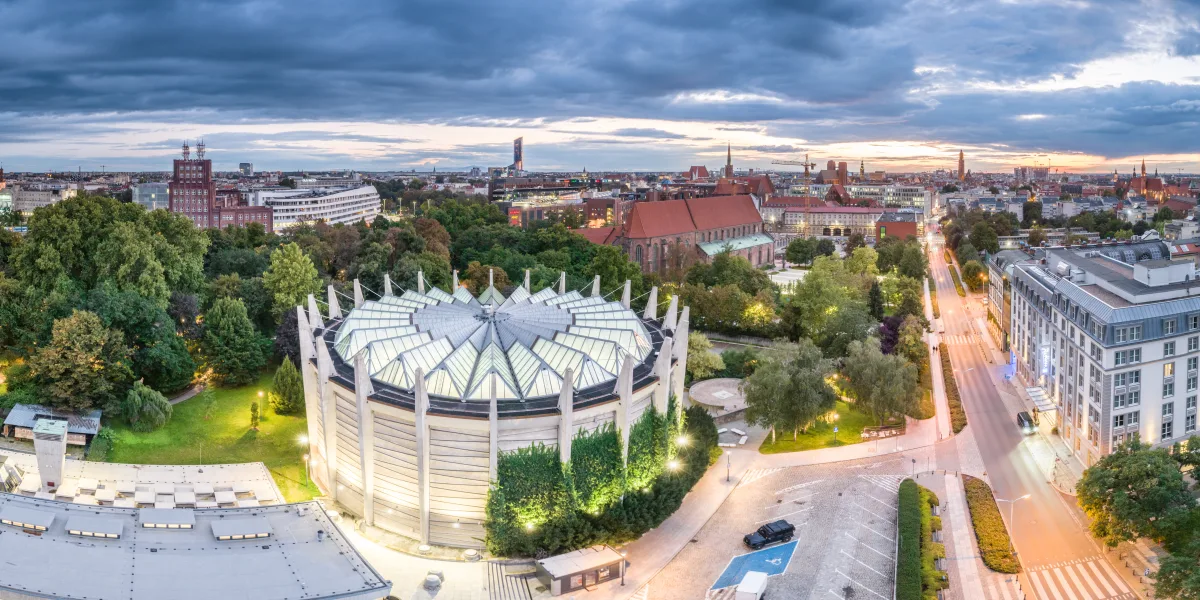
Post-war Wrocław was populated mainly by Poles arriving from various parts of the country: around 29 per cent of the new residents came from areas seized by the USSR, more came from the Poznań region, and a significant group came from Lwów and the Vilnius region. This last group brought part of their own cultural heritage with them: in 1946, the Panorama of the Battle of Racławice arrived in Wrocław, having previously been on display in Lwów between 1894 and 1944, although its public unveiling had to wait until 1985. Meanwhile, the city's pre-war German residents were being expelled, and traces of the German past, inscriptions, signs and lettering, were systematically removed from the streets. The first Polish settlers long regarded Wrocław as a temporary place, and were in fact called pioneers; only over time did the city come to be treated as a place of permanent settlement, rather than merely a source of supplies.
Rebuilding the Market Square
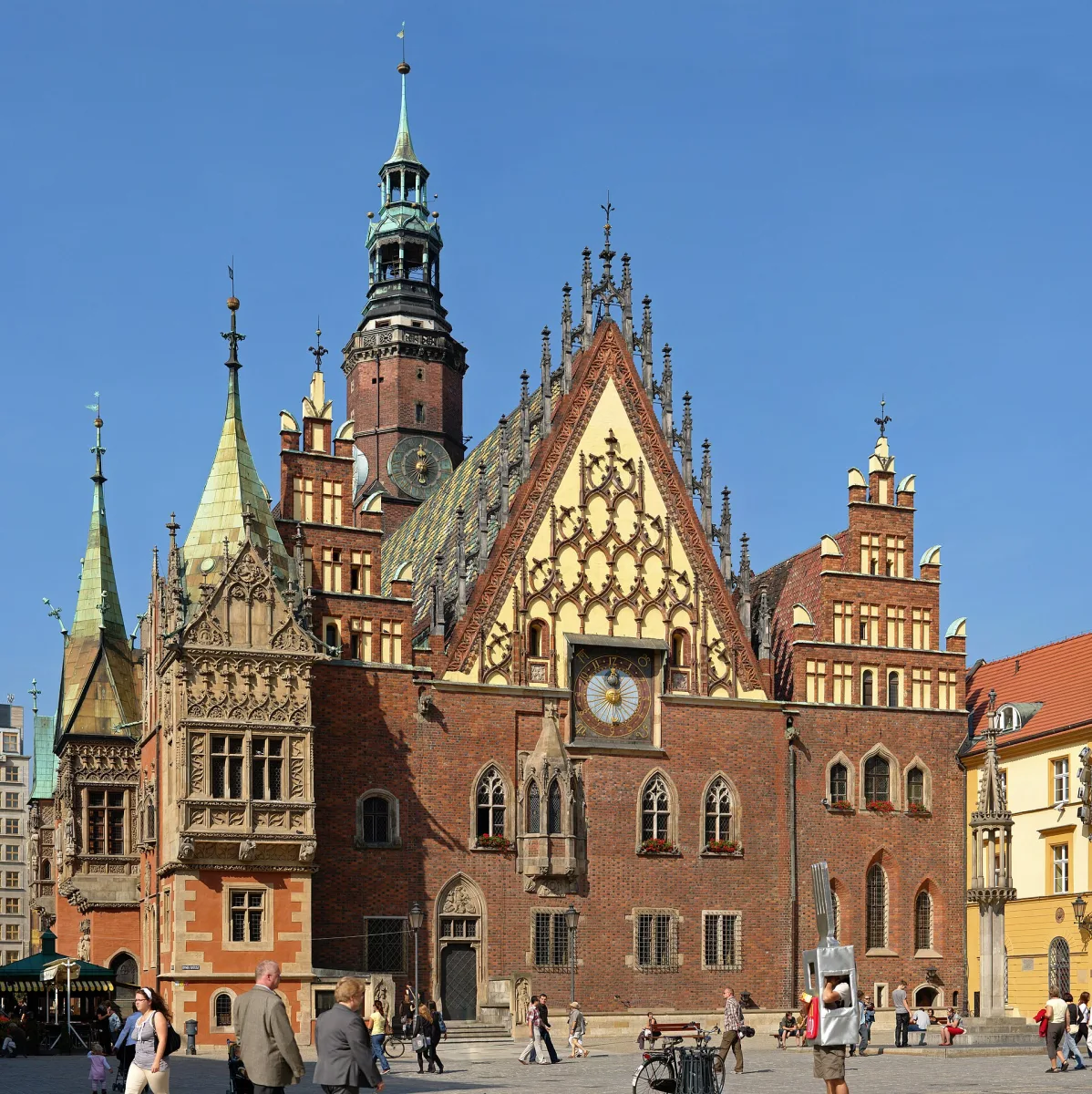
The war destroyed more than 60 per cent of the buildings surrounding the Market Square, and only seventeen tenement houses survived intact along its frontages; the northern side suffered the worst. The decision to carry out a full, historical reconstruction, rather than build modern blocks on the site, was only made in 1953, eight years after the war. By 1955 most of the tenement houses had been rebuilt, though without their full facade decoration, which was completed only over subsequent decades. In total, twenty-four tenement houses were reconstructed in their historical form, eleven were rebuilt or remodelled, and thirteen were renovated. The last of the frontage buildings, the House Under the Golden Dog, was only completed between 1992 and 1994, nearly half a century after the end of the war. The Old Town Hall and the New Town Hall, standing in the middle of the square, survived the war in better condition and mainly required renovation rather than reconstruction from scratch.
Ostrów Tumski and the question of the churches
The oldest part of the city, Ostrów Tumski, settled as early as the 10th century, also suffered in the fighting of 1945. Among the buildings destroyed were the Chapel of the Blessed Virgin Mary, the Church of St John and the Hospitaller Brothers' monastery. The reconstruction of Wrocław Cathedral itself is a separate, years-long chapter of this story; it is worth noting only that bringing the cathedral district back to life proceeded alongside the work on the Market Square and continued for decades after the war.
How long it took
A symbolic moment at which Wrocław began to present itself as a rebuilt and developed city was the great Recovered Territories Exhibition held in 1948, seen by more than a million and a half visitors; the Iglica, today one of the city's symbols, was built for the occasion. The population itself, however, only returned to its pre-1939 level in 1983, nearly forty years after the end of the war, and individual tenement houses on the Market Square were still being completed in the 1990s. The reconstruction of Wrocław was therefore not a single event but a process spread over an entire post-war generation, from the first clearing of rubble from the streets, through decisions about what to restore and what to replace with something new, to finishing work still being carried out at the end of the 20th century.

Be the first! Add a comment.
You need to log in to add a comment.
Log in