
Why this area has so many pilgrimage sites
The Kłodzko Land and the neighbouring Bardo Mountains lie on the Polish-Czech border, crossed since the Middle Ages by trade and pilgrim routes. It was in this region that the cult of Mary put down particularly deep roots, and its beginnings are linked to legends of miraculous healings at small figures of the Mother of God. Over time, monasteries, churches and entire pilgrimage complexes grew up around such places, and local tradition established two centres of more than regional importance: Bardo and Wambierzyce. Both lie close to each other, within a few dozen kilometres, which for centuries made it easy for pilgrims to visit both in turn.
Bardo: the figure and the bridge
At the heart of the sanctuary in Bardo is a small, 43.3-centimetre figure of Our Lady of Bardo, carved from lime wood. Sources differ on its exact age: some date it to the early 11th century and consider it the oldest wooden Romanesque sculpture in Poland, while others point to the 13th century and describe it as the oldest surviving wooden sculpture in Lower Silesia. Regardless of the exact date, it is one of the oldest objects of Marian devotion on Polish soil.
Legend tells of the miraculous healing of a Czech knight in 1270, said to have started mass pilgrimages to Bardo. The scale of this movement is confirmed by the monastery's Book of Miracles: in the years 1600-1650 alone, it recorded 1,321 healings and extraordinary events attributed to the figure. Pilgrims also reached Bardo thanks to a bridge over the Nysa Kłodzka river, built as early as 1379 specifically to make the crossing easier for pilgrims heading to the town. The present Baroque basilica, built between 1686 and 1704, holds about five thousand worshippers, which gives a good sense of how large the pilgrimage traffic was at the time it was built.
Wambierzyce: a Calvary with hundreds of chapels and a moving nativity scene
Wambierzyce, known as the Silesian Jerusalem, is more than a single church. Around the Sanctuary of Our Lady Queen of Families of Wambierzyce stretches an extensive Calvary of more than a hundred structures: chapels, gates and Stations of the Cross. The surrounding hills were given symbolic names referring to the topography of the Holy Land: Mount Calvary as Golgotha, Mount Sinai, and the nearby stream was named the Kidron. The creator of this layout was Daniel Paschasius von Osterberg, and most of the work was carried out between 1683 and 1709. Legend held that his personal pilgrimages to the Holy Land were the inspiration, though modern research points instead to the maps and biblical descriptions available at the time as the source.
The present Baroque basilica was built between 1715 and 1723, in a style drawing on Italian Baroque, and in 1936 it was given the title of minor basilica. The entrance is reached by a distinctive staircase with a total of 56 steps in three flights: ten symbolise the choirs of angels, the next thirty-three the years of Christ's life on earth, and the last fifteen the age of Mary at the moment of the Annunciation. At the centre of devotion stands a Gothic figure of the Mother of God with the Child, 28 centimetres tall. Legend attributes the origin of the sanctuary to the miraculous recovery of sight by the blind Jan of Raszewo, who is said to have prayed at the figure placed in the hollow of a lime tree; the oldest record of this story comes from a chronicle dated to the turn of the 12th and 13th centuries.
Next to the basilica stands a moving nativity scene considered the oldest of its kind in Poland. It was made in the mid-19th century by the woodcarver Longin Wittig together with his son. The nativity scene has more than eight hundred wooden figures, of which nearly three hundred move by means of hand-driven mechanisms, built on the model of old clockwork mechanisms.
The tradition of pilgrimage feasts
Every year, on the first Sunday of July, thousands of pilgrims come to Wambierzyce for the Main Feast of the Visitation of the Blessed Virgin Mary, the most important indulgence celebration at this sanctuary. Bardo has a similar annual rhythm of celebrations, with feasts held during the summer season that draw pilgrims from across the region, not only from the immediate area. Cyclical celebrations of this kind have their roots in medieval church endowments and have set the rhythm of religious life across the whole Kłodzko Land for generations.
Other sanctuaries in the area
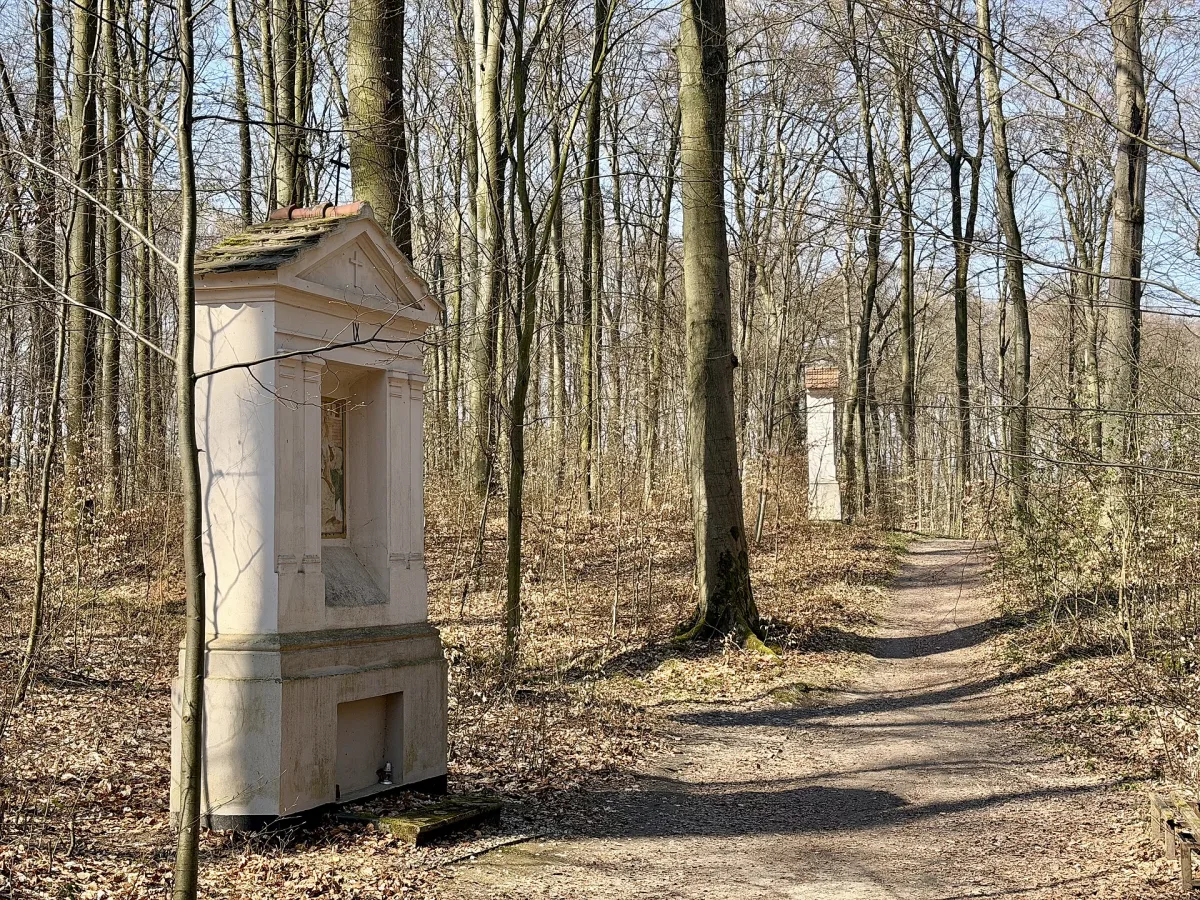
The network of pilgrimage sites in Lower Silesia does not end with Bardo and Wambierzyce. In Trzebnica there is the Sanctuary of St Hedwig with the tomb of St Hedwig of Silesia, and next to it the Trzebnica Calvary: sixteen Baroque Stations of the Cross chapels founded by the Cistercian nuns in 1734. In the Kamienne Mountains, in Lubawka, a more modest Lubawka Calvary on Świeta Góra has survived: six chapels and a Way of the Cross from the turn of the 18th and 19th centuries, today partly falling into ruin. In Wałbrzych there is also the Sanctuary of the Relic of the True Cross, a much younger foundation, consecrated only in 2000. The Bardo Mountains themselves hold one more trace of old-time devotion: the Bardo Calvary, thirteen Redemptorist chapels spread over a distance of 1,740 metres, and Rosary Hill with rosary chapels along the old pilgrim road.
What pilgrimages look like today
After 1945, care of the sanctuary in Wambierzyce was taken over by Franciscan friars, who consolidated its role as a Polish pilgrimage centre, though for centuries before that the Silesian Jerusalem had drawn pilgrims from Poland, Bohemia and Germany alike. Today, people make the pilgrimage to Bardo and Wambierzyce both on foot, in organised parish groups setting out from nearby towns and villages, and by coach or car: the sanctuaries combine a religious function with a tourist one, and visitors take in both the interiors of the basilicas and the Calvary chapels scattered across the surrounding hills.
Be the first! Add a comment.
You need to log in to add a comment.
Log in