
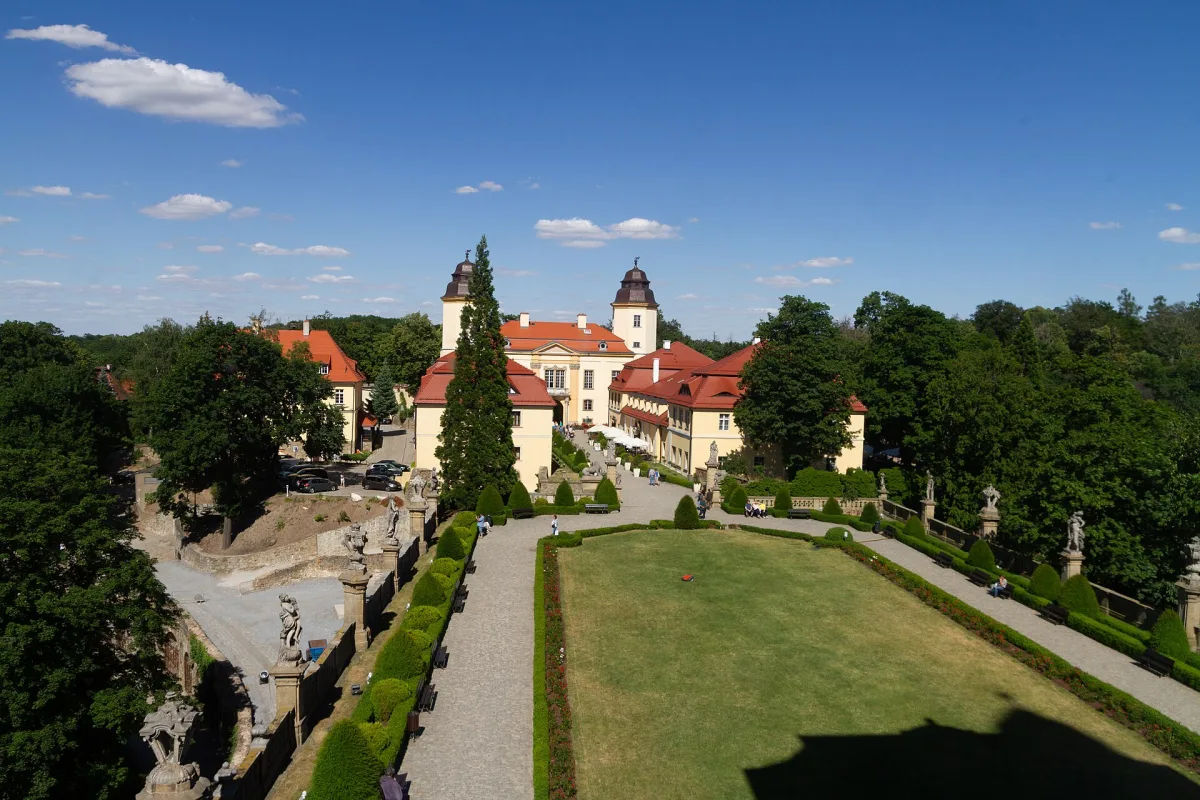
Lower Silesia has more castles and strongholds than any other region of Poland, the result of centuries of Piast dynastic divisions, later Silesian-Bohemian disputes and the Prussian expansion of border fortifications. Some of the sites are now museums with a full visiting offer, some function as hotels within historic walls, and a good many have survived only as stone ruins on mountain summits, to be seen only from the outside.
Grand residences open to visitors
The largest and most extensive building in the region is Książ in Wałbrzych, the third-largest castle in Poland after Malbork and Wawel, covering around 42,840 square metres. It arose on the site of a wooden stronghold between 1288 and 1292 and stands on the Piast Castles Trail. A visit takes in the representative interiors as well as tunnels from the Second World War, cut into the rock beneath the castle.
A visit of similar scale is offered by Kłodzko Fortress, an extensive system of fortifications built in stages from the Middle Ages up to the 18th century. The first wooden fortifications on this site existed as early as before 1114, and the fortress owes its present shape partly to work carried out between 1690 and 1702 under the direction of Jacopo Carove. Today it is a museum where visitors can tour the surface bastions and kilometres of underground counter-mine corridors.
Above the Bystrzyckie Lake, on the summit of Góra Choina in the Wałbrzych Mountains, stands Grodno Castle. Its Gothic walls are dated to the second half of the 14th century, and the building is attributed to Duke Bolko I of Świdnica-Jawor. The site today operates as a museum with an inn and a hotel, and the view of the reservoir from the castle walls is one of the most recognisable landscapes in the region.
Wojnowice Castle near Wrocław has a different character: a Gothic-Renaissance moated castle, one of the few defensive knightly residences of this type in Poland. Its origins date back to the mid-14th century, and in the 16th century Jakub Boner transformed the former stronghold into a Renaissance residence for his wife Lukrecja. Today the castle is open to visitors and houses a restaurant and hotel rooms.
Ruined strongholds on tourist trails
Far more of Lower Silesia's castles have survived only as ruins, reached by hiking trails. The best known of them is Chojnik Castle, on the summit of the mountain of the same name in the Karkonosze (Giant Mountains), at an altitude of 627 metres, within the strict protection zone of the Karkonosze National Park. The stronghold was built in the 1350s, and on its south-eastern side a 150-metre cliff drops away into the Piekielna Valley. The castle walls, though without a roof, can be explored from the inside.
In the Rudawy Janowickie, on a granite rock outcrop, stands Bolczów Castle, dated to 1375 and attributed to Clericus Bolze, a courtier of Duke Bolko II. After destruction in fighting with the Hussites, the stronghold was rebuilt in 1517-1518, and in the 19th century the ruins were converted into an inn - today it is a popular stop on trails around Janowice Wielkie.
In the Suche Mountains, on a hill 870 metres high, lie the ruins of Rogowiec Castle. The first wooden stronghold here was built in the 12th century by Duke Bolesław the Tall, and the stone castle was built around 1292 by Bolko I of Świdnica - the upper castle had a shape close to a triangle, with walls up to 3.6 metres thick.
Above the Polskie Wrota pass, in the municipality of Lewin Kłodzki, rise the stone ruins of Homole Castle from the 13th century - a site with no surviving interiors, whose remains can only be viewed from the outside, from the road leading up to the Gomoła hill.
Castles above river gorges
Several of Lower Silesia's strongholds were built where rivers cut through mountain ranges, which made them natural defensive points. Above the Leśniańskie Reservoir on the Kwisa river, on the gneiss rocks of the Izera Mountains, stands Czocha Castle, a former border stronghold on the Silesian-Lusatian border. After 1392 it came within the borders of the Polish Crown, and today it functions as a hotel and conference centre with a visiting route through the oldest parts of the walls.
Above the Bóbr river, on Góra Zamkowa near Wleń, lies Wleń Castle, regarded as the oldest brick-and-stone castle in Poland and one of the few built in the Romanesque style. It was built at the end of the 12th century on the initiative of Bolesław the Tall, on the site of an earlier timber-and-earth stronghold raised to the rank of castellany as early as 1108. Duke Henry the Bearded and his wife Hedwig, later the patron saint of Silesia, often stayed at the castle. Today it is a permanent ruin, open to visitors.
Above the Kwisa river, in the village of Kliczków in Bolesławiec County, stands Kliczków Castle. It was built between 1291 and 1297 as a border stronghold of Bolko I the Strict, meant to defend against invasions from Bohemia, and over time it changed from a fortress into a residence. Today it operates as a hotel, but its historic interiors and courtyard can be visited.
Piast strongholds in the heart of cities
Not all the region's castles have to be sought in the mountains: several stand in the centres of Lower Silesian towns. Piast Castle in Legnica is among the oldest castles in Poland: it was built by Duke Bolesław I the Tall in the second half of the 12th century and extended by Henry the Bearded in the 13th century. The site has opened up the remains of the Romanesque chapel of St Benedict and St Lawrence, discovered during archaeological work, as well as a Gothic tower.
In Oleśnica, on Zamkowa Street, stands the Ducal Castle, also known as the Castle of the Dukes of Oleśnica, a Renaissance building erected on the site of a Gothic stronghold from the 13th century. The defensive stronghold of the Piasts of Oleśnica was first mentioned in 1239, and the castle's golden age fell in the time of the descendants of the Bohemian king George of Poděbrady. It now houses the headquarters of the Voluntary Labour Corps, and the facades with their sgraffito decoration can be viewed from the outside and in part from within.
Fortresses and artificial ruins
A separate category of Lower Silesian fortifications is formed by the modern-era Prussian fortresses. The Srebrna Góra Fortress near Srebrna Góra was built between 1765 and 1777 on the pass leading from the Bohemian side of the Sudetes into Lower Silesia, and was meant to defend the Silesia captured by Prussia against an attempt by Austria to retake it. The design was drawn up by the engineer Ludwig Wilhelm Regeler, with corrections made personally by King Frederick the Great. The fortress consists of six forts on two hills and is one of the largest military sites in the region.
Stary Książ Castle in Wałbrzych has a completely different character - a separate site from the nearby Książ, although the two places are historically and visually linked. A settlement already existed on this site in the second half of the 9th and 10th centuries, and at the end of the 13th century Bolko I the Strict built a stone defensive castle here, to which he moved his seat in 1290. After being destroyed in 1484, the ruins were adapted in the 19th century as a romantic viewpoint for the neighbouring Książ castle - it is a picturesque ruin to be viewed from the outside, not a site with a full visiting route.
This variety, from the representative interiors of Książ to the stone walls of Homole visible only from the road, shows that Lower Silesia offers castle visits for every level of difficulty: from guided walks around courtyards to all-day expeditions along mountain trails to ruins hidden in forests.
Be the first! Add a comment.
You need to log in to add a comment.
Log in