
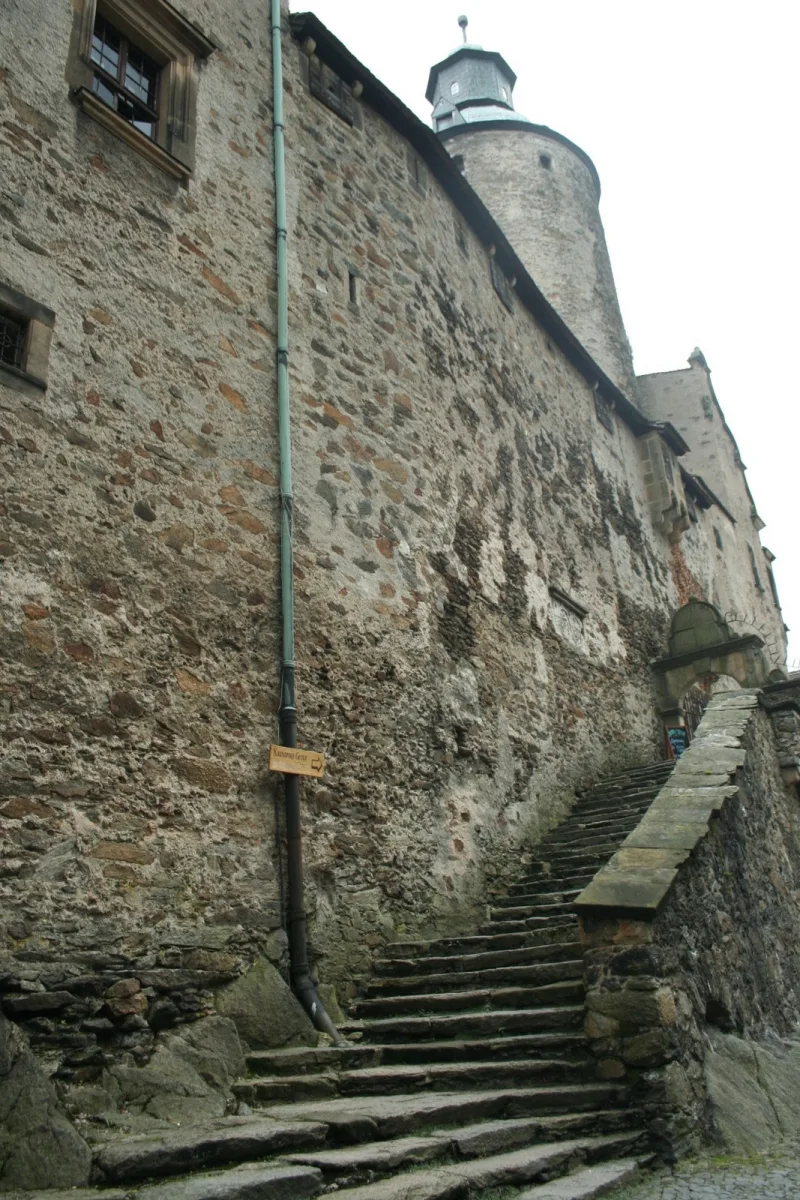
Above the Leśniańskie Reservoir, on gneiss rocks over the Kwisa river, stands one of the most written-about castles in Lower Silesia. Czocha Castle has seven centuries of history behind it, but it is the hundred years since its great rebuilding and the war years of the twentieth century that have become overgrown with stories that are hard to separate from facts. We check what is known for certain about Czocha and what is only a repeated legend.
A border stronghold and a rebuilding from a hundred years ago
The castle was built between 1241 and 1247 as a stronghold defending the Silesian-Lusatian border, on the orders of the Silesian Piasts or of the Czech king Wenceslaus I Přemyslid. The oldest part of the building is the keep by the main gates, around which a residential section was later added. Over the following centuries the castle changed hands many times: in 1253 it was captured by the Margraviate of Brandenburg and handed to the Bishop of Meissen, in 1319 it passed to the Duchy of Jawor, and in 1346 it was taken over by Bolko II the Small. In the early 15th century the Hussites besieged it without success, although in 1427 a unit led by Czirnin briefly captured it before the stronghold was retaken. From 1451 to 1700 the castle belonged to the Lusatian von Nostitz family.
In the 19th century Czocha fell into decline. The Upper Silesian educator Józef Lompa, in a geography textbook from 1847, described it as a ruined castle. This changed in 1909, when the stronghold was bought for 1.5 million marks by the Dresden cigar manufacturer Ernst Gütschow. Between 1912 and 1920 he carried out a major rebuilding, led by the Berlin architect Bodo Ebhardt, based on an engraving of the castle from 1703. The rebuilding gave Czocha its present, picturesque shape, but cost the destruction of many medieval fragments of the walls. Gütschow, who maintained contacts with the tsarist court and, after the Russian Revolution, bought works of art from Russian emigres, lived at the castle until March 1945.
The castle's wartime role: what is known and what cannot be confirmed
Among the stories told about Czocha, the most recurring one is that of a secret cipher school of the Abwehr, German military intelligence, said to have operated at the castle during the Second World War. This account is repeated in many popular texts about the castle, but without documents that would confirm it conclusively. Even material repeating this version notes that there is no hard evidence for it, that it is tradition, not an established fact.
Linked to the same period is a second, even looser hypothesis: that the extensive, multi-level cellars and corridors beneath the castle may have served the Third Reich for work on the so-called wonder weapon, the Wunderwaffe. This, too, remains in the realm of speculation, formulated in a conditional mode rather than as confirmed archival sources. What is certain, however, is that Gütschow himself did not leave the castle until March 1945, leaving behind some of its valuable furnishings, which in itself neither confirms nor rules out any of the military functions attributed to Czocha in this period.
The trapdoor bed and the real secret passages
The most colourful of the legends circulating around the castle is the story of the bed with a trapdoor, said to have stood in the Princely Chamber. According to the account, the castle's owner used it to get rid of unfaithful lovers: the bed was said to collapse beneath them, dropping the victim deep into the building. This is a legend in its pure form, with no historical confirmation whatsoever, repeated today mainly during guided tours and in texts about the castle's dark secrets.
Alongside this story, however, there is something that is not a legend: a network of genuine secret passages and corridors, said to number around forty beneath the castle and within its walls. To this day it is not known whether all of them have been found and documented - this is one of the few threads where fact and legend meet, because the extensive, still not fully explored underground system really does exist, and it is probably this that feeds the stories about the castle's secret wartime functions. A separate legend, well known in Lower Silesia, is the figure of the White Lady, identified with Gertrude, an alleged traitor from the time of the Hussite wars - this thread, however, is described more fully in connection with other Lower Silesian castle ghosts, and here it is enough to note that it, too, remains only an account, not an established history.
Soviet plunder and a secret military facility
After the war the castle came within Poland's borders, but before it became accessible to tourists it went through decades in which it was repeatedly stripped of furniture and furnishings by Soviet troops. Part of the collections gathered there went for restitution to Jelenia Góra, and from there to Warsaw. A story that circulated for a long time, that the castle's holdings were embezzled on 1 February 1946 by the then mayor of Leśna, was later disproved: it was established that the removed icons indeed went to Jelenia Góra, not into private hands.
From 1952 a Military Holiday Home operated at the castle. Throughout the years of the People's Republic of Poland (PRL), the site was subject to such strict military secrecy that it did not even appear on publicly available maps. Only from September 1996 did Czocha become publicly accessible as a hotel and conference centre, and today it is managed by AMW Rewita, a company belonging to the Military Property Agency. During winter and summer school holidays, themed camps for children and young people are organised here.
The castle on screen: Czocha as a film set
Czocha's picturesque walls and courtyards have repeatedly served as a film set. Films shot here include "Where Is the General?" (Polish: "Gdzie jest generał?"), "Valley of Happiness" ("Dolina szczęścia"), "The Witcher" ("Wiedźmin"), "Legend" from 2005, "Beyond Sherwood Forest" ("Poza Lasem Sherwood") from 2009 and "Factory of Evil" ("Fabryka Zła"), as well as the TV series "The Secret of the Fortress of Ciphers" ("Tajemnica twierdzy szyfrów"), "Two Worlds" ("Dwa światy"), "Holy War" ("Święta wojna") and "First Love" ("Pierwsza miłość"). The very title of the series about the fortress of ciphers shows, in fact, how firmly the Abwehr legend has already entered popular culture, regardless of whether it has full backing in historical sources.
Visiting Czocha today
The castle offers guided tours during the day, as well as a separate, night-time tour of the building's darkest corners. The programme includes multimedia torture chambers and a route leading through fragments of secret passages and corridors, about which legend says more than can be confirmed today. In summer, from June to September, the courtyards and the castle tower are additionally open. Every year the castle also hosts the Knights' Stronghold festival, when for a few days Czocha turns into a medieval settlement, where re-enactors teach how to build catapults and fight with swords, and the highlight is a staged battle for the castle.
Be the first! Add a comment.
You need to log in to add a comment.
Log in