
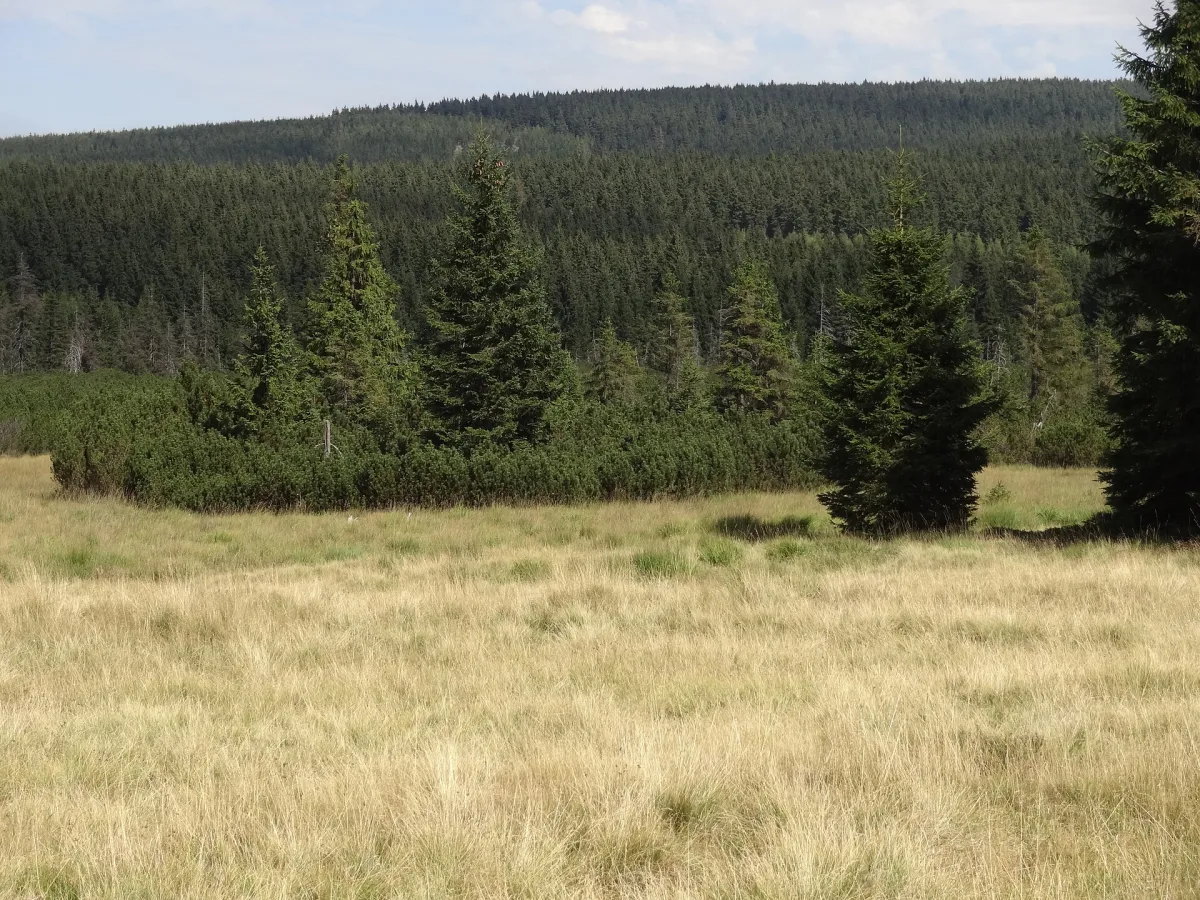
Peat bogs and the Izera plateau
The heart of the Izera Mountains is not rocky ridges but a wide, flat plateau covered with peat bogs. The Izera Valley Peat Bogs nature reserve protects a fragment of the Izera Plateau, where the peat layers are as much as 11,000 years old. The highest point of this part of the mountains is Wysoka Kopa, treeless since the ecological disaster of the 1980s. Along the route across the plateau it is worth making a detour to Poidło, a small waterfall on the Wodopój stream.
Świeradów-Zdrój - spa architecture
Today's Świeradów-Zdrój was first recorded in 1524 under the name Fegebeutel, and the name Flinsberg was used from 1559 until 1945. The heart of the resort is the Spa Park, with a larch promenade hall, the longest structure of its kind in Lower Silesia, and the Spa House from 1899. In front of the building stands a monument to a little frog, commemorating the legend of a Berlin physician, Leonhard Thurneysser, who found a dead frog in one of the springs.
Above the town rises a wooden viewing tower on Czerniawska Kopa, built on the site of a prewar predecessor, and in a former watermill operates the Devil's Mill, with an over a hundred-year-old, still-working bread oven. The radioactivity of Świeradów's springs was discovered in 1933 by engineer Schmidt, who was then mayor of Bad Flinsberg.
Szklarska Poręba and skiing traditions
The western edge of the Izera Mountains runs straight down to Szklarska Poręba, from where a cable car goes up to Szrenica, a Karkonosze peak with a mountain hostel from the 1920s and a viewpoint over the Jelenia Góra Valley and the Izera Mountains. In the town, the first ski club on the Silesian side of the mountains, Windsbraut, was already active in 1900, giving rise to a tradition of winter sports that continues today all the way to the Piast Race, held every February on the nearby Jakuszyce Meadow since 1976 - the event has been cancelled only once, during martial law. In the lower part of the town it is also worth seeing the Kamieńczyk Waterfall, dropping 27 metres in a rocky gorge and considered the highest waterfall in the Polish Sudetes.
The extinct volcanoes of the Kaczawskie Foothills
East of Złotoryja the landscape turns into the Land of Extinct Volcanoes, added to the UNESCO list in 2024 as Poland's third geopark. Its symbol is the Wielisław Organs, a wall of solidified lava over 35 metres high, formed in a volcanic vent into columns resembling organ pipes. Above Wojcieszów rises Góra Połom, a 667-metre peak of the Kaczawskie Mountains, and next to it the Góra Miłek nature reserve on a limestone hill - the only natural habitat of the European cyclamen in Poland.
Gold, caves and mines
Złotoryja took its name from gold, which in the Middle Ages was mined here at a rate of nearly 50 kilograms a year, before the deposits were exhausted in the mid-13th century. Today the former workings house the Aurelia Gold Mine, an underground gallery open to visitors since 1973, with troughs for panning gold by hand, and the town also has the Gold Museum, with the Leopold Schmeterling collection, built into the old defensive walls. A local legend links the name of the Aurelia adit to a miner who stayed underground too long to earn money for his daughter Aurelia's First Communion, and never came back out. Every year, in the last week of May, the Polish Gold Panning Championships are held here.
The portal writes separately about the Walloons, seekers of precious stones who worked these mountains from the Middle Ages onward, and the glassworks they left behind. Traces of former mining can also be seen in the rocks above Jelenia Góra - on Chojnik, a mountain with caves and five marked trails leading to the castle ruins on its summit.
Jelenia Góra as a base
The Jelenia Góra Valley lies within a single day's reach of the Izera, Kaczawskie and Karkonosze ranges all at once, making it a natural base for excursions. The Natural History Museum displays the natural history collection of the Schaffgotsch family, gathered since the 16th century in a former post-Cistercian provostry, and after a full day's hike visitors can relax at the Cieplice Thermal Baths, with pools ranging from 27 to 36 degrees and a salt cave. The castles above the Kaczawa river and the glassworks of the Izera Mountains already have their own descriptions on the portal - good places to start planning a route deeper into both ranges.
Be the first! Add a comment.
You need to log in to add a comment.
Log in