
Why the region has so many Jewish burial grounds
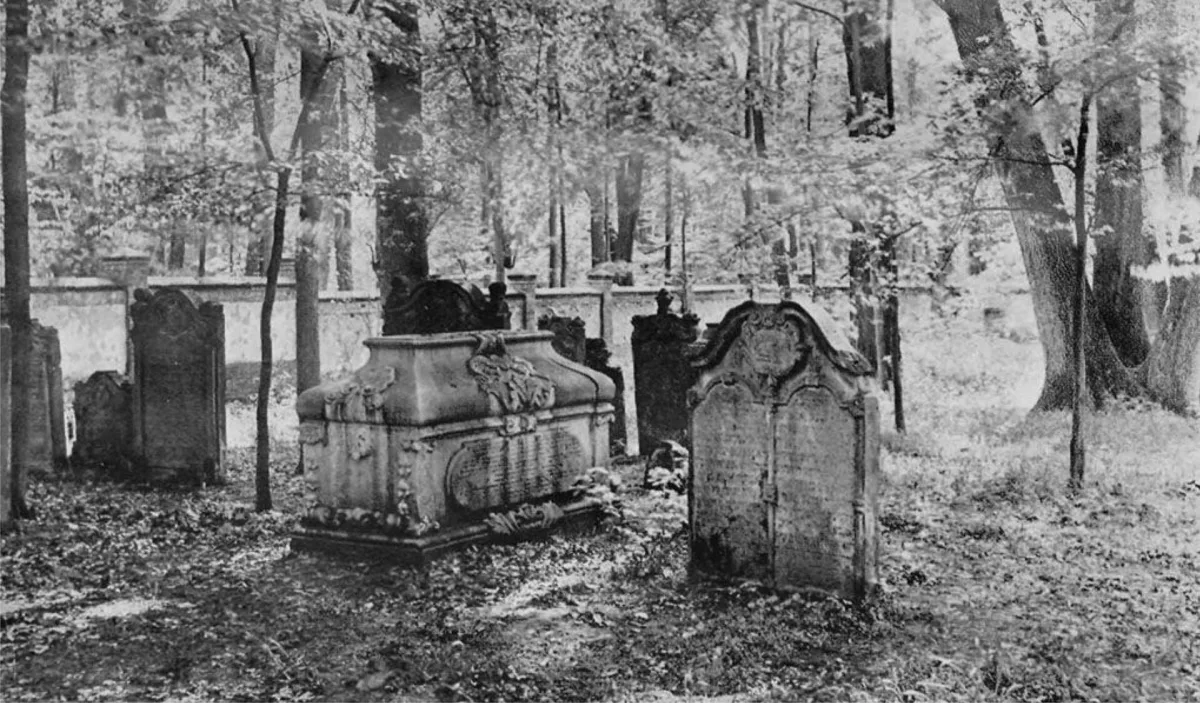
Lower Silesia today has several dozen Jewish cemeteries within its borders - some turned into memorial sites with no trace of a grave left, others preserved with dozens or hundreds of headstones. Each one was established by a separate, local religious community: merchants and craftsmen settling in a given town first organised a synagogue and a burial brotherhood (chevra kadisha), then bought land for a cemetery. The founding dates span several centuries: the cemetery in Brzeg Dolny was established as early as 1689, the one in Twardogóra in 1751, the one in Syców in the 17th century, but most of the region's cemeteries were founded only in the first half of the 19th century - in Strzelin in 1815, in Lwówek Śląski in 1815, in Dzierżoniów in 1825, in Bolesławiec in 1817, in Milicz in 1819. The youngest cemeteries were opened only at the turn of the 19th and 20th centuries, when town communities were growing and the old cemeteries could no longer hold new generations.
Wrocław, as the regional capital and the seat of the largest community, had two successive burial grounds: the Old Jewish Cemetery on Ślężna Street, opened in 1856, and the New Jewish Cemetery on Lotnicza Street from 1902, which still belongs to the Jewish Religious Community of Wrocław today and still accepts burials.
War and postwar closures
The fates of the region's individual cemeteries diverged in two directions, depending on what happened in November 1938 and in the following decades. During Kristallnacht, the Jewish cemetery in Brzeg Dolny was devastated so thoroughly that not a single intact headstone survives there today - only fragments of matzevot and grave surrounds remain. Some cemeteries, such as the ones in Bierutów or Duszniki-Zdrój, survived the Third Reich period intact, and the destruction came only after the war: in Bierutów the devastation was carried out by the local Polish population shortly after 1945, even though the site was entered into the heritage register in 1990 anyway.
The second wave of disappearances came in the 1960s and 1970s, when the authorities of the Polish People's Republic liquidated cemeteries to make way for new development. The cemetery in Złotoryja was closed in 1973, the cemetery in Bolesławiec was dismantled in 1963-1965 - at the time of its liquidation there were still 128 graves on a plot of under a thousand square metres, and the surviving matzevot were moved in the early 1970s to the local municipal cemetery. In Lwówek Śląski, the site of the former cemetery, already sold to a local gardener during the war, was "completely ruined" in March 1968 - today only single stone fragments lie in the town park, with no commemorative plaque. The cemeteries in Ząbkowice Śląskie and Milicz were built over directly with blocks of flats and houses. Where a burial ground has physically survived to our times, it was usually because the authorities incorporated it into the grounds of an active municipal cemetery (as in Szczawno-Zdrój or Świebodzice), or because the site was simply left aside, overgrown and undeveloped.
How to read the matzevot
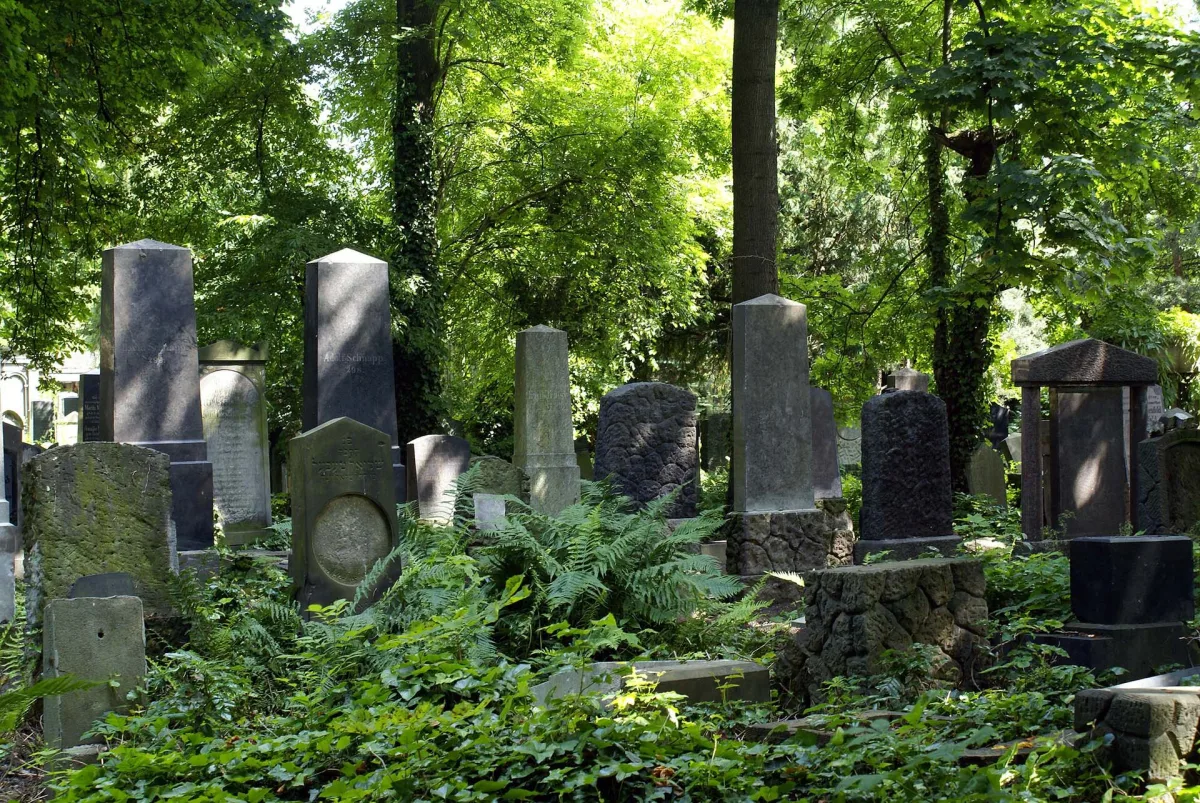
The headstones in Lower Silesia's Jewish cemeteries, where they have survived, can be partly read even without knowledge of Hebrew - it is enough to know a few recurring motifs. Hands arranged in a gesture of blessing mean the deceased came from a family of kohanim, priests. A jug pouring out water is the sign of a Levite, an assistant to the priests during purification rites. A lion symbolises strength and can be a reference to the name Jehuda or Arie, a crown denotes a good name, and a broken tree or a candle extinguished halfway are symbols of premature death. At the Old Jewish Cemetery in Wrocław, these traditional, austere forms of matzevot gradually gave way to monumental family tombs drawing on the architectural styles of their time - from classicism to Moorish, Egyptian and Art Nouveau motifs.
In Judaism a grave itself is inviolable for as long as its location is known - exhumation is permitted only in a few strictly defined situations, for example when remains are moved to the Holy Land or when a grave faces imminent destruction. That is why even liquidated cemeteries, now built over, remain marked in the sources as burial sites, not as ordinary plots of land.
The region's cemeteries - an overview
In Lower Silesia, Jewish cemeteries have survived in very different states - from ones where hundreds of headstones still stand, to ones where no trace remains in the landscape at all. The Jewish cemetery in Dzierżoniów, established in 1825 on a triangular plot, has around 250 surviving headstones, the oldest of which dates from 1838 - it is one of the better preserved cemeteries in the region. Similarly, the cemetery in Świebodzice, walled off within the grounds of the municipal cemetery and put in order in 1998, has several surviving, though damaged, headstones.
At the opposite end are places where the cemetery exists only as a point on a map: in Złotoryja, in Milicz and in Ząbkowice Śląskie not a single headstone has survived, and the site is now occupied by houses or housing estates. In between are burial grounds with a handful of surviving matzevot: Lubań has ten, Bielawa three, Mieroszów three legible ones from 1946-1948. Jelenia Góra had two further cemeteries - an older one, today with no trace left, and a newer one from 1879, mostly built over by a hotel. A separate case is Zgorzelec, where a traditional cemetery with matzevot never existed on the Polish side at all - the community's actual cemetery lay in German Görlitz, and on the Polish side only a mass grave of Jewish prisoners from Stalag VIII A has survived. The cemetery in Bierutów, though without a single surviving matzeva, has kept its brick wall instead and has been listed on the heritage register since 1990.
Who cares for them today
The active New Jewish Cemetery in Wrocław on Lotnicza Street belongs to the Jewish Religious Community of Wrocław, which is responsible for it. The fate of the smaller, long-closed cemeteries tends to be more scattered: some, as in Chojnów, passed into municipal ownership after the war, while some remain formally the property of the Union of Jewish Religious Communities in Poland. On its behalf, care for the cemeteries scattered far from large communities is organised by the Foundation for the Preservation of Jewish Heritage - in Lower Silesia it supports the conservation of cemeteries in Kłodzko, Strzegom and Ziębice. Where a burial ground is part of an active municipal cemetery, as in Szczawno-Zdrój or Świebodzice, routine upkeep in practice falls to the municipal administration.
Rules worth following when visiting
A Jewish cemetery is a burial site, not a viewpoint, and Judaism sets specific requirements for visitors. Men enter the cemetery grounds with their heads covered - an ordinary cap or hood is enough. Headstones must not be touched or sat on, and visitors must not walk over graves outside the marked paths - where the ground is overgrown and unmarked, as in many of the places described here, this simply means caution and keeping to the visible paths. Instead of flowers, a pebble is left on the grave, a custom rooted in the tradition of marking a grave with a lasting, non-withering trace of a visit. Silence is kept at a cemetery, fitting for a place where the remains of the dead still rest, even if two hundred years have passed since the burial.
Be the first! Add a comment.
You need to log in to add a comment.
Log in