
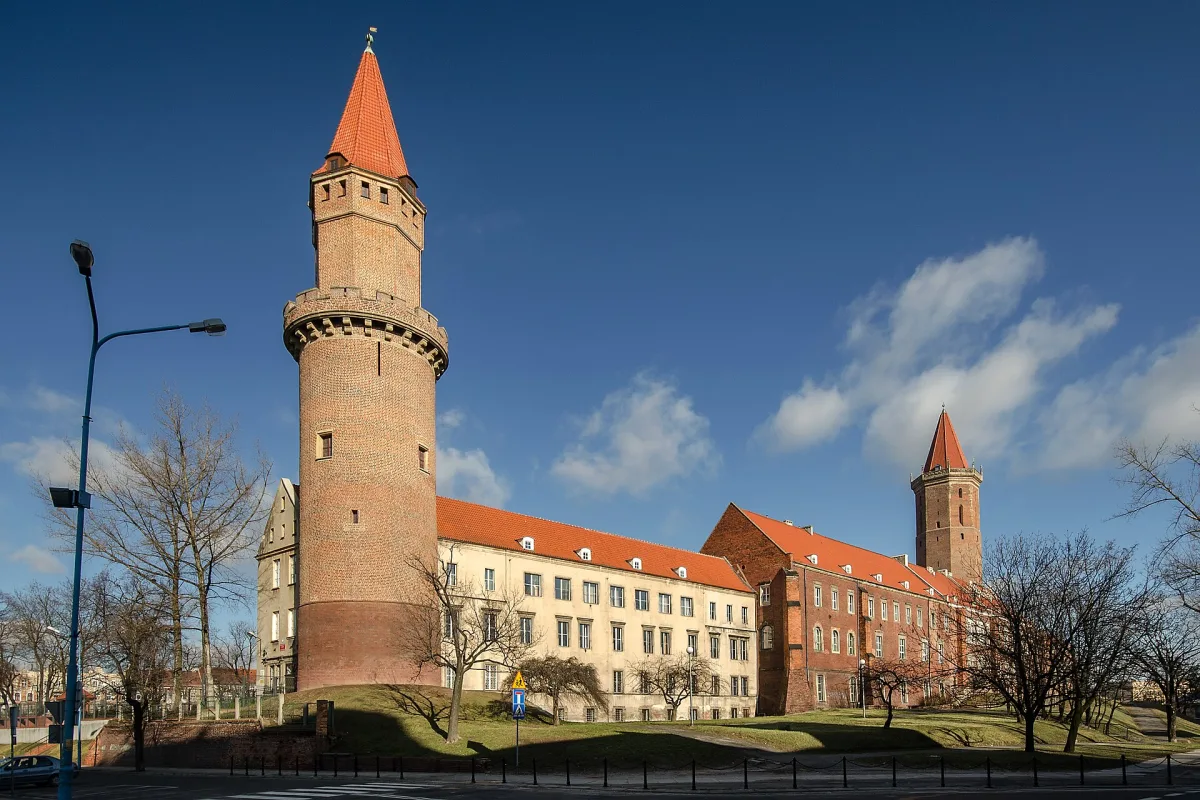
Legnica - City of the Silesian Piasts
Legnica has one of the oldest castles in Poland. The Piast Castle was built in the second half of the 12th century by Duke Bolesław I the Tall, and in the first half of the 13th century it was extended by Henry the Bearded. To this day it retains relics of the Romanesque chapel of St Benedict and St Lawrence and Gothic towers, even though the building itself lay in ruins to the extent of nearly seventy per cent in May 1945 and was not rebuilt until the 1960s and 1970s. A little further on, on Cathedral Square, stands the Cathedral of the Holy Apostles Peter and Paul - a Gothic, twin-towered building whose present form took shape between 1333 and 1380, with a surviving west portal decorated with a Gothic statue of the Mother of God.
The last chapter of the Legnica line of the Piasts is commemorated by the Mausoleum of the Silesian Piasts by the Church of St John the Baptist - the first Baroque burial chapel in Silesia, built between 1677 and 1679 for the last representatives of the dukes of Legnica-Brzeg. On the Market Square it is worth noting the Herring Houses, eight buildings put up on the site of former herring stalls, two of which, at numbers 54 and 55, are decorated with Renaissance sgraffiti from around 1570 depicting the coat of arms of the Duchy of Legnica.
Museums of Legnica
Legnica is the only city in Poland with a museum devoted entirely to copper. The Copper Museum is housed in a Baroque building that was once the residence of the abbots of Lubiąż, dating from 1728, and the institution was founded in 1962. It combines two roles: showing the history of copper mining and processing in the region and documenting the history of Legnica itself. The city also has a more recent chapter of its history, linked to the post-war stationing of Soviet troops and the nickname Little Moscow - the portal covers this topic separately, so here it is enough just to mention it.
Legnickie Pole - Site of the 1241 Battle
A dozen or so kilometres from Legnica lies Legnickie Pole, where on 9 April 1241 the forces of Henry II the Pious clashed with the Mongol invasion - an event the portal has already covered separately, so here only a brief reminder. At the spot where, according to tradition, the body of the fallen duke was found, a monastic complex gradually grew up, and since 1961 part of it has housed the Museum of the Battle of Legnica, located in the Gothic, former Benedictine church dedicated to the Holy Trinity and the Blessed Virgin Mary. The exhibition shows the weaponry of the period and the historical background of the clash, and Legnickie Pole itself remains the main site of remembrance for the battle, even though some researchers today point to a different, more precise location for the battlefield.
Głogów - Piast Stronghold on the Oder
Głogów, like Legnica, has a Piast castle by the river. The Castle of the Dukes of Głogów was built in the second half of the 13th century by Duke Konrad I, who used it to control a ford across the Oder. After a fire in 1291 his successor Henry III extended the fortification with a rectangular wall, and in the following centuries the castle even hosted kings of Poland - in 1462 Casimir IV Jagiellon stayed here. Today the walls house the Museum of Archaeology and History. Nearby, on the same spot since the end of the 13th century, stands the Town Hall, which after fires in 1420, 1433 and, above all, 1574 was rebuilt in the Renaissance style - its tower is counted today among the tallest town hall towers in Silesia.
Crossing the Oder and linking the Old Town with Ostrów Tumski is the Bridge of Tolerance, a structure from 1917 previously known as the Pink Bridge - it has carried its current name since 2005. From the bridge you can see the silhouette of the castle on one side and the roofs of Ostrów Tumski on the other, where the Głogów collegiate church, one of the more important churches in the region, still stands today - its history deserves a separate, more detailed account. Similarly brief mention is due to the Baroque Star Fort, built in the mid-18th century on the initiative of Frederick the Great as part of a system of fortifications which, in 1944, Berlin turned into the fortress of Festung Glogau - the defence of the city, waged against a hopeless situation, ended in 1945 with the destruction of about 95 per cent of the built-up area. The portal has also covered this dramatic episode in a separate article.
Chojnów - a Town on the Via Regia
Chojnów lay on the border of the duchies of Legnica and Głogów, guarding the Via Regia trade route running from Germany to Ruthenia - a castle here is already mentioned in records from 1292-1293. After being captured and burned during the Hussite Wars in 1428, the building was rebuilt in Renaissance style in 1546-1547 on the orders of Duke Frederick III, to a design by the Italian architect Francesco Parr. Today the castle walls house the Regional Museum, whose history goes back to 1903 - it originally operated in the Weavers' Tower, a Gothic defensive tower from the 15th century, before moving to the castle in 1933.
Jawor - a UNESCO-listed Church and a Gingerbread Museum
Jawor is one of three sites in Lower Silesia inscribed on the UNESCO World Heritage List. The Church of Peace, timber-framed and built of wood, was erected in 1654-1656 under the terms of the Peace of Westphalia, which allowed Silesian Protestants to build churches outside town walls, using only impermanent materials: wood, straw and clay. It has almost 1,180 square metres of floor space, which, together with the twin church in Świdnica, makes the two buildings the largest timber-framed sacred structures in the world.
In the centre of the town also stands the Castle, a Piast ducal seat from the 13th century, which from 1278 was the main residence of Duke Bolko I the Strict, and in the 18th and 19th centuries served as a prison, in use until as late as 1956 - during the Second World War it housed a harsh Gestapo prison for women. The history of the town and the region is shown by the Regional Museum, operating since 1929 in a former post-Bernardine monastery complex, with an exhibition devoted to traditional Jawor gingerbread and the Baroque Bremen Treasure.
Lubin - Capital of the Copper Basin
Lubin owes its modern growth to the discovery of a copper deposit in 1957 by a team led by geologist Jan Wyżykowski - one of the largest deposits of this metal in the world. The history of the town, from the Middle Ages to the twentieth century, is shown by the Historical Museum, an unusual institution with four branches scattered around the town. The main one is the historic Town Hall on the Market Square, where, besides an exhibition on everyday life of residents in the 20th century, there is also a display devoted to the Lubin Massacre of August 1982 - one of the most dramatic events of martial law in Lower Silesia. The museum is visited by around 360,000 people a year, making it one of the most frequently visited cultural institutions in the region.
How to Plan a Trip Between Legnica and Głogów
Legnica and Głogów are less than fifty kilometres apart, and along the way, between them, lie Chojnów and Legnickie Pole - the route is suitable for a day trip by car, or a two-day trip with an overnight stay in one of the towns. Jawor and Lubin call for separate excursions, as they lie on opposite sides of this corridor - Jawor south of Legnica, towards the Sudetes, Lubin to the north-west, towards Głogów. Both towns are better combined with a wider tour of the region than squeezed into one day together with Legnica, because each of them has a programme dense enough - a castle, a museum, a church or a tower - that there is no point rushing.
Be the first! Add a comment.
You need to log in to add a comment.
Log in