
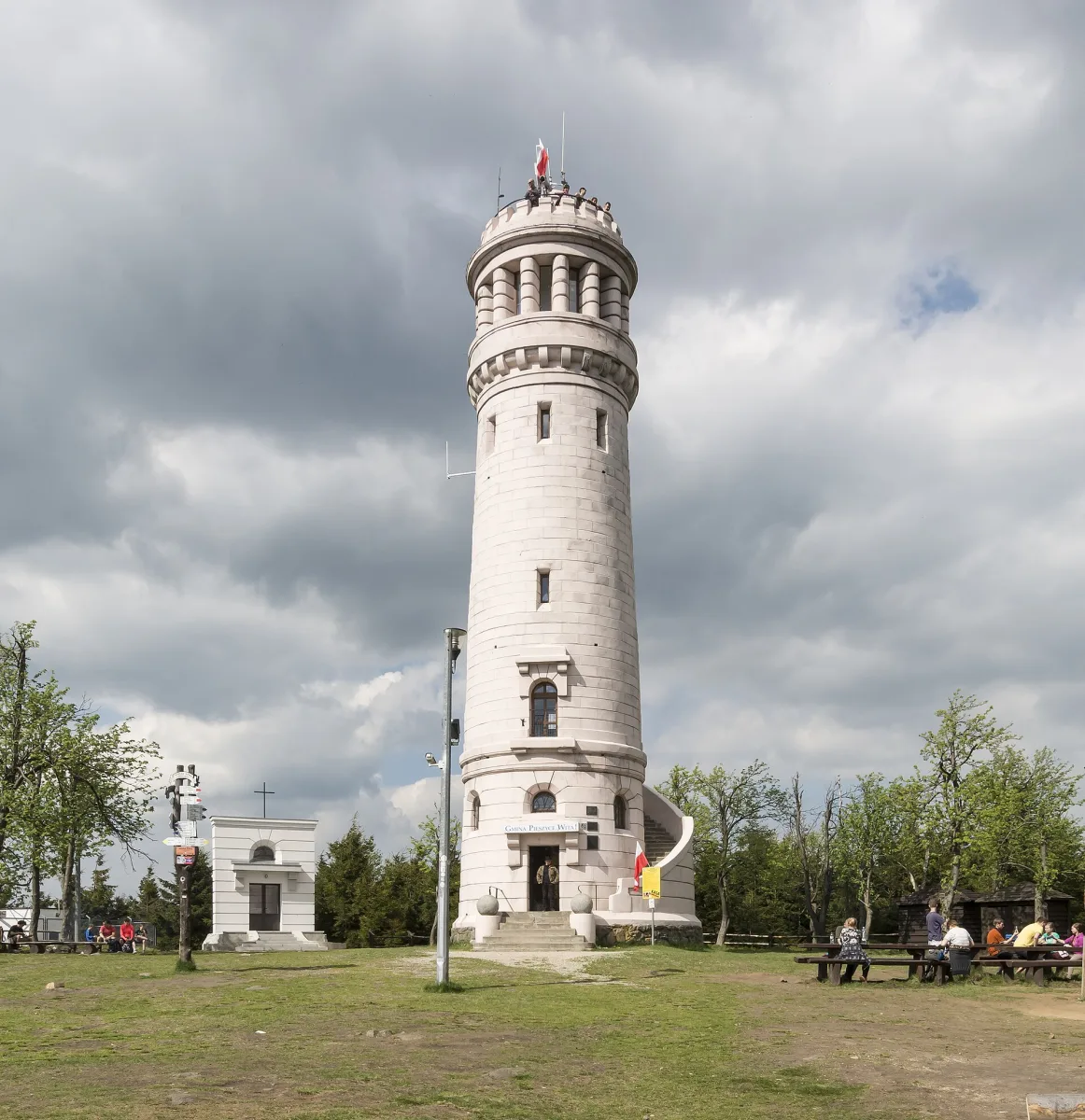
Wielka Sowa and the viewing tower
The highest peak of the Owl Mountains is crowned by the viewing tower on Wielka Sowa. The first, wooden structure was put up here in 1885 by a carpenter from Walim named Heubner, and it opened a year later. The current, 25-metre tower made of local gneiss was built in 1905-1906 and replaced that first structure. The name of the Owl Mountains (Góry Sowie) is linked to the folk belief that owls were the guardians of these peaks, which is why a wooden sculpture of three owls, the work of Stanisław Taraszczuk, stands at the summit.
Nearby, in the massif of Włodarz, lie hidden the tunnels of an unfinished German complex from the Second World War - the portal writes about the Riese project itself separately. On the other side of the valley rises Borowa, the highest peak of the Wałbrzych Mountains, built of volcanic rhyolites, with a newer openwork viewing tower in the shape of a hyperboloid, where the viewing platform stands at a height of 15.3 metres.
Wałbrzych returns to the surface
The portal describes the history of the Wałbrzych Coal Basin and its more than four centuries of coal mining in a separate article. It is worth seeing its traces with your own eyes, though. In the former Julia mine, the Stara Kopalnia Centre for Science and Art now operates, with an underground route, a former bathhouse and winding machines from 1911. The last wagon of coal left here on 20 September 1996, ending more than a century of mining at this site.
A completely different kind of interior is hidden in the Palmiarnia (Palm House) in Wałbrzych, a 20th-century winter garden whose walls were built from volcanic tuff brought from Etna, with over 250 plant species under a glass roof.
Książ Castle and the palaces in its shadow
The third-largest castle in Poland and its most famous resident, Princess Daisy von Pless, have their own separate description on the portal. Less well known is its romantic neighbour, Stary Książ Castle, an artificial ruin of a former Piast stronghold, arranged as a scenic feature for the main castle.
Beneath Książ itself, in 1944-1945 the Germans dug underground chambers with an area of at least 3,200 square metres, estimated from the amount of concrete brought to the construction site. The Riese Włodarz underground complex in nearby Głuszyca is part of the same, never completed undertaking. The castle's underground chambers were only opened to tourists in 2019, over 70 years after their construction ended.
Świdnica, city of the Church of Peace
Świdnica lies a dozen or so kilometres from Wałbrzych and is worth a trip in its own right. The Church of Peace is the largest baroque timber church in Europe, built in just ten months and inscribed on the UNESCO list. Next to it stands the Cathedral of St Stanislaus and St Wenceslaus, a Gothic church with a tower over 101 metres high, the tallest in the whole of Silesia.
From the market square you can see the town hall tower, a 58-metre structure rebuilt after it collapsed in 1967, and the Gothic Councillors' Hall of the town hall houses the Museum of Old Trade in Świdnica, with collections of old measures, weights and merchant packaging.
Jedlina-Zdrój and Głuszyca
A railway line runs from Wałbrzych to Jedlina-Zdrój through a tunnel under Mały Wołowiec, bored in 1907-1912. It is 1,601 metres long and is the longest railway tunnel in Poland. During the Second World War it reportedly served as a shelter for special trains, which still draws seekers of hidden military installations to this area. It is in the vicinity of Wałbrzych that the legend circulates of an armoured train loaded with treasure, said to have set out from Wrocław at the end of 1944 and never reached its destination. Despite decades of searching, including a widely reported case in 2015, no one has ever found the gold train.
In Jedlina-Zdrój itself it is worth seeing Pałac Jedlinka, a baroque residence at the foot of the Wałbrzych Mountains, today a museum, hotel and brewery with a restaurant, and the Palace in Jedlina-Zdrój from around 1792, with a portico of four Doric columns. Neighbouring Głuszyca, whose name is said to relate to the silence that once prevailed in the area, was one of the main construction sites of the Riese complex. Illegally searching for historic artefacts there with a metal detector is today a criminal offence in Poland punishable by up to 8 years in prison.
Srebrna Góra and the Owl Mountains Railway
The portal has devoted a separate text to the Srebrna Góra Fortress, the largest mountain fortress in Europe never to have been captured. Less well known is the history of the Owl Mountains Railway (Kolej Sowiogórska), opened in 1902 between Dzierżoniów and Radków. It was the only line in Silesia with a section fitted with an additional rack rail, to climb the steep gradient near Srebrna Góra. It became something of a legend in Silesia and was popularly known as the Owl (Sowa), and today its former route can be followed on foot or by bicycle.
Be the first! Add a comment.
You need to log in to add a comment.
Log in