
Lower Silesia is folded with hills all the way from the Karkonosze to the Strzelin Hills, so there are more spots here from which you can see dozens of kilometres in every direction than in other regions of the country. Some are steel and wooden towers put up in recent years, others are stone structures more than a hundred years old, restored after decades of neglect. Below is a rundown of viewpoints arranged by region, with what you can see from each and how to get there.
Karkonosze and the Jelenia Góra Valley
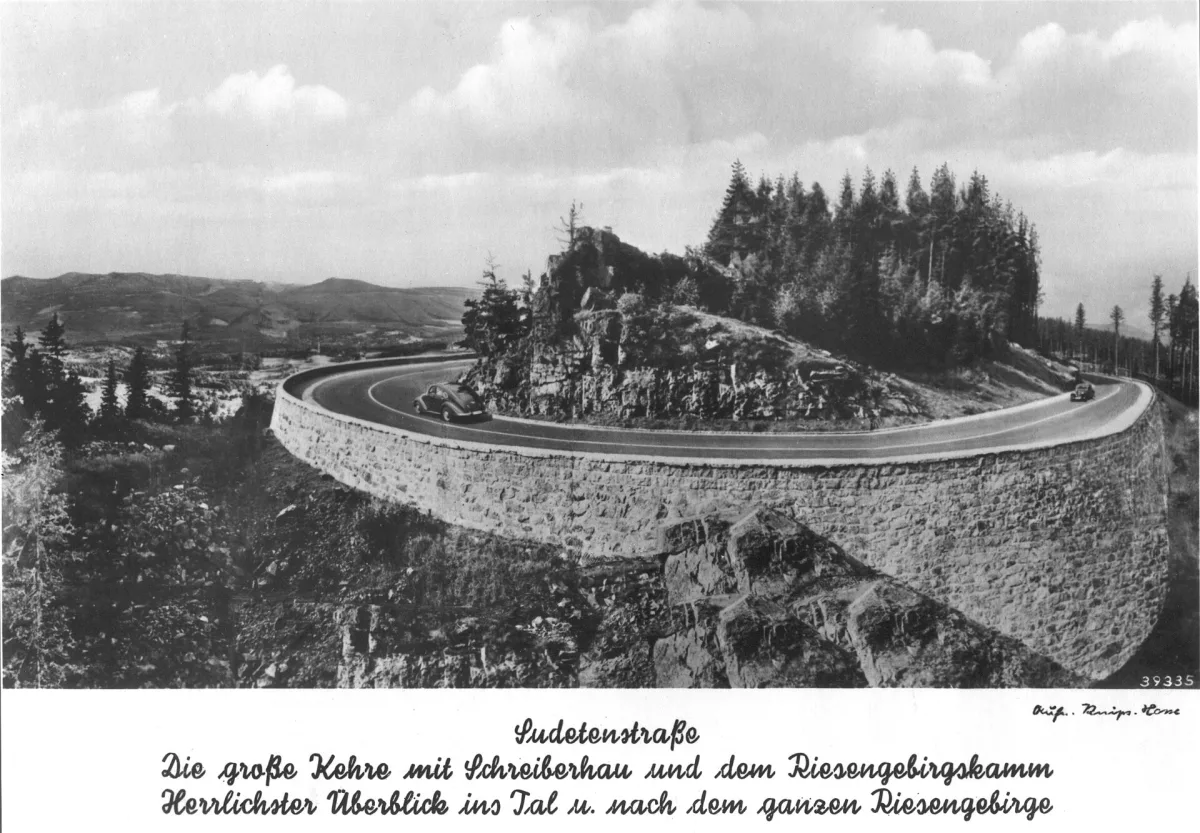
The most recognisable viewpoint in this part of the Sudetes isn't a tower but a bend in the road. Zakręt Śmierci (the Death Bend) lies on regional road number 358 between Szklarska Poręba and Świeradów-Zdrój, on the slope of Czarna Góra. It was built in 1935-1937 during the construction of the Sudetes Road, and owes its name to the numerous accidents caused by the sharp angle of the bend and the steep slope. Today it functions above all as a viewing stop with a panorama of the Karkonosze range and the Jelenia Góra Valley below. It's reachable only by car or bicycle along the regional road, with no separate entrance gate, so care is needed when stopping there.
In Jelenia Góra itself there are two towers you can reach on foot from the city centre. Wzgórze Krzywoustego stands 375 metres above sea level and lies in a bend of the Bóbr river. On its summit stands a tower from 1911, 22 metres high, nicknamed the Mushroom for the shape of its roof. From the terrace there's a panorama of the Karkonosze and the town itself, and entry has been free since the renovation completed in 2009. Closer to the market square stands the Castle Gate Tower, the only surviving part of the old town gate leading from the direction of the castle. Its present form from 1584 combines a cylindrical lower section with an octagonal upper structure, and the former defensive gallery now serves as a viewing platform right in the centre of Jelenia Góra.
Owl Mountains and Kamienne Mountains
This range has the highest concentration of observation towers in Lower Silesia. On the summit of Wielka Sowa, the highest peak of the Owl Mountains (1015 m above sea level), stands the observation tower on Wielka Sowa from 1905-1906, built of concrete blocks, which sets it apart from the stone towers built in the same period. It can only be reached on foot, by trails from several directions. A few kilometres further, on the summit of Kalenica (964 m above sea level), stands the steel Kalenica Observation Tower from 1932-1933. From its upper terrace stretches one of the region's wider panoramas: you can see the Owl Mountains, the Table Mountains, the Bardzkie Mountains, the Bystrzyckie Mountains, the Złote Mountains and the Orlickie Mountains, and in good visibility also the Śnieżnik Massif and the Karkonosze with Śnieżka. Entry is free all week.
In the Kamienne Mountains, on the border of Wałbrzych and Jedlina-Zdrój, stands the observation tower on Borowa, an openwork steel structure opened in December 2017, whose terrace at a height of 15.3 metres gives views of the surrounding ranges of the Sudetes. Above Wałbrzych itself tower the stone observation tower on Chełmiec from 1888, visible from almost anywhere in the town, and the triangular observation tower on Góra Trójgarb above the village of Witków, opened in 2018. It has five terraces at heights from 17 to 23 metres and 160 steps to the highest one. In clear weather you can see the Kamienne Mountains, Ślęża, the Karkonosze and even Wrocław from it.
The Kłodzko Region
The region's highest viewpoint stands on the summit of Śnieżnik, the highest mountain of the Eastern Sudetes, at 1425 metres. The observation tower on Śnieżnik was built in September 2022 on the site of a stone predecessor from 1895-1899, blown up in 1973. It has a steel structure clad in glass, and is reached on foot by hiking trails from Stronie Śląskie or from the direction of Międzygórze. A few kilometres further, on the watershed of three seas, stands the wooden observation tower on Trójmorski Wierch, opened in 2010, 25 metres high, which also serves as a fire lookout.
In the Włodzickie Hills, above Nowa Ruda, stands the observation tower on Góra Wszystkich Świętych, a structure built of red sandstone in 1913, raised on the site of a small wooden tower from 1889. From the 648-metre summit you can see a panorama of the Kłodzko region and the mountains on the Czech side. It's reached on foot from the direction of Nowa Ruda-Słupiec.
The Foreland and the area around Wrocław
Ślęża towers over Sobótka and the whole Sudeten Foreland, and on neighbouring Wieżyca stands the Bismarck Tower on Wieżyca, a stone structure built of granite quarried on the spot, opened in 1907 on the initiative of students from Wrocław. From the terrace you can see the Ślęża range and the Sudetes stretching below, and it's reached by hiking trails through the massif. Closer to Wrocław, in the Oder valley, stands the 40-metre observation tower in Kotowice with three roofed platforms, from which, in good weather, you can make out the outline of the Ślęża Massif, the Niemcza-Strzelin Hills and the Sudetes. Entry is free, and the site lies close to cycling trails.
To the south, on the summit of Gromnik, the highest point of the Strzelin Hills (391 m above sea level), stands the observation tower on Gromnik, on the site of a former Ślężanie stronghold and a medieval castle. It's sometimes closed during the winter season. There's also a viewpoint in Wrocław itself: the sixty-two-metre water tower on Wiśniowa Avenue in the Borek estate was built in 1904-1905 to a design by Karl Klimm, and its gallery at a height of 42 metres gave views of Ślęża and the Karkonosze. The structure is currently closed to visitors and can only be viewed from the outside.
Be the first! Add a comment.
You need to log in to add a comment.
Log in