
The blast that uncovered prehistory
On 14 October 1966, at around one o'clock in the afternoon, miners working at the Kletno III marble quarry carried out a routine blast. After the explosion, a horizontal crack about two metres wide opened up in the wall of the working, several metres above the level where extraction was actually taking place. It led to a small chamber.
Among the blocks of extracted rock, the workers noticed numerous bones. At first no one knew exactly what was lying inside - only a palaeontological examination established that these were not human remains but the bones of animals from thousands of years ago. The cave discovered that day in the Śnieżnik Massif, in the Kleśnica valley near Kletno, took its name from the species whose bones were most numerous inside it: the Bear Cave (Jaskinia Niedźwiedzia).
The decision that saved the cave from quarrying
The geological documentation for the Kletno III quarry assumed extraction of around 200,000 tonnes of marble a year - for the post-war economy this was too valuable a resource to give up easily. Even so, in December 1966 further exploitation of the deposit at this spot was halted. For the realities of the time, this was an unprecedented decision: the scientific value of the find outweighed the value of the raw material.
This opened the way to years of research and exploration, carried out by both university teams and cavers. In the following years the cave turned out to be much larger than the first uncovered chamber had suggested.
Cave bear bones and other traces of the Ice Age
Excavation work carried out between 1967 and 1970 yielded around 20,000 fragments of bones from Pleistocene animals, that is, from tens of thousands of years ago. Nearly 90 per cent of the finds belonged to the cave bear, a species that died out towards the end of the last glaciation, with the remains of females predominating. Among the bones found were five almost complete skulls and one almost complete skeleton.
A similar find, though on a smaller scale, was also recorded in the nearby Radochowska Cave in the Golden Mountains (Góry Złote), where the bones of cave bears and cave lions were discovered - this shows that the whole Śnieżnik Massif was, in the Ice Age, a refuge for large predators and omnivores.
Three levels of passages and rich cave decorations
The Bear Cave is today the longest cave in the whole of the Sudetes - its total length reaches around 4.5 kilometres, and the difference in level between its lowest and highest points is 118 metres, from minus 29.7 to plus 88.6 metres. The passages are arranged on three levels, and the entrances lie at an altitude of 800-807 metres above sea level.
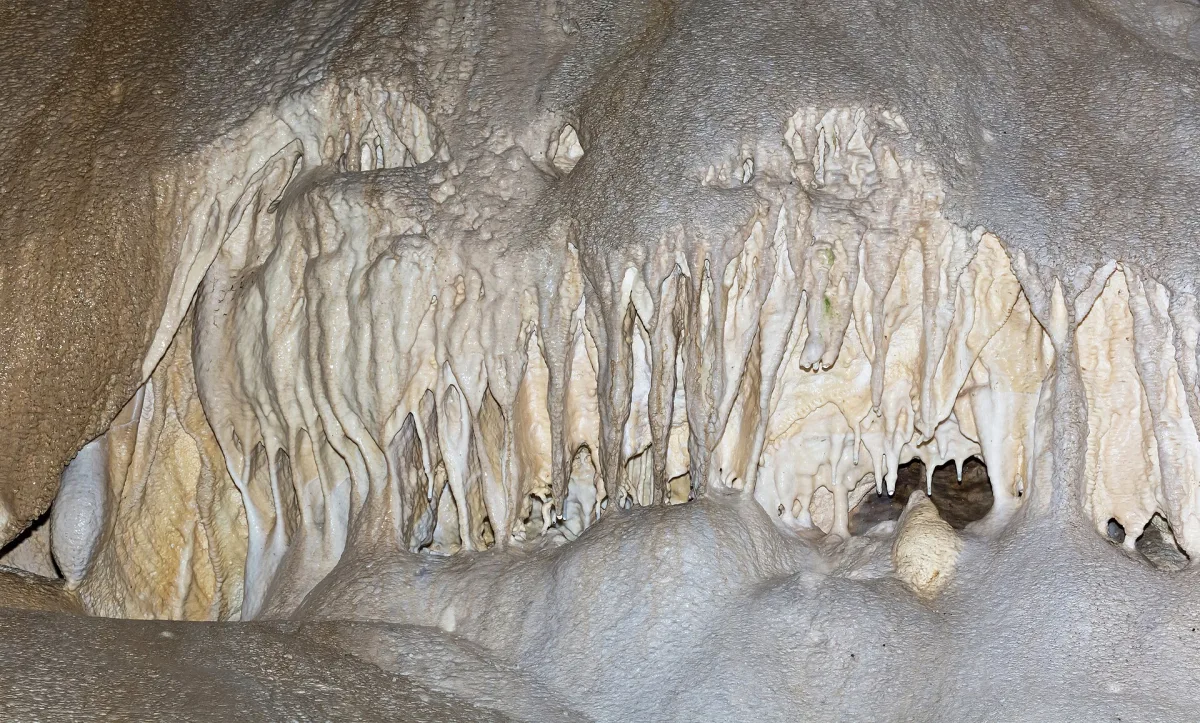
The interior is decorated with rich cave formations: stalactites and stalagmites, flowstone, cascades, draperies and rimstone pools, which together make it one of the most beautiful caves in Poland. In 2012, after years of exploration, the Mastodon Chamber (Sala Mastodonta) was discovered - a huge chamber around 115 metres long, 30 metres wide and up to 30 metres high, showing that even more than forty years after the first blast the cave was still able to surprise researchers.
Eight years of preparation and a limited number of visitors
Eighteen years passed between the chance discovery and the cave's opening to tourists. Eight of them were taken up by preparatory work: mining operations to widen and secure the passages, the installation of lighting and the construction of an entrance pavilion. The tourist route, covering the middle section of the cave, around 700 metres long, officially opened on 11 June 1983. A guided tour takes about 45 minutes, and inside the cave a constant temperature of around 6 degrees Celsius is maintained all year round.
In 1977, even before the route was opened to tourists, a nature reserve for inanimate nature was established around the cave, covering the cave itself and the surrounding karst phenomena. It is this reserve status that lies behind today's restrictions: daily and annual limits on the number of visitors are in place, introduced to protect the cave's fragile microclimate, its delicate formations and the fauna living inside it.
What is studied in the cave today
The Bear Cave is still the subject of scientific research. Radon concentration measurements are carried out, and speleological exploration of new, unopened parts of the system continues. Geophysical surveys suggest that the cave may have further, still undiscovered branches heading towards the border with the Czech Republic - more than half a century after the blast that uncovered it, it is still not known where its passages actually end.
Be the first! Add a comment.
You need to log in to add a comment.
Log in