
Where did the Sudetes get so many old viewpoints
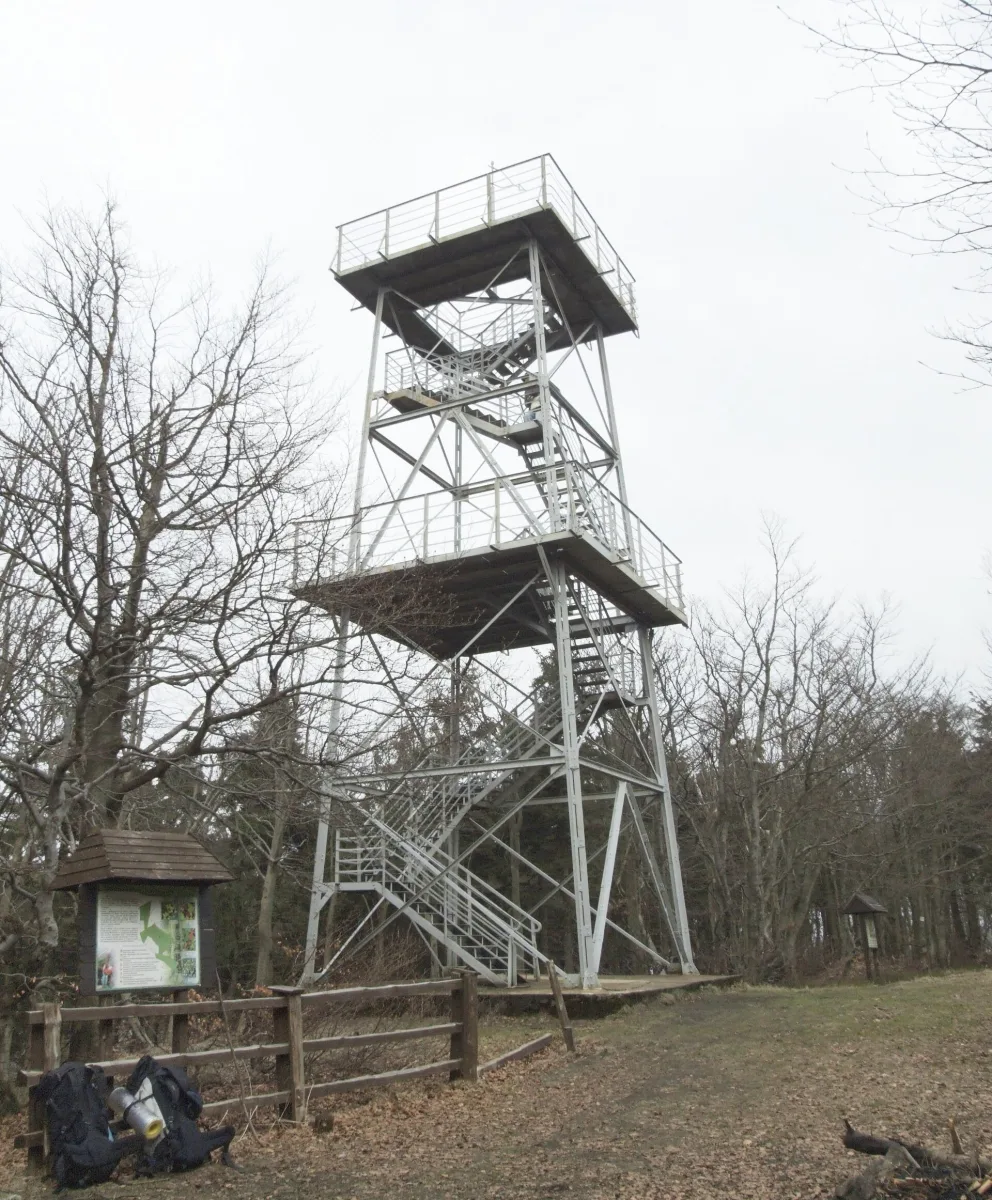
Most of the stone and wooden towers standing today on summits of the Sudetes date back to the turn of the 19th and 20th centuries. It was then that local mountain societies operated throughout the Sudetes, on both sides of today's border - the German equivalents of today's PTTK (Polish Tourist and Sightseeing Society) - which set themselves the goal of building trails, mountain huts and observation towers on one summit after another. Kalenica Observation Tower in the Owl Mountains was erected in 1932-1933 by the Eulengebirgsverein (Owl Mountains Society) to mark its fiftieth anniversary - so the society itself was founded back in the 1880s and had been systematically developing the surrounding summits for half a century. Similarly, the tower on Góra Wszystkich Świętych near Nowa Ruda was funded in 1913 by a section of the Kłodzko Mountain Society, replacing a modest wooden mini-tower put up on the same spot back in 1889. The towers served a double purpose: they gave tourists a view above the treetops, while also serving as a showcase for the society that built them and drawing visitors to the nearby mountain huts and inns.
Summits that grew over with forest
Not every old tower has survived to our times, and some summits that were a hundred years ago the target of sightseeing trips give no view at all today. On Wielka Kopa in the Rudawy Janowickie a fifteen-metre wooden observation tower stood before 1945. Today there is no trace of it, and the summit itself is almost entirely overgrown - anyone climbing it hoping for a panorama will find only forest. A similar fate, though in a different form, befell Grodziszcze between Gorzuchów Kłodzki and Bożków. There stands a four-storey building of dressed stone, erected in 1813 by Count Anton Alexander von Magnis - conceived from the start as a viewpoint built in the shape of an artificial ruin of a medieval castle, with a kitchen on the ground floor and a parlour upstairs. The observation tower at Grodziszcze survived two wars, but never received proper care - today it is badly neglected, though it still stands on the summit.
Towers demolished and rebuilt
Some old viewpoints disappeared for reasons quite different from neglect. The stone tower on Śnieżnik, the highest summit of the Eastern Sudetes, was built in 1895-1899 and blown up in 1973. The idea of putting up a new one appeared as early as the 1980s, but it took several more decades before the plan was realised - the steel-and-glass structure, built from 100 tonnes of steel, was not completed until September 2022, on the same spot as its predecessor. Similarly, on Czerniawska Kopa in the Izera Mountains there now stands a wooden larch tower - on the site of a pre-war predecessor known today only from old photographs. The tower on Wielka Sowa also has its own predecessor: the first, wooden structure was put up in 1885 by a local carpenter from Walim, and just twenty years later, in 1905-1906, it was replaced by the current twenty-five-metre tower built of local gneiss.
How to spot a former viewpoint in the field
Traces of former viewpoints can be easy to miss today. What most often remains of them is a foundation or a low stone plinth at a spot where the forest suddenly thins out, or where a regular circle of laid boulders can be seen in the thicket. A second clue lies in the names of summits and passes - German maps from before 1945 often named hills directly after the towers standing on them (Aussichtsturm), and these names are sometimes forgotten along with the structure itself. It is also worth paying attention to clearings that were once cut and are now overgrown - on Chełmiec in the Wałbrzych Mountains, in the 1880s, two dirt roads were laid out to the summit and a section of forest was cut down specifically to make it easier for tourists to reach the tower that stood there - such an artificially widened corridor in old woodland is today sometimes the only trace of former tourist traffic at a spot where no tower remains at all.
Where it is worth climbing today
Despite the losses, some of the old viewpoints in the Sudetes are still in use, some have been renovated, and a few places have gained entirely new towers on spots that had long been famous for their panoramas. The tower on Borowa in the Wałbrzych Mountains is an open, sixteen-sided structure in the shape of a hyperboloid, with a terrace at a height of 15.3 metres. On Trójgarb above Witków there now stands a twenty-seven-metre tower with five terraces, from which, on a clear day, Mount Ślęża, the Karkonosze (Giant Mountains) and Wrocław can all be seen at once. Quite new, meanwhile, is the reinforced-concrete tower at Suszyna in the Table Mountains, built in 2014 and clad in sandstone to blend into the rocky landscape of the area. Anyone looking for a view closer to Wrocław can head for the forty-metre tower at Kotowice above the Oder valley, from where, on days without fog, both Ślęża and the first ridges of the Sudetes can be seen.
Be the first! Add a comment.
You need to log in to add a comment.
Log in