
The rock that cooled in a volcanic vein
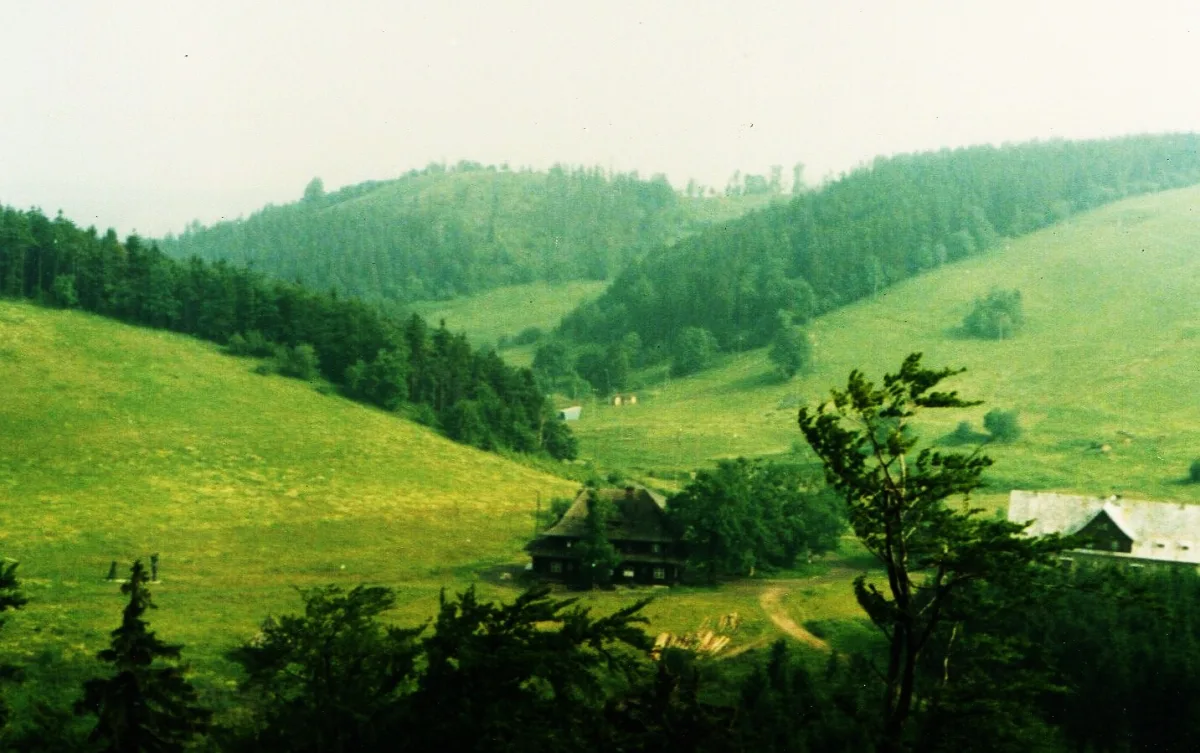
On the slopes of the Suche Mountains, between the peaks of Klin and Bukowiec, lies an active quarry extracting a rock long known as melaphyre. Modern geology classifies it as trachyandesite - a dark grey, fine-grained volcanic rock. It formed from magma that did not reach the surface as lava from a crater, but solidified underground, squeezed between older rock layers as an intrusion known as a sill. This happened in the Early Permian, almost 300 million years ago, when this part of what is now the Sudetes saw volcanic activity linked to a depression known as the Intra-Sudetic Basin.
The quarry in Rybnica Leśna works one of the largest trachyandesite veins of this type in the region - a massif of considerable thickness, running through the terrain over a distance of several kilometres. This is precisely why the deposit has proved large enough to support industrial extraction here for almost a hundred years.
The scale of the workings and where the stone goes
The quarry has operated since 1935. Extraction was temporarily halted in 2015, but today the plant is working at full capacity again. The open pit has nine levels and is worked using the blasting method - successive sections of rock are blasted with explosives, then crushed and sorted into fractions. Annual output reaches around 1.7 million tonnes of aggregate, with the documented reserves of the deposit estimated at 160 million tonnes.
Trachyandesite from Rybnica Leśna, like other rocks of this type mined in the Sudetes, is used mainly in road and rail construction - as aggregate for road surfaces and ballast beneath rail tracks. It is an industrial raw material, not an ornamental or building stone in the sense that granite, for example, can be.
What the quarry has revealed for geologists
For geologists, the site is today more than just a source of aggregate - it is an artificial exposure showing a cross-section through the volcanic vein that is not available anywhere else in the area in a natural way. The walls of the pit's successive levels clearly show the structure of the trachyandesite massif, one of the largest of its kind in the Intra-Sudetic Basin. For this reason the site is sometimes listed as a geotourism location, even though there is no visitor infrastructure here at all - it is simply the wall of an active mine, which can be viewed from a distance.
Volcanic rocks of the melaphyre group, which also includes trachyandesite, usually have a porphyritic structure with an amygdaloidal texture - meaning that gas bubbles formed in the cooling magma, which over time turned into small, rounded empty cavities in the rock. Under favourable conditions, water circulating later through such cavities can deposit secondary minerals such as quartz, chalcedony or agate. However, the available sources on the quarry in Rybnica Leśna do not confirm whether such specimens are actually found here - this is a general feature of rocks of this type, not a documented fact about this specific quarry, so it should be treated with caution, as a possibility rather than a certainty.
Nature protection right next door
The quarry borders protected land - it adjoins the Wałbrzych Sudetes Landscape Park as well as a Natura 2000 site. This proximity of an active industrial plant and a protected area is fairly typical in the Sudetes: the extraction of igneous rocks has long been concentrated in places where hard rock comes close to the surface, and such places are usually also steep, sparsely built-up slopes that have over time been brought under nature protection. The boundary between the two can therefore be very close - in this case it is a matter of a few trails and access roads.
Rules of access: an industrial plant, not a tourist attraction
The quarry in Rybnica Leśna is an active mining enterprise, not a site adapted for visitors. Entry to the open pit area is forbidden - blasting work takes place there and heavy machinery is in operation, so it is simply a dangerous place for outsiders. A view of the workings, the machinery, crushers, screens and conveyor belts, can however be had from the outside: from the nearby road and from the tourist trails running through the area - the blue and red trails, leading towards the PTTK Andrzejówka shelter. This is enough to get a sense of the scale of extraction without entering the plant's grounds.
On the way to the trail, it is also worth stopping at the nearby peak of Krzywucha, built of the same rock as the quarry below - a good spot to see what the same geological formation looks like in a natural state, unaltered by mining.
Be the first! Add a comment.
You need to log in to add a comment.
Log in