
The border that cut one city in two
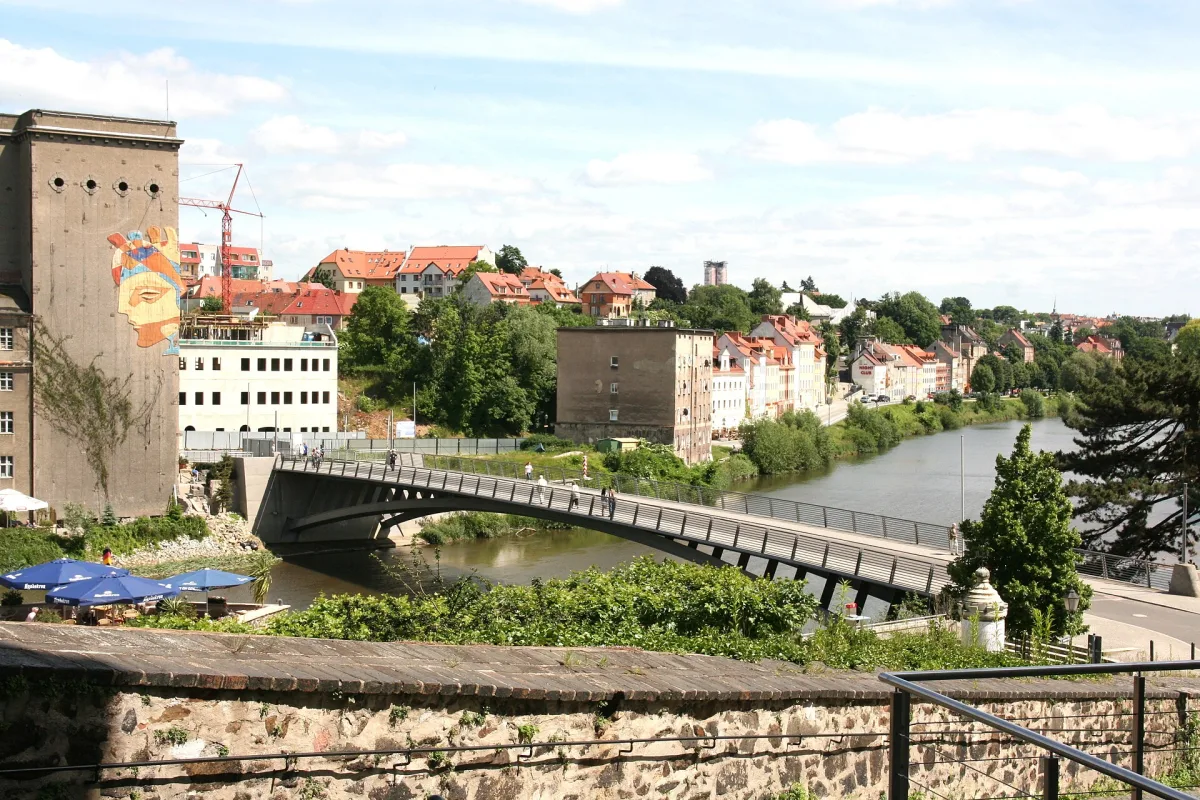
Zgorzelec and the German Görlitz were, until 1945, one city, split only by the post-war border on the Lusatian Neisse. The portal covers this division separately - here it's worth noting only why this particular place became one of the more important smuggling borders of post-war Poland. The river running through the middle of the former Görlitz meant that on one side of the bridge were Poles, on the other Germans, and the distance between the two sides was sometimes just a few dozen metres. Where a border runs this close to people's homes and to pre-war family ties, informal movement naturally arises too, something the authorities try to control and residents try to get around.
Cigarettes in tyres and under car seats
The best-documented smuggling in the available sources took place at the turn of the 1980s and 1990s and through the 1990s themselves, when cigarettes were regularly transported through the border crossing in Zgorzelec. Goods were hidden in car tyres, in boots with false bottoms and under seats. Women sometimes pretended to be heavily pregnant to hide tobacco on themselves, and children were drawn into the smuggling too. This wasn't the work of organised criminal groups in the usual sense - according to local accounts, it was simply ordinary people for whom a short trip across the bridge became a source of extra income at a time when the differences in prices and the availability of goods on the two sides of the border were huge.
Everyday life on the border
For the residents of Zgorzelec, the border crossing was at the time a place they knew by heart - with kilometre-long queues of cars and thorough searches. Local accounts from those years describe an atmosphere of mutual suspicion: German officers treated the checks as a routine fight against smuggling, and during this period the town gained a reputation as a place where, alongside cross-border trade, thefts and robberies also occurred. This should be read, though, as a description of one transitional stage in the town's history, not as its permanent character - similar phenomena accompanied most border crossings between Poland and Western European countries in those years, not only Zgorzelec.
Not only the Lusatian Neisse
A similar, though older and differently shaped, cross-border movement also took place in the mountains, further south in the region. The area around the Owl Mountains lies at the former meeting point of the Silesian-Bohemian and Prussian-Austrian borders, which for centuries favoured the informal movement of goods across the border running along the ridges. After the Second World War this movement was interrupted for a long time - the new Polish-Czechoslovak border was tightly sealed, with checkpoints and restrictions on access to the border zone, which also applied to tourism. As late as the second half of the 20th century, the Polish border service, for years, did not allow Czechs and Slovaks onto the Karkonosze border trail, and Poles could only walk it in organised groups, with a guide, a ban on photography and accompanied by an armed soldier. The contrast between the former permeability of the border on the Neisse and the tightly sealed border in the mountains shows well that Lower Silesia's borderland had, in the post-war decades, several very different faces depending on the stretch.
The end of an old phenomenon
Change came with successive stages of European integration. The crossing that today links the two old towns of Zgorzelec and Görlitz, the Old Town Bridge, was rebuilt from scratch only in 2003-2004, after almost sixty years during which the pre-war bridge lay in ruins, blown up by retreating German troops in the spring of 1945. The real end of border controls, however, came only with Poland's entry into the Schengen Area on 20 December 2007. From that day the checks on the bridge disappeared completely, and with them the point of the old smuggling based on physically crossing a guarded checkpoint - once nobody checks the boot any more, transporting goods stops being a feat and becomes an ordinary purchase on the other side of the river.
What's left of the old borderland
Today the border on the Lusatian Neisse in Zgorzelec is above all a line on the map, which pedestrians and tourists cross without stopping, as if strolling through a single city. Since 1998, the authorities of Zgorzelec and Görlitz have formally cooperated under an agreement known as Europastadt (European City), with joint sessions of both town councils, and price differences between Poland and Germany still prompt residents of both countries to shop daily on the other side of the border - except that this now happens entirely legally and without the need to hide anything in tyres. The trace of the old, less formal border survives more in the memories and local stories of the borderland's older residents than in the reality of today's open Old Town Bridge connecting the two cities.
Be the first! Add a comment.
You need to log in to add a comment.
Log in