
The Spirit of the Mountains, who used to frighten wanderers
The Karkonosze legend of Liczyrzepa, also called the Spirit of the Mountains, goes back to the Middle Ages and is probably linked to an old pagan cult of the springs of the Elbe, which rise on the Czech slope of Łabski Peak. The oldest known depiction of this figure comes from Martin Helwig's map of Silesia from 1561, where Liczyrzepa has horns, a tail and hooves.
In later stories he was by turns a guardian of the mountains and hidden treasures, a fearsome demon, or an old man with a staff who helped lost wanderers, provided they treated him with respect. The Polish form of the name was only introduced in 1898 by the writer Stanisław Bełza, before that the terms Rzepolicz and Rzepiór were in circulation, and the German name Rübezahl still has no conclusively explained origin to this day.
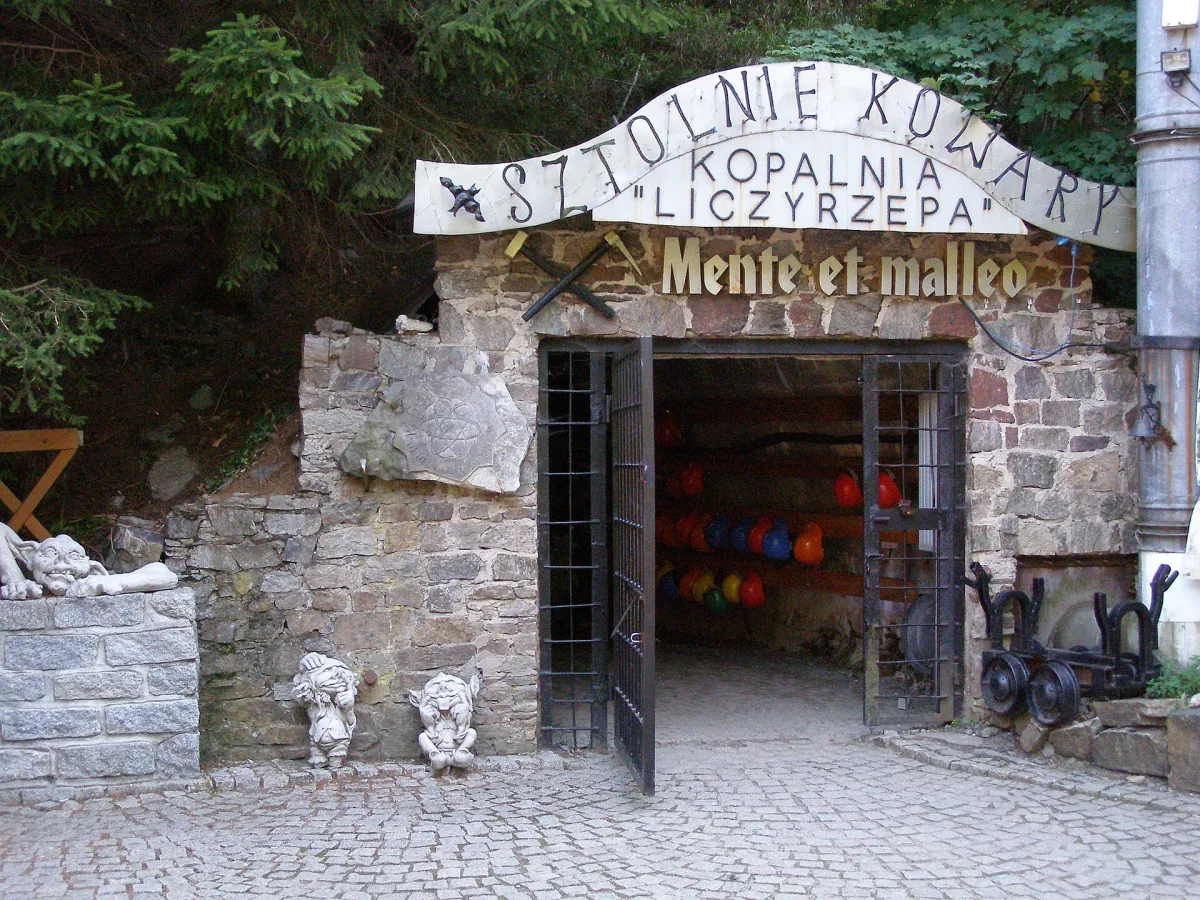
The legendary figure's name is carried today by the Liczyrzepa Mine in Kowary, a former fluorite and uranium ore mine, now open as an underground tourist route. The history of the workings is purely a mining one, the name refers to the legend alone.
The Spirit of the Mountains comes most fully to life at the Castle of Silesian Legends in Pławna Dolna. It was created on the initiative of the artist Dariusz Miliński, and inside a string-operated puppet theatre with human-sized figures performs shows based on Karkonosze folk tales, with the Spirit of the Mountains in the leading role. Monumental sculptures of characters from the same stories stand in front of the building.
Chojnik Castle and the legend of the headstrong princess
The ruins of Chojnik Castle above Jelenia Góra-Sobieszów are linked to the legend of Princess Kunegunda. She is said to have set a condition for her suitors: she would give her hand to whoever rode a full circuit of the castle walls in full armour. The tale has been known for generations and inspired, among others, Friedrich Schiller, Theodor Körner and Andrzej Sapkowski.
In reality the castle was built in the mid-14th century, and the first written mention of it dates from 1364. For most of its history it belonged to the House of Schaffgotsch. On 31 August 1675, during a storm, the building was struck by lightning, a fire broke out, and the upper castle was never fully rebuilt. Today it is a lasting ruin with an observation tower, reached by a trail leading to the top of the hill.
Mount Chojnik itself hides more than just the castle walls. In its rocks and caves, among them Dziurawy Kamień (the Holey Rock) and the Robbers' Cave, and at the foot of its northern slopes in the Robbers' Rocks, the names alone suggest that the area's former inhabitants linked this terrain with stories of robbers lying in wait for travellers crossing the Karkonosze.
Ślęża, the mountain where the sun was worshipped
Mount Ślęża was, from the Bronze Age until Christianisation in the 10th and 11th centuries, a centre of a pagan solar cult among the local tribes. The medieval chronicler Thietmar wrote that all the surrounding inhabitants revered the mountain for its size and significance, and that ancient rites were performed on its slopes.
A trace of those times survives in the stone carvings scattered across the slopes and summit, probably created in the sphere of Celtic culture, around 400-200 BCE. The best preserved, the Bear Statue, stands today beneath a maple by the church on the summit. A medieval legend linked it to the figure of Duke Piotr Włostowic, who founded an Augustinian monastery on the same site in 1110. The carving itself was originally found near Strzegomiany, and was only moved to the summit of Ślęża in 1903.
Places of past trials and punishments
Not all Lower Silesian tales are fairy stories about spirits and deities, some places remember the real, harsh law of past centuries. In the Small Market Square in Bystrzyca Kłodzka stands a pillory from 1556, a stone column with the Latin inscription "Deus impios punit", meaning "God punishes the impious", to which people convicted of minor offences and moral transgressions were chained. The column was moved twice around the town, commemorated by the German word "Transferirt" carved onto it, along with the date 1736.
In Złoty Stok, nothing is left of the former gallows of 1558 except archaeological traces discovered only in 2010. The place where death sentences were carried out for several centuries is today marked by a replica of a cross, where the condemned prayed before their execution.
Rocks with devilish names
The Sudetes are full of solitary rock formations to which former inhabitants gave names associated with unclean forces. The Devil's Club, also known as Czarcia Skała (Devil's Rock), rises in Gorzeszów to a height of around eight metres. It is a club-shaped rock of jointed sandstone, formed by erosion during the Cretaceous period. There are more similarly bizarre boulders in the Sudetes, and their shape has for centuries led people to see the devil's hand in them, though in reality they were shaped only by water and wind.
Castle cellars and other tales
Beneath Świny Castle in the Kaczawa Foothills, a local legend circulates about an underground passage linking this stronghold with Bolków Castle, several kilometres away. No such corridor has ever been confirmed, but the story has survived alongside hard facts: in 1624 the mystic Jacob Böhme stayed at Świny Castle, and the building itself is recorded in a mention in the Chronicle of Cosmas from 1108.
A few kilometres away stands Bolków Castle, the story's second hero. On its grounds survives a window dated to 1289-1290, regarded as the oldest surviving window in Poland, and the whole structure rises above the town on a ninety-metre cliff.
Another trace of past times is Krzyżna Hill near Karpnik, where the remains of the former Sokolec Castle survive below the summit. In the rock, one hundred and twenty steps were cut in 1822, leading to a viewpoint, today crowned by a seven-metre cast-iron cross, cast at a foundry in Gliwice in 1830.
Be the first! Add a comment.
You need to log in to add a comment.
Log in