
A wall that looks like an instrument
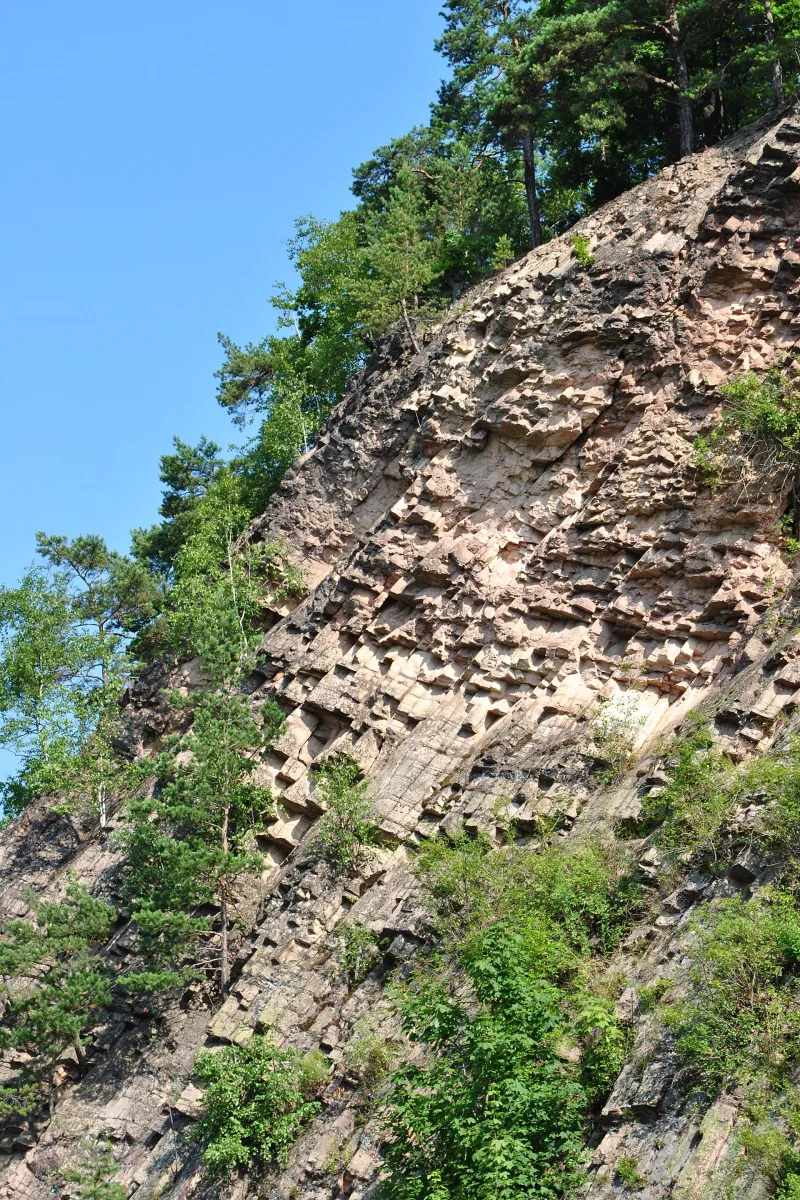
On Wielisławka hill above the village of Sędziszowa, in the municipality of Świerzawa, stands a rock wall built of vertical, tightly packed columns. From a distance it really does resemble the pipes of a great church organ, hence the name Wielisławskie Organs. Each column has a four- or five-sided cross-section and a diameter of only 20-30 centimetres, but together they form an impressive, regular wall, one of the most distinctive rock formations in the Kaczawa Foothills.
How a stone pipe forms
Geologists call the phenomenon responsible for this shape columnar jointing. When lava solidifies in a volcanic vent or in a thick sheet on the surface, it contracts as it cools, much like mud that cracks into regular pieces on the bottom of a drying pond. In rock, these cracks run perpendicular to the surface from which the rock is cooling, and, if the process is sufficiently even, they arrange themselves into a regular grid, most often hexagonal or square. The result is that a uniform mass of solidified rock turns into something that looks like a series of vertical columns standing side by side.
The calmer and more uniform the cooling, the more regular the columns turn out. That is why the most "geometric" walls of columnar jointing usually form in narrow volcanic vents, where the lava cooled slowly and evenly from all sides, which is exactly the case at Wielisławka.
Rhyolite, not basalt: a rarer case
In the surrounding Kaczawa Mountains and Kaczawa Foothills, most rock "organs" are basalt, as is the case at the Myśliborskie Organs. The Wielisławskie Organs are an exception, however: they are built of rhyolite (formerly called porphyry), an acidic volcanic rock in which regular columnar jointing appears less often than in basaltic lava. They formed in a volcanic vent in the Lower Permian, around 300 million years ago, in the same volcanic period that also shaped many other hills in the region.
The quarry that exposed the columns
Were it not for human activity, the columns of the Wielisławskie Organs would probably still lie hidden beneath a layer of weathered rock and vegetation. In the 19th century a quarry operated here, extracting stone, and it was precisely this excavation that exposed the regular, vertical structure of the columns, visible today as a rock wall. A similar mechanism, quarrying that happened to lay bare a geological phenomenon, recurs elsewhere in the region at other post-volcanic formations, for example at the nearby Czartowska Rock.
Protecting the formation
Because of its geological value, the Wielisławskie Organs were placed under protection as a natural monument of inanimate nature in 1994. This status does not ban entry or visiting, but it protects the rock formation itself from further damage or extraction, exactly what exposed it in the 19th century, and what could also destroy it.
Similar columns in the region and around the world
Columnar jointing can be seen in the Kaczawa Mountains and Foothills in several other places too, among them the Myśliborskie Organs near Jawor, where the wall is formed of twenty-metre basalt columns, and Czartowska Rock near Pomocne, where regular columns are visible in the walls of a former quarry on the slope of a hill that was once a volcanic vent.
On a world scale, the most famous formations of this type are the Giant's Causeway in Northern Ireland and, on the other side of the North Channel, Fingal's Cave in Scotland, both built of basalt columns formed by the same process of cooling lava, only on a much larger scale than at Wielisławka.
How to get there
The Wielisławskie Organs lie on the slope of Wielisławka hill above the village of Sędziszowa, in the municipality of Świerzawa, in Złotoryja County. On the same hill, on the flattened summit, also stand the ruins of Wielisławka Castle, so it is worth combining both places in one walk. A marked nature and geology path, "Around Wielisławka", loops through the area, taking around an hour to walk, with information boards explaining each element of the landscape along the way.
Be the first! Add a comment.
You need to log in to add a comment.
Log in