
Where the phrase "city of a hundred bridges" comes from
Wrocław is sometimes called the city of a hundred bridges, though in practice this figure is an understatement. According to data from the Roads and City Maintenance Board (ZDiUM) from 2021, Wrocław has 111 bridges and 38 footbridges standing on its territory, close to 150 crossings in total. Before the Second World War there were even more: 303 bridge and footbridge structures of various sizes were counted at the time.
Such a large number results from the city's location. Wrocław stands on more than a dozen islands surrounded by the branching arms of the Oder (Odra), the Old Oder, navigation and flood canals, and smaller rivers: the Bystrzyca, the Oława and the Widawa. Every crossing from one part of the city to another requires a bridge or footbridge, and without these crossings districts such as Ostrów Tumski (Cathedral Island) or Kępa Mieszczańska would be cut off from the rest of the city.
The oldest crossing over the Oder
The oldest bridge described in the portal is Tumski Bridge, a two-span, steel, riveted structure from 1889, linking Ostrów Tumski with Wyspa Piasek. It stands where crossings had already existed since the 12th century and once marked the boundary between the municipal jurisdiction on Wyspa Piasek and the ecclesiastical jurisdiction on Ostrów Tumski. Until 1945 it bore the German name Dombrücke, and today it is used by pedestrians only.
Bridges every Wrocław resident knows
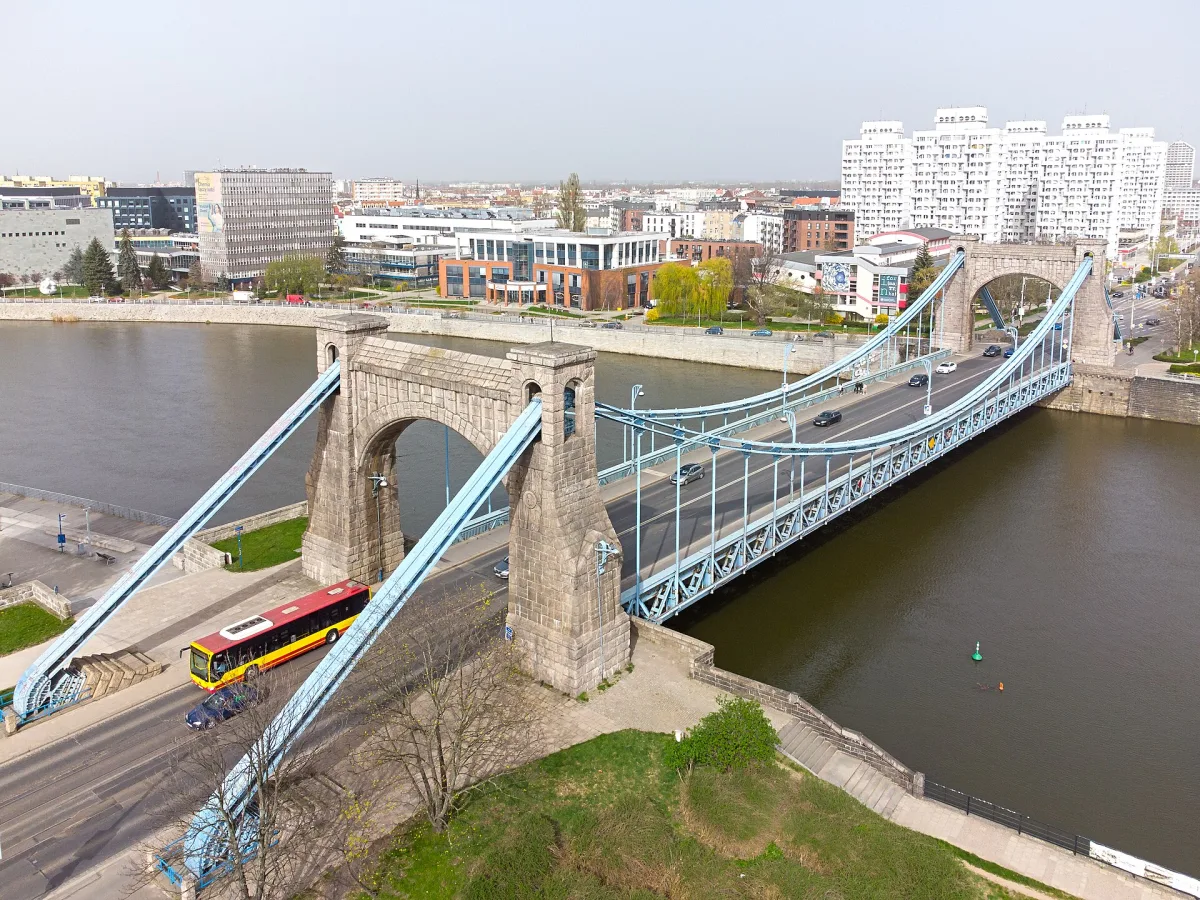
The symbol of the city is Grunwaldzki Bridge, a suspension bridge over the Oder opened in 1910. The winning design, "Gespannt" ("Tensioned"), was chosen in a competition that attracted 39 proposals, and the structure is supported on two pylons built of clinker brick and faced with granite.
Right next to the University of Wrocław stand the University Bridges, a pair of steel structures over the South Oder and North Oder, carrying the tram line that links Plac Uniwersytecki with Kępa Mieszczańska.
In the city centre, over the river's main current, road and tram traffic is also carried by the Pokoju Bridge, built between 1954 and 1959 to a design by Jan Kmita, on the site of an earlier crossing destroyed in 1945 during the siege of Festung Breslau.
The Szczytnicki Bridge has a more intimate character: a three-span arch structure linking Plac Grunwaldzki with Szczytnicki Park, built between 1888 and 1890 from clinker brick and widened in later reconstructions.
The smallest footbridges on the islands
Wrocław's islands in the City Water Junction are linked by a network of small footbridges, which are easy to cross without even noticing they are separate bridge structures.
The Zwierzyniecka Footbridge is 232.4 metres long and hangs on steel cables over the Oder, linking Wielka Wyspa with the Siedlec-Rakowiec estate, on the site of a former ferry crossing that operated until the 1960s.
Much shorter is the Żabia Footbridge, measuring 56.52 metres in length, which has led from Nadodrze to Wyspa Bielarska since 1975 and gained illuminated lighting in 2002.
A similar function is served by the Słodowa Footbridge, a cable-stayed crossing from 2003 between Wyspa Słodowa and Nadodrze, with a main span of 48 metres over the riverbed.
Even smaller is St Clare's Bridge, linking Wyspa Słodowa with Wyspa Bielarska over the canal of the former St Clare's mills, so unassuming that it is easier to walk past it than to notice it.
A bridge that does not stand over a river
Not every crossing in Wrocław leads over water. The Penitents' Bridge, also known as the Penitents' Bridge, links both towers of St Mary Magdalene's Cathedral at a height of 45 metres. It was already mentioned in 1459, shortly after the towers were completed, and after a fire on the night of 22 to 23 March 1887, caused by a fireworks display, it was rebuilt between 1888 and 1892.
Names that are misleading
The Warsaw Bridges do not stand in Warsaw, but in the northern part of Wrocław: they took their name from a former route that led from here towards Oleśnica and on to the capital. This is a group of five crossings over the Oder, the Old Oder and canals, with a two-way carriageway and a double-track tram line along their entire length.
Equally misleading are the Jagiellonian Bridges, four single-span road bridges over the Navigation Canal and the Flood Canal, linking the Zacisze and Mirowiec estates. Two of them were built as early as 1916-1917, while two twin structures were only added in 1984.
Record holders among Wrocław's crossings
The highest point among Wrocław's bridges belongs to Rędziński Bridge on the A8 motorway, suspended from a single pylon 122 metres high, the tallest in Poland. Its construction, delayed by the flood of May 2010, was completed in August 2011.
The narrowest, meanwhile, is Bartoszowicki Bridge over the Flood Canal, a steel, three-span structure from 1913-1917 that is a mere 5.5 metres wide.
Among the newest is the Olympic Bridge, opened on 23 December 2023 and named after the nearby Wrocław Stadium, formerly the Olympic Stadium. It is 700 metres long and 24 metres wide, making it one of the largest crossings added to the city in recent years.
Be the first! Add a comment.
You need to log in to add a comment.
Log in