
Bolesławiec is known worldwide for its blue-and-white ceramics, even though the town itself lies off the main tourist routes of Lower Silesia. This colour and these patterns did not come from nowhere - behind them lie several hundred years of work by potters who had at hand a raw material rarely found in such quality.
Clay from beneath Bolesławiec
Beneath the town lie deposits of stoneware clay formed from the sediments of a former Cretaceous sea, rich in feldspar and silica. After firing at high temperature, this clay turns into stoneware: a hard material, practically non-absorbent and resistant to mechanical damage and heat. It was this property of the raw material, not fashion or chance, that made pottery develop here on an industrial scale.
The first traces of ceramic firing on the site of present-day Bolesławiec go back, according to archaeological research, to the Lusatian culture of about three thousand years ago. The first written mentions of local potters, however, date only from 1380, and the first potters' guilds were already active here in the 13th and 14th centuries. The craft therefore developed alongside the town itself, drawing on clay that lay literally underfoot.
White vessels and feldspar glaze
For centuries Bolesławiec ceramics were brown or greyish, depending on the additives in the clay and the firing method. This changed in the second half of the 19th century, when Johann Gottlieb Altmann was the first to use a health-neutral feldspar glaze at the local workshops and began producing vessels from white clay. It was this change that transformed the appearance of the wares and created the background against which the characteristic blue stamped pattern could stand out - without the white, light-coloured base, the cobalt decorations would not have had such contrast.
In 1897 the Royal Ceramics School opened in Bolesławiec, which standardised and raised the level of training of local craftsmen. Its director, Wilhelm Pukall, introduced new forming and decorating techniques, which improved the quality and recognisability of the wares sent out from here across Germany.
The stamp, the sponge and the "peacock's eye"
The characteristic pattern of Bolesławiec ceramics is not painted with a brush but stamped on. Craftsmen cut patterns out of a specially prepared sponge or piece of leather, dip them in paint and press them onto the surface of the vessel - layer by layer, motif by motif. Thanks to this method, every piece, even one repeating the same pattern, carries small, natural differences resulting from the manual work.
Among the most recognisable motifs is the so-called "peacock's eye" - an arrangement of concentric circles resembling the pattern on a peacock's feather, alongside dots, little leaves, crescents, a daisy or a "pinwheel" built from symmetrically arranged elements. These patterns are combined and repeated in different arrangements, allowing thousands of combinations while keeping just a dozen or so basic stamps.
How a vessel is made - step by step
The production of a typical vessel from Bolesławiec stoneware goes through several stages. First, the mass made from local clay is shaped, most often by casting in plaster moulds, which give the form to plates, jugs or bowls. The shaped, still raw vessels must dry before their first firing, at a temperature of around a thousand degrees Celsius. Only on a surface prepared this way are the patterns applied with a stamp, after which the whole piece is covered with a transparent glaze and fired again, this time at a temperature of 1,100 to 1,300 degrees. It is this second, high-temperature firing that turns the clay into hard, glassy stoneware and fixes the colours permanently.
The workshops before and after 1945
Until the end of the Second World War, Bolesławiec's ceramics workshops operated as German craft and industrial enterprises, exporting their wares deep into Germany and abroad. The war nearly halted production - some workshops scaled back their activity, and many skilled craftsmen lost their jobs or left the town as the borders shifted.
After 1945, when Bolesławiec came within Poland's borders, production had to be rebuilt almost from scratch, largely with new people, since most of the former German masters had left. Professor Tadeusz Szafran oversaw the rebuilding. In 1950 Cepelia was established, taking over the marketing of folk crafts across Poland, including ceramics from Bolesławiec. From 1964 the role of artistic director was held by Bronisław Wolanin, who fixed the design style characteristic of the town and helped it survive in an almost unchanged form to this day.
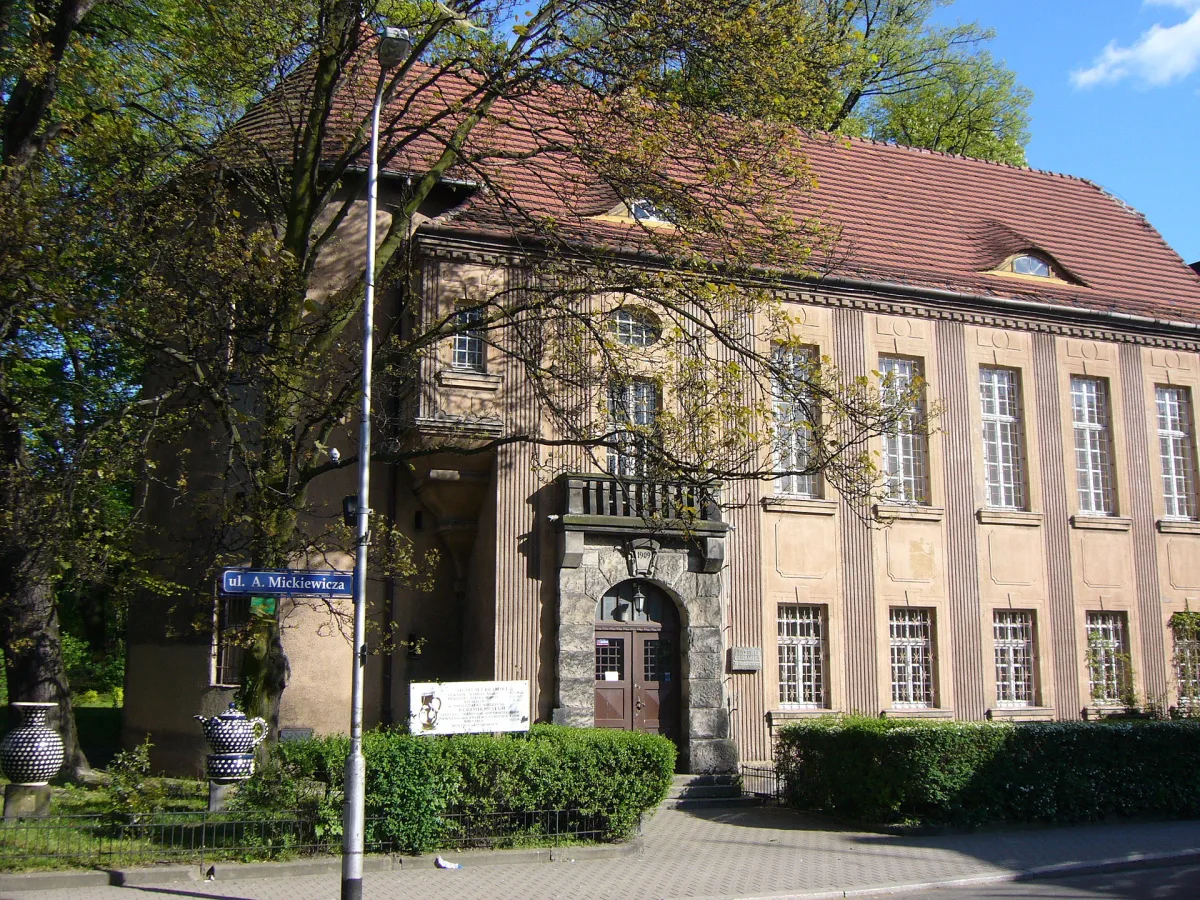
The history of these changes, together with the history of the town itself, is shown by the Ceramics Museum in Bolesławiec, which operates in two buildings: the ceramics department is at Mickiewicza Street, while the former Kutuzov Museum houses the town history department. The institution was founded back in 1908 as the Town Museum, and its collections survived both world wars, though not without losses.
The potters' annual festival
Since 1991 Bolesławiec has hosted the Bolesławiec Ceramics Festival every year in August - what began as a local fair has grown into the largest ceramics festival in Poland and one of the more important events of its kind in Europe. The programme includes a ceramics fair with local producers, workshops and demonstrations of pottery techniques, a procession of clay figures through the town's streets, exhibitions and author meetings, as well as concerts and a food zone. The event combines a display of traditional craft with current artistic work and attracts both collectors and families looking for a day trip.
A symbol of this tradition also remains the legendary Great Pot, made in Bolesławiec in 1753 by master potter Johann Gottlieb Joppe - a vessel two metres high with a capacity of two thousand litres, still cited today as proof of the skill of local craftsmen almost three hundred years ago.

Be the first! Add a comment.
You need to log in to add a comment.
Log in