
Congregations in county towns and their first houses of prayer
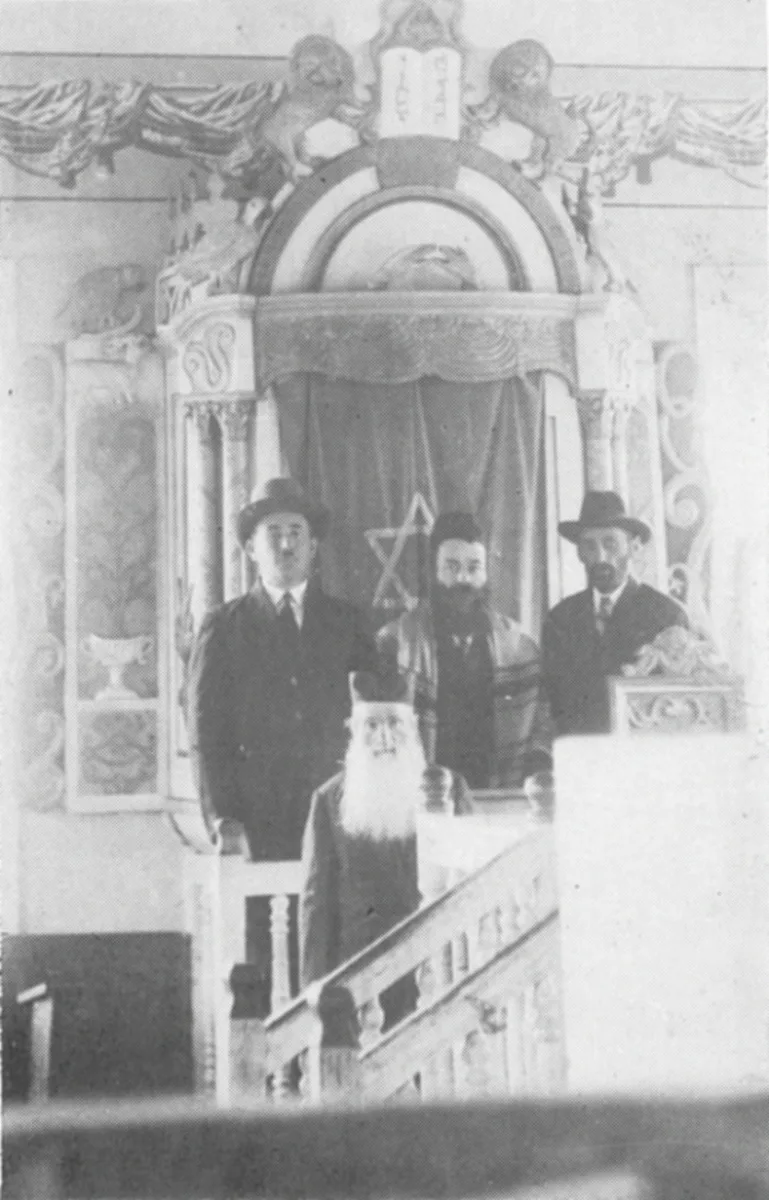
Before a Jewish religious congregation in a given town built a brick synagogue, it usually prayed for years in a rented room or in the private home of one of the community's wealthier members. Building its own synagogue meant the congregation had grown large and solvent enough to bear the cost of a brick building.
Most of the region's surviving synagogues were built in two waves. The first falls in the first half of the 19th century, when Prussian authorities gradually lifted restrictions on Jews settling in towns: the synagogue in Strzelin was erected in 1815, in Brzeg Dolny in 1848, and in Bierutów as early as 1809, on the site of an even older prayer house. The second wave came in the 1860s and 1870s, when urban congregations had grown so much that the old houses of prayer stopped being enough; that is when, among others, the synagogue in Ząbkowice Śląskie was built, opened in 1860 and consecrated with the participation of Wrocław rabbi Abraham Geiger.
The scale of these communities was small compared with Wrocław. In county towns, the synagogue was often a single, small building that had to serve the entire local community for generations.
Architecture: from brick with semicircular windows to neo-Gothic
Synagogues in the small towns of Lower Silesia rarely had the monumental character found in the large German cities. A typical building was made of brick, erected on a rectangular plan, without external ornamentation that clearly indicated its religious function; the former synagogue in Wałbrzych from 1883 was built this way, among others. A recurring motif is windows ending in a semicircle on the upper storeys; this detail has survived to this day on the facade of the synagogue in Kowary, despite the building's change of function.
An exception in style is the synagogue in Ząbkowice Śląskie, built in 1858-1860 by carpenter Julius Glatzer in neo-Gothic form, with three tiers of windows: the two lower ones ending in a semicircle and the upper one pointed.
Kristallnacht: different towns, different outcomes
On the night of 9 to 10 November 1938, a wave of violence against Jewish institutions swept the whole region, but its consequences for individual buildings varied. The synagogue in Wałbrzych on what is now Mickiewicza Street burned down completely and was never rebuilt; today no trace of the building remains on the site. A similar fate befell the synagogue in Strzelin: damaged during Kristallnacht, it was adapted by the authorities as the seat of the National Socialist Transport Column, after which the building was destroyed as the war went on. Available sources do not say whether any fragment of it has survived to this day.
In Bierutów, the synagogue from 1809, rebuilt in the late 19th century, was set on fire and vandalised in November 1938, but the building's structure itself survived, unlike in Wałbrzych or Strzelin, where fire consumed the construction almost completely. The synagogue in Ząbkowice Śląskie, though vandalised the same night, also survived as a building; it was precisely this difference between total destruction and a vandalised but standing wall that later decided the further fate of a given building.
Warehouses, shops, flats: a new life for the surviving buildings
Synagogue buildings that survived the war as standing structures mostly never returned to their original function; the communities for which they were built ceased to exist as a result of the Holocaust and the war. The synagogue in Kowary, vandalised by the Nazis, became an ordinary warehouse after the war and still serves that function today, with only fragments of its former exterior decoration preserved. Similarly, the synagogue in Bierutów now houses the gymnasium of the local school complex, and Hebrew inscriptions are still visible on the walls, the last legible trace of the building's former religious function.
The synagogue in Ząbkowice Śląskie underwent the most radical transformation: after Kristallnacht the building was converted into flats with a shop unit on the ground floor, which cost it much of its original architecture. The synagogue in Brzeg Dolny took yet another direction; there the change of function happened even before the war: the local Jewish congregation dissolved itself in 1916, and in 1926 the building passed into the hands of the town authorities, who converted it into a fire station, adding garages and an observation tower. That function has survived to this day.
Congregations that rebuilt after the war
Not all houses of prayer in Lower Silesia date from before the war. After 1945 the region briefly became the largest concentration of Holocaust survivors in Poland, and newly arrived Jews founded their own small congregations in towns previously inhabited by entirely different communities. In Kłodzko, the orthodox congregation's house of prayer was founded in 1946, right after it was established; it first operated in a room of a tenement house on Bolesława Chrobrego Square, and was later moved to a corner building near the Kłodzko market square, at the junction of Wita Stwosza and Wodna streets. Available sources do not establish whether the building has survived to this day at either of these addresses.
In Wałbrzych, where the pre-war synagogue burned down in 1938, the post-war congregation, by then much smaller, set up a house of prayer in an ordinary private flat at Mickiewicza 18, only after 1968. No markings indicating its religious function were deliberately placed on the building. Today services are held at a different address, on Parkowa Street.
A survey of surviving buildings in the region
The state of preservation of Lower Silesian synagogues ranges from buildings still serving a sacred function to places where no trace remains on the ground at all. In Wrocław, two synagogues remain active: the Synagogue under the White Stork, the largest and oldest surviving in the region, and the Small Synagogue on the same Pawła Włodkowica Street, thoroughly renovated in 2015, where daily and Sabbath prayers are held. Outside the region's capital, none of the historic synagogues still serves a religious function today; the closest to its original purpose is probably the house of prayer in Kłodzko, though even that one was only established after the war and in a completely different building from the town's pre-war synagogue.
Among the buildings that survived as standing walls but changed function are the synagogue in Kowary (a warehouse), the synagogue in Bierutów (a school gymnasium), the synagogue in Ząbkowice Śląskie (flats and a shop) and the synagogue in Brzeg Dolny (a fire station). On the other side of the ledger are buildings that did not survive at all: the former synagogue in Wałbrzych on Mickiewicza Street, burned down on Kristallnacht, and the synagogue in Strzelin, damaged the same night and destroyed as the war went on. The newer, post-war houses of prayer are represented by the house of prayer in Kłodzko and the former house of prayer in Wałbrzych on Mickiewicza 18, set up in a private flat after 1968. This whole set shows how unevenly the fate of Jewish architectural heritage in the region has played out.

Be the first! Add a comment.
You need to log in to add a comment.
Log in