Surviving fragments of Wrocław's former water fortifications along Podwale Street, today the Old Town Promenade.
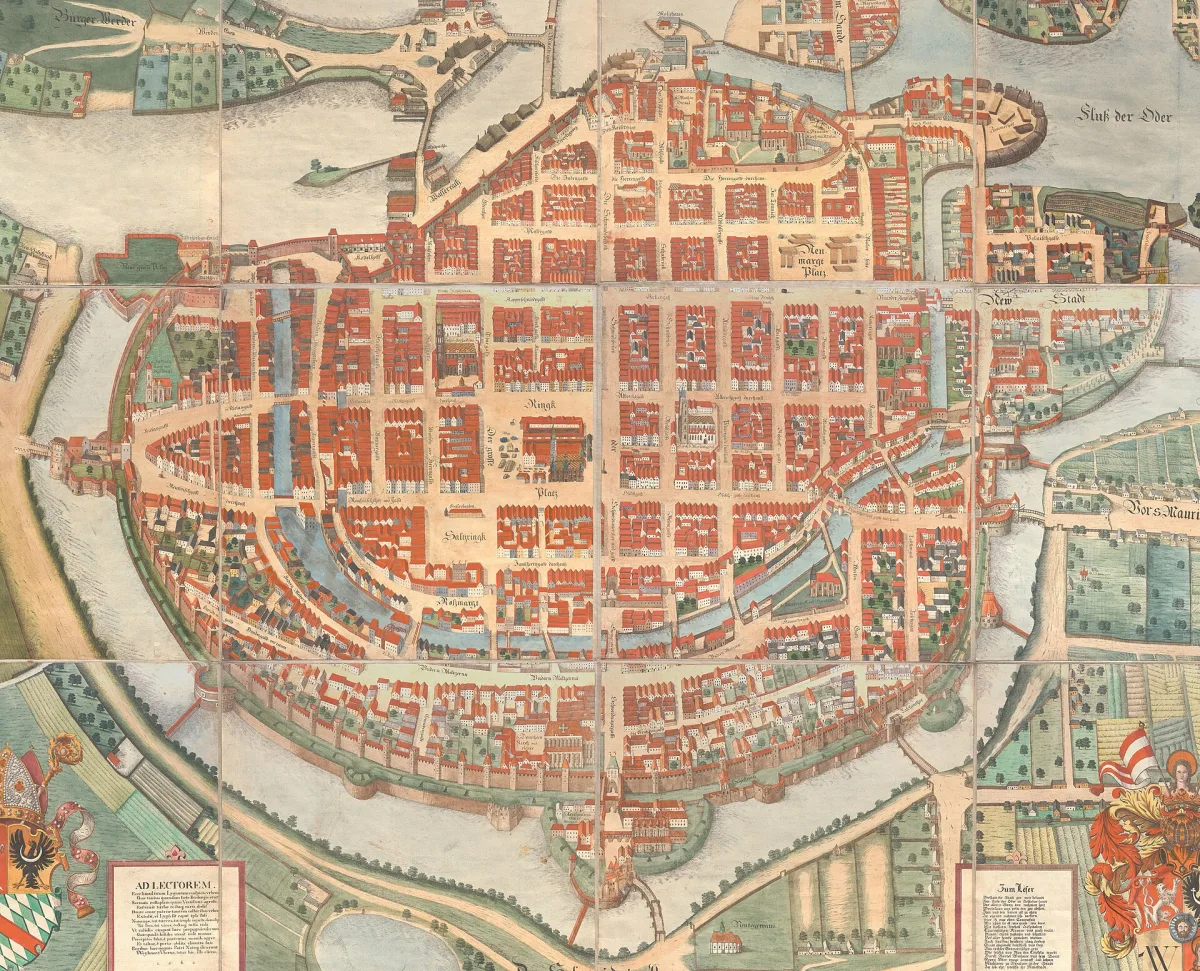
The City Moat (Fosa Miejska) in Wrocław is a remnant of the city's fortification system, largely based on natural and artificial sections of the Oder (Odra) and the Oława river flowing into it, running today along Podwale Street.
The inner moat, known as the City Oława or Black Oława, was created in the 13th century. In the same century an outer line of fortifications was laid out with a second, outer moat, about three hundred metres from the Black Oława, which made it possible to gain a large area of land for building. A wall with towers ran along the moat, supplemented at the beginning of the early modern era with bastions. In the 17th century these were replaced by a new bastion perimeter, which slightly altered the course of the moat and gave its outline more geometric forms.
After the city was taken by the troops of the Confederation of the Rhine under Jérôme Bonaparte, the fortifications were ordered to be demolished, which took place in 1807-1810. Successive sections of both moats were systematically filled in at that time. The inner moat was completely eliminated around 1869, and today's W-Z route runs approximately along its former line. Significant fragments of the outer moat have survived, however, although the sections based on the Oder's side branch in the right-bank part of the city were completely eliminated, which meant Ostrów Tumski ceased to be a true island. The last section of the outer moat, together with the link to the Oława, in the area of today's Słowacki Park, was eliminated in the 1870s and 1880s.
The strip of greenery along the surviving moat, and further along the Oder, is today known as the Old Town Promenade (Promenada Staromiejska). Two hills remain from the system of former bastions: Liebich Hill, now known as Partisans' Hill, and Holtei Hill, now referred to as Polish Hill.
On at least two occasions Wrocław's authorities considered the complete elimination of the moat: in the 19th century such plans were not carried out, and after the end of the siege of the city in 1945 the idea returned of filling in the moat with rubble from the streets, though this too was never implemented. Later only conservation work was carried out on the moat, and the first thorough dredging and cleaning did not take place until around 1965, during which unexploded ordnance and ammunition from the Second World War, among other things, were removed from it.

Be the first! Add a comment.
You need to log in to add a comment.
Log in