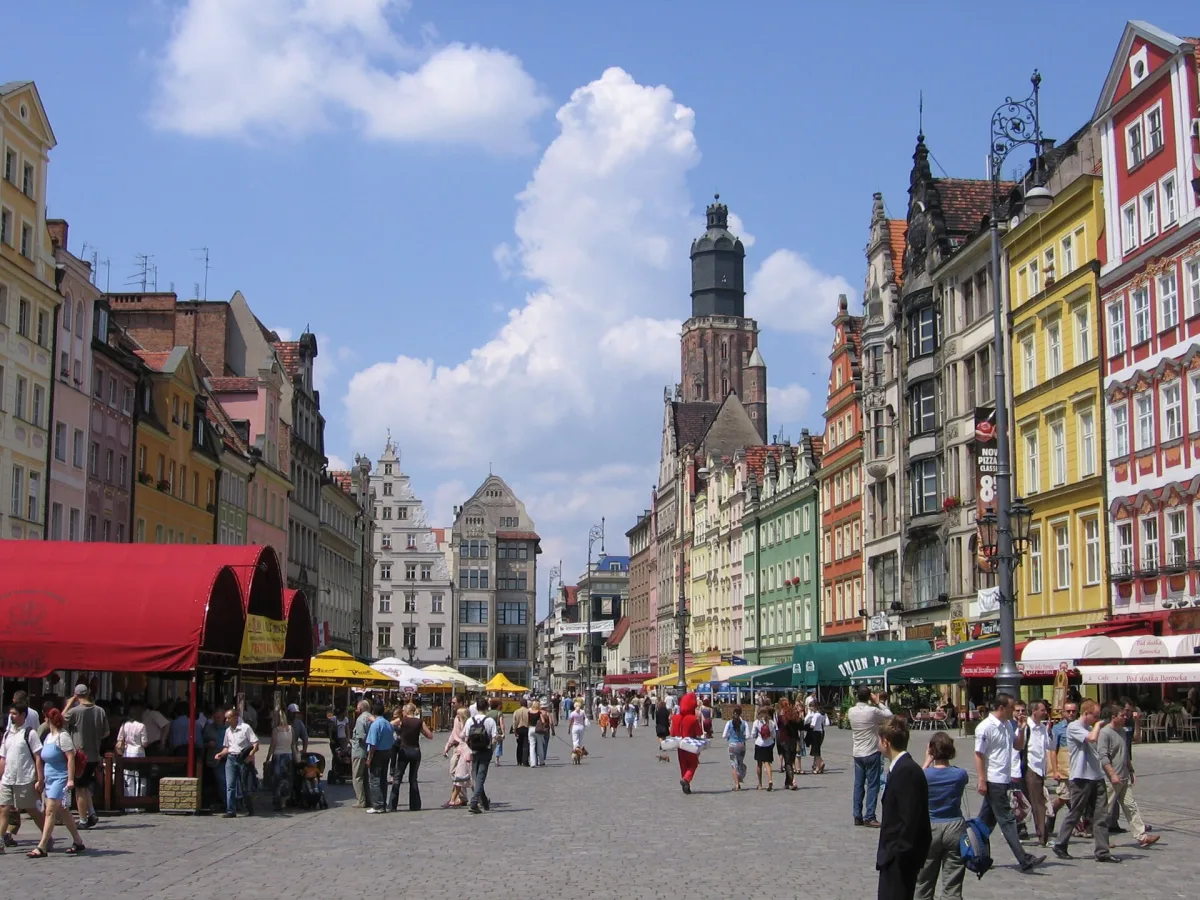
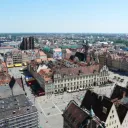
One of the largest old-town market squares in Europe, with a central block housing the Old and New Town Halls in the centre of Wrocław.
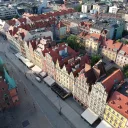
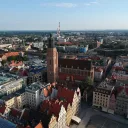
The Market Square in Wrocław is a medieval market place, today the central part of Wrocław's pedestrian zone. It is one of the largest old-town market squares in Europe, with the largest town halls of any market square in Poland. The square was laid out around 1232 on the initiative of Duke Henry the Bearded, the city's second founding charter followed in 1241 and 1242 thanks to Bolesław the Bald, and the legal regulation was carried out in 1261 by Henry III and Władysław. Originally the Market Square measured 600 by 480 feet; today its dimensions are about 204 to 206 by 169 to 170 metres, and the whole area covers 3.64 hectares, divided into 36 equal plots laid out among the frontages.
According to the findings of Olgierd Czerner, the concept of the Market Square covers the whole area of the square together with its architectural elements and the buildings surrounding it on all four sides. Because of the difficulty in establishing the boundaries of former plots, the area is taken to be defined by the streets Ofiar Oświęcimskich, Szewska, Igielna and Kiełbaśnicza. The Market Square forms an urban layout together with Plac Solny, lying diagonally opposite, and the square by St Elizabeth's Church.
The central part of the square is occupied by the central block, rotated 7 degrees clockwise. It consists of the Old Town Hall, the New Town Hall and tenement houses, and its interior is crossed by narrow lanes: Przejście Garncarskie, Przejście Żelaźnicze and Sukiennice street, as well as Jerzy Grotowski Lane. Other trading buildings used to stand here as well: the Cloth Hall, mentioned even before the Mongol invasion, was demolished between 1821 and 1824. The Rich Stalls, known since 1242, were built in brick from 1373. The Linen Weavers' Stalls numbered 38 stands and are documented from 1299, and the Smatruz, operating from 1273, held 32 bread stalls. The Small Scale was built in 1521 and 1522 for weighing goods, and the older Great Scale, dating from the fourteenth century, was demolished in 1846.
Construction of the Old Town Hall began between 1299 and 1301, its tower was raised in 1354, and it received its spire in 1559. Neo-Gothic elements, including twelve statues on the southern facade, were added in 1890 and 1891. For centuries the Old Town Hall was the seat of the city authorities and the court. This changed between 1860 and 1863, when the New Town Hall was built to a design by August Stüler. It is there that the office of the Mayor of Wrocław is located today, and where meetings of the City Council are held.
On the site of the former Great Scale, a monument to Frederick II by August Kiss was erected in 1846. The monument to Aleksander Fredro, the work of Leonard Marconi, was moved from Lviv in 1946 and placed in the Market Square in 1956. A sandstone pillory from 1492 also once stood on the square, destroyed in 1945 and reconstructed in 1985. Today's fountain on the Market Square was designed in 2001 by Alojzy Gryt.
In 1945 more than 60 per cent of the buildings on the square were destroyed, with only 17 buildings surviving. The decision to rebuild was taken in 1953, and by 1955 most of the tenement houses had been reconstructed: 24 were rebuilt from scratch, 11 restored, and 13 renovated. The last of the tenement houses, "Under the Golden Dog", was not rebuilt until 1992 to 1994.
Ten streets lead into the Market Square, two at each corner. From the south-east, Świdnicka and Oławska streets arrive; from the north-east, Wita Stwosza and Kuźnicza; from the north-west, Odrzańska and świętego Mikołaja. The south-west corner adjoins Plac Solny, with Ruska and Gepperta streets. Kurzy Targ street arrives at the eastern frontage, the narrow Więzienna street at the northern one, and Przejście świętej Doroty, which turns into Jerzy Grotowski Lane, at the southern one.

Be the first! Add a comment.
You need to log in to add a comment.
Log in