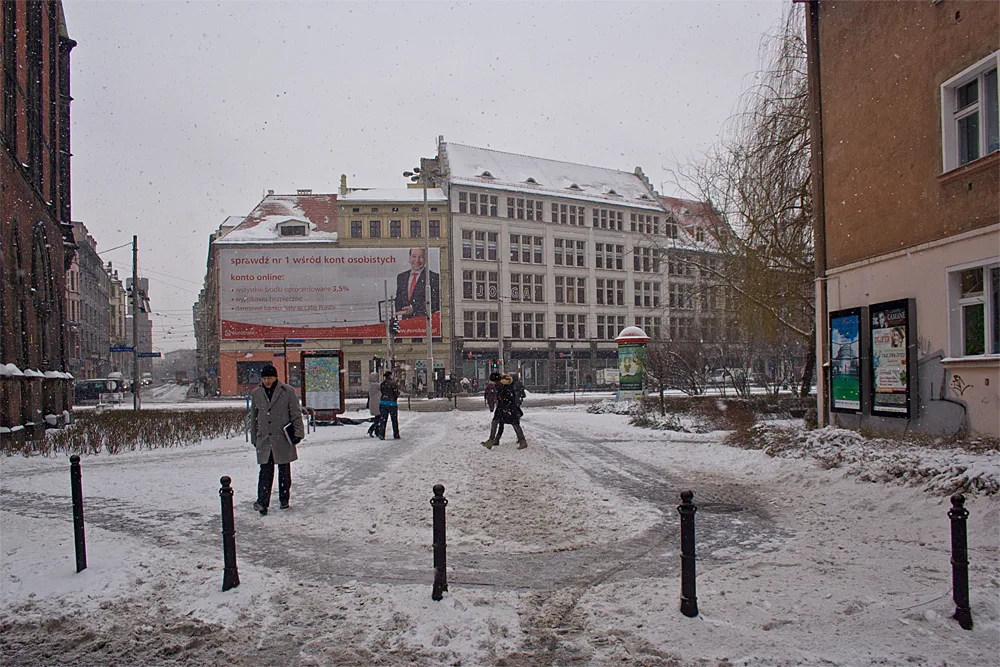
A memorial square in the Old Town in Wrocław, named in honour of the Warsaw Ghetto Uprising, with a monument unveiled in 1963.
Ghetto Heroes Square lies in the Old Town in Wrocław, today in the form of a small green square and promenade between the University Library building and the tenement houses of Psie Budy street. The name commemorates the Warsaw Ghetto Uprising, and the place itself has a long and complicated history worth knowing before walking through it.
In 1744, in the time of King Frederick II the Great, the square was called Judenplatz, meaning Jewish Square. In the 19th century it functioned as Carlsplatz (Karlsplatz), in honour of Emperor Charles IV. In 1929 it was renamed Lassalleplatz, to commemorate Ferdinand Lassalle, a German social democrat born on the spot in 1825, but already in 1933, under the Nazis, the name Karlsplatz was restored. After the war, in 1945, the square briefly received back the name Jewish Square, and on 19 April 1946, on the third anniversary of the outbreak of the Warsaw Ghetto Uprising, it was given its present name, Ghetto Heroes Square.
On 19 April 1963, on the twentieth anniversary of the uprising, a monument dedicated to its participants was unveiled on the square: a granite wall with the inscription "1943 kwiecień 1963" and a plaque with an inscription in Polish and Yiddish. The monument remains the square's main feature and the main reason to stop here for a moment of reflection rather than simply pass through.
Originally the square was an important street junction, connecting Kazimierza Wielkiego, Krupnicza, świętego Antoniego, Złote Koło, Białoskórnicza, Psie Budy and Szajnochy streets. None of the pre-war tenement houses around it survived the Second World War. In 1887-1891 an imposing building housing the municipal savings bank and library was erected at the square, which today houses the University Library. At number 3 there once stood the Bialska Synagogue, operating from 1832 to 1892, and until 1814 the Seven Wheels Mill also functioned here. After the construction of the W-Z Route in the 1970s, the square shrank considerably, taking on its present, intimate form.

Be the first! Add a comment.
You need to log in to add a comment.
Log in