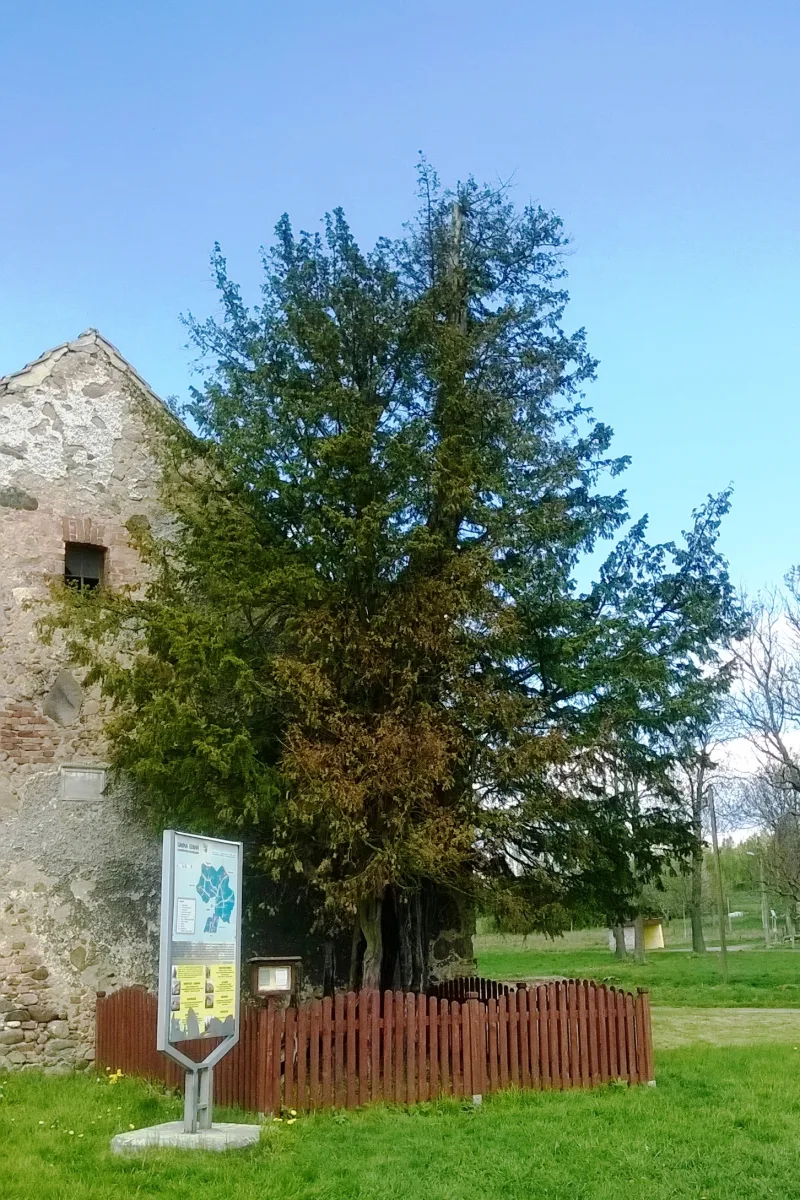
A common yew in the village of Henryków Lubański, regarded as the oldest tree in Poland, estimated at between 1,250 and as much as 1,500 years old depending on the source.
The Henryków Yew is a common yew tree growing in the village of Henryków Lubański in Lower Silesia, regarded as the oldest tree in Poland. It grows next to farm buildings, protected by a wooden fence, and for decades has attracted people interested in nature and the region's history.
The exact age of the yew is hard to determine, so successive measurements have produced different results. In 1987 it was estimated at about 1,250 years, in 1992, following an assessment by Dr Cezary Pacyniak, at 1,253 years, and in 2020 at 1,270 years. Some sources give even higher figures, from 1,300 to 1,500 years. Whichever estimate is taken, the Henryków Yew is one of the oldest living organisms in the country.
The tree is about 15 metres tall, and the circumference of its trunk is currently about 4.25 metres, although in the past it was measured at as much as 5 metres. The yew is protected by a wooden fence that does not allow visitors to approach the trunk directly, and its health is monitored on an ongoing basis.
The yew survived damage inflicted by soldiers in 1813 and a shell fragment in 1945. In 1989 a strong hurricane broke one of the tree's boughs. In the 1990s the tree underwent conservation treatment, and after 2016 its roots were protected against rodents and scaffolding and a misting system were installed by the trunk. Thanks to these measures, in 2020 the yew put out new shoots and needles.
The Henryków Yew is a natural monument, established by a decree of the Jelenia Góra voivode in 1992. A story going back to the Middle Ages is also connected with the tree: according to it, King Władysław Jagiełło is said to have announced harsh penalties for anyone who cut down valuable trees such as yews.

Be the first! Add a comment.
You need to log in to add a comment.
Log in