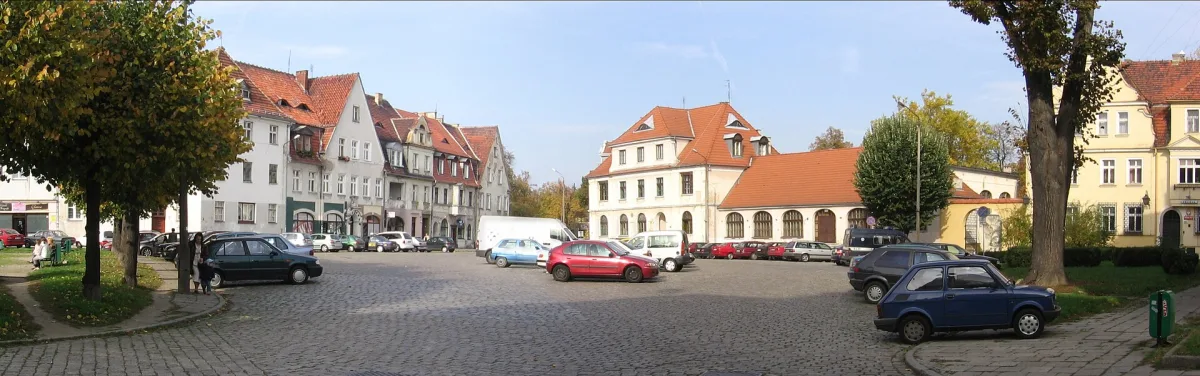
The main square of the Karłowice-Różanka estate in Wrocław, designed as a garden city in the early 20th century.
Józef Piłsudski Square is the main square of the Karłowice-Różanka estate in Wrocław, designed according to the garden city concept. The estate was meant to be an exclusive district of the city - construction began in 1911, and it was incorporated into Wrocław in 1928.
In 1913 an architectural competition was held for the design of the estate's market square. The jury included renowned architects, among them Hermann Muthesius and Hans Poelzig, but none of the winning competition designs was ultimately built.
The houses around the square were built in two stages to a design by Erich Grau. In 1914 the first buildings, with shops on the ground floors, were erected. In 1926 the "Eichborngarten" Estate Cooperative added further low residential buildings forming compact rows - in the end, simple three-storey houses were built with two-, three- and four-room flats. Several of these buildings are listed in the heritage register, including a former inn from 1915-1920, which for years housed the "Agora" Estate Cultural Centre, founded in 1958. Today the building houses the Wrocław Psie Pole Police Station.
The square has borne the following names in turn: Karlowitzer Markt (until 1929), Am Markt (1929-1945), Plac Żuławskiego (1945-1953) and Plac Gottwalda (1953-1989). It has borne its present name, Józef Piłsudski Square, since 1989.
From Karłowice-Różanka the closest attractions are the Botanical Garden of the University of Wrocław and the Centennial Hall, a few kilometres away towards the city centre.

Be the first! Add a comment.
You need to log in to add a comment.
Log in