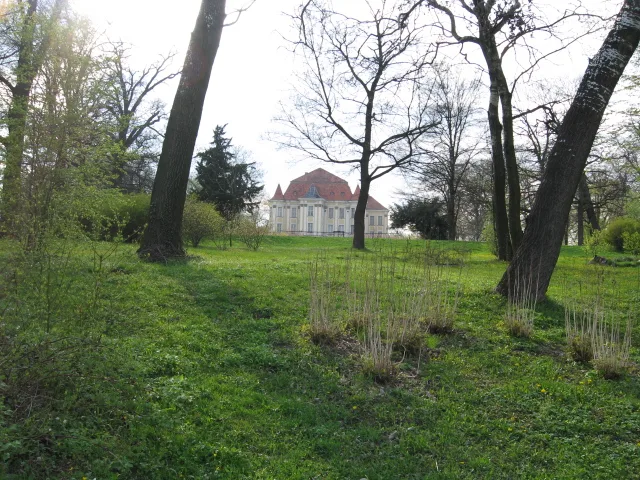
A former palace park on 21 hectares in Leśnica by the Bystrzyca, with a Renaissance castle, a hornbeam maze and ponds, entered in the heritage register.
Leśnicki Park is a former palace park in the western part of Wrocław, within the Leśnica neighbourhood. It covers 21 hectares and forms the southernmost part of a larger green complex, whose northern section is made up of the Las Mokrzański forest.
The park lies in the ecological corridor formed by the Bystrzyca river, which forms its eastern boundary. To the south it borders ulica Średzka, and to the west ulica Marszowicka. To the north of the park stretch the water-catchment areas of Las Mokrzański. A footbridge crosses the Bystrzyca, allowing passage to the Stabłowice neighbourhood.
The park's 19th-century layout was designed by J.P. Lenné. In the post-war period the park fell into decline, and wartime damage remained unrepaired for a long time. It was only at the end of the 20th century, under the direction of Halina Krajewska, that the park was restored in a way that referred back to Lenné's original concept. The park, together with the palace complex, is entered in the register of immovable heritage monuments under numbers ZU/4 from 29 January 1958 and A/5293/193 from 15 February 1962. The site is looked after by the Municipal Greenery Authority.
The park's attractions include ponds, dendrological specimens, a hornbeam maze and natural stands of anemones, with a playground provided for children. Natural monuments also grow here: a London plane and a pedunculate oak. The site's biggest attraction, however, is the Renaissance castle in the southern part of the park, which houses the "Zamek" Culture Centre.
Nearby, on the other side of the Bystrzyca, stretches Park Stabłowicki. In Leśnica itself it's also worth seeing the Statue of the Madonna and St John of Nepomuk in Leśnica, Plac Świętojański in Wrocław and the St Andrew the Apostle's Church in Wrocław.

Be the first! Add a comment.
You need to log in to add a comment.
Log in