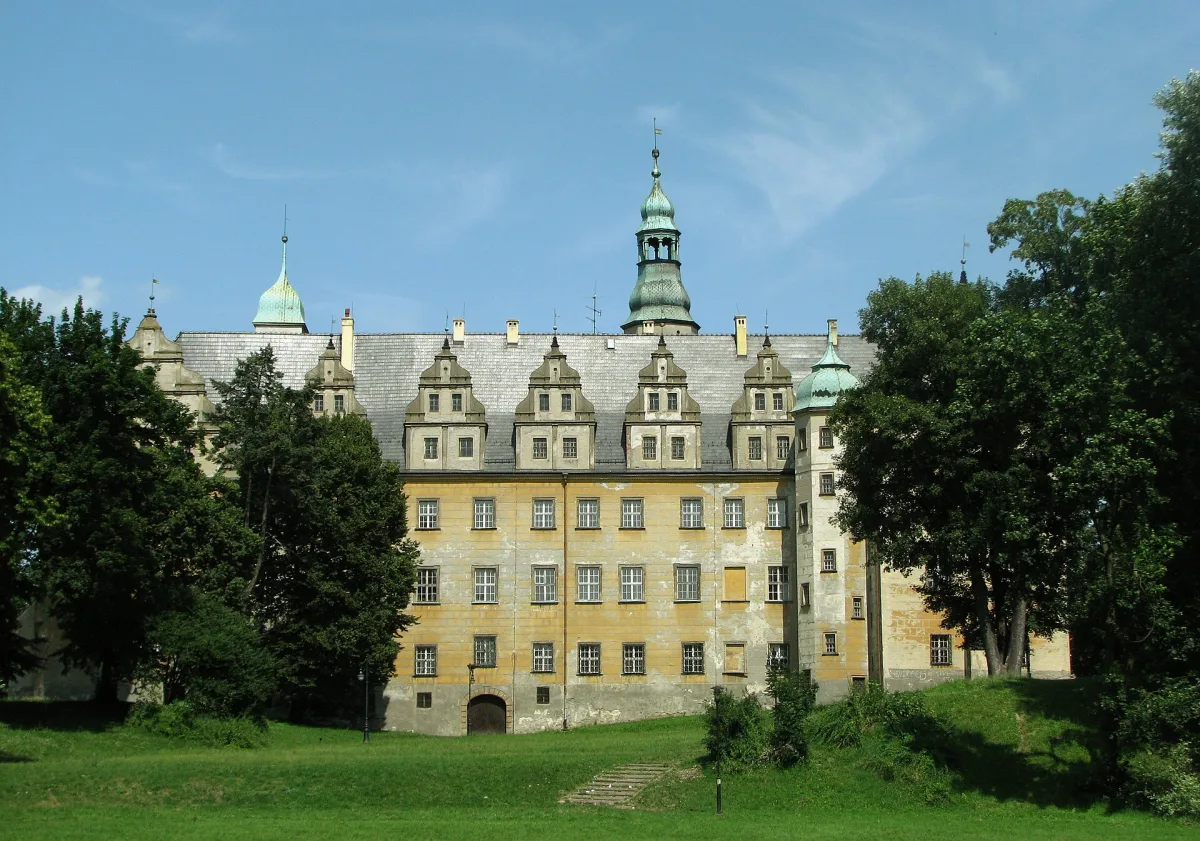
A Renaissance castle with 13th-century origins on Zamkowa street in Oleśnica, today the seat of the Headquarters of the Voluntary Labour Corps.
The Oleśnica Ducal Castle, also known as the Castle of the Dukes of Oleśnica, stands at Zamkowa 4 street in Oleśnica. It is a Renaissance building erected on the site of a Gothic stronghold from the 13th century, entered in the register of immovable heritage monuments of the Lower Silesian Voivodeship. For centuries it was the seat of successive families ruling the Duchy of Oleśnica.
A fortified settlement of the Piasts of Oleśnica was first mentioned in 1239, and the first record of the castle itself dates from 1292. Its construction was probably initiated by Conrad I of Oleśnica. Its heyday came in the time of the descendants of the Czech king George of Poděbrady, who took over the duchy after the local Piast line died out. John of Poděbrady began a major rebuilding and erected the front castle, also called the Widows' Palace, intended for ducal widows. Charles II of Poděbrady gave the building its present form, adding the east wing with Renaissance arcades and the south wing.
After the Poděbrady line died out, the Duchy of Oleśnica, and with it the castle, was taken over by the House of Württemberg, who ruled it until 1792. Later the castle belonged to the House of Welf, until 1884, and towards the end of the 19th century it became a crown fief of the Hohenzollerns. They carried out a thorough renovation of the building, which from then on was their summer residence until 1945.
The castle has four wings, three storeys and a basement, built around an inner courtyard. Its towers have six and seven storeys. A large part of the facades is covered with sgraffito, typical of the Renaissance, a decorative wall technique executed in multi-layered plaster.
After the Second World War, Hungarian and Italian prisoners of war were held in the surviving buildings. Later a branch of the Soviet International Red Cross was based here, followed by a construction technical school. Between 1970 and 1990 a regional branch of the Archaeological Museum in Wrocław operated here, and from 1975 to 1993 the castle housed the Central School of Instructors of the Polish Scouting Association. Since 1993 the castle has been owned by the Headquarters of the Voluntary Labour Corps. The building is part of the European Route of Castles and Palaces.
In Oleśnica itself, near the castle, you will also find the Ejection Seat Museum in Oleśnica and the water tower. Anyone looking for outdoor activity can visit the Oleśnica ATOL Recreation Complex with its indoor pool.

Be the first! Add a comment.
You need to log in to add a comment.
Log in