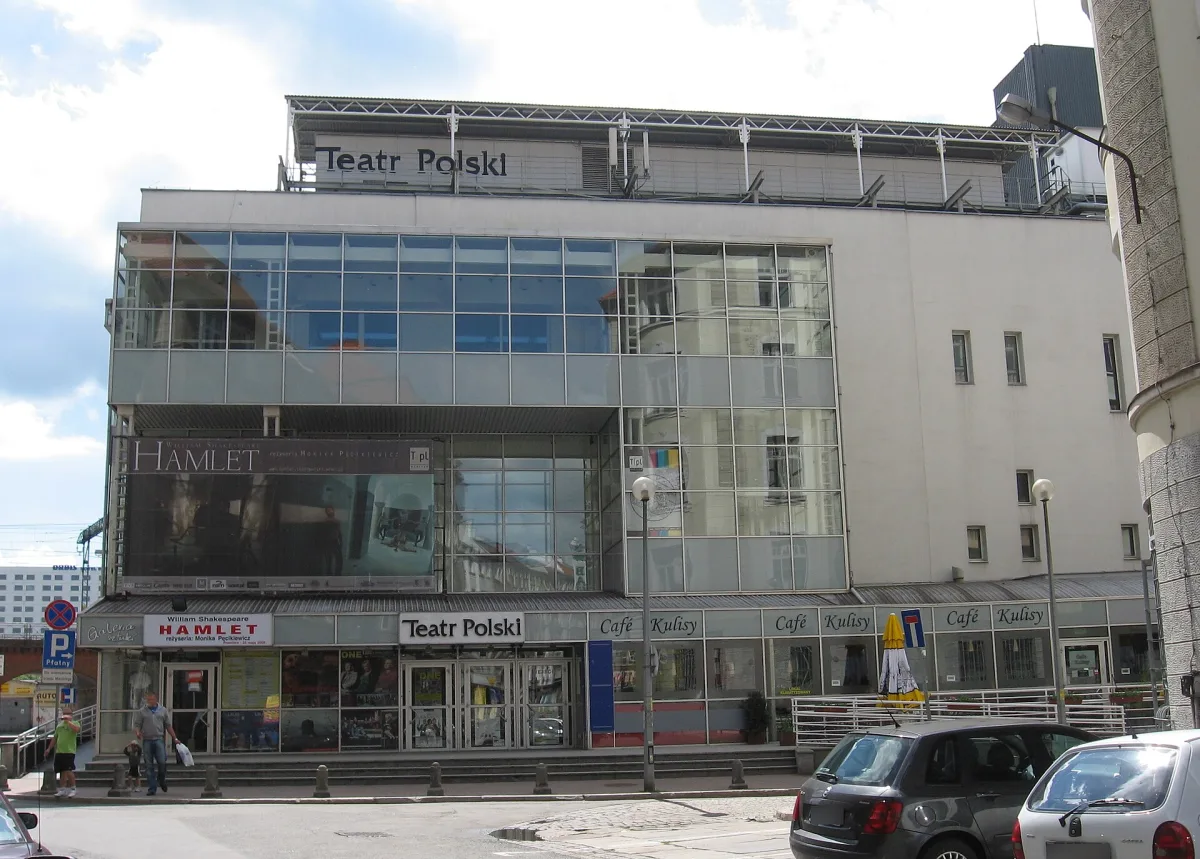
A local government theatre in Wrocław founded in 1949, operating on three stages in a historic building from 1906.
The Polish Theatre in Wrocław is a local government cultural institution operating since 1949, when it was founded as the State Lower Silesian Theatre in Wrocław. It has held its current name since 1969, and its main seat is in a historic building on ulica Gabrieli Zapolskiej.
The history of the main stage building goes back to 1906, when the merchant Paul Auerbach commissioned the Berlin architect Walter Hentschel to design a modern operetta house. The building used a reinforced concrete structure, innovative for its time, and its solutions later influenced the construction of the Centennial Hall in 1913. It originally held 1,736 seats and was mainly used for musicals and operettas.
The building suffered serious damage during the Second World War and was rebuilt in 1950. The first premiere after the rebuilding was the production "A Thousand Brave Men" ("Tysiąc walecznych"), staged in December 1950.
On the night of 18 to 19 January 1994, a fire destroyed the theatre's auditorium. The rebuilding was led by architect Wiktor Jackiewicz, and the work was completed in 1996.
Today the Polish Theatre operates on three stages: the main Jerzy Grzegorzewski Stage on ulica Gabrieli Zapolskiej, the Chamber Stage on ulica Świdnicka, and the Świebodzki Stage, located on plac Orląt Lwowskich, in the former area of Wrocław Świebodzki railway station.
The theatre has played an important role in Wrocław's cultural life, including during the celebrations of the European Capital of Culture in 2016. In 2015, one of its productions opened the Avignon Festival as the first Polish presentation in the event's history.
The Polish Theatre lies right in the city centre, surrounded by other cultural institutions. In the immediate vicinity are BWA Wrocław and the New Synagogue in Wrocław, and a few minutes' walk away the National Forum of Music and the Wrocław Puppet Theatre. This makes it easy to combine an evening at the theatre with visiting the nearby museums and squares.

Be the first! Add a comment.
You need to log in to add a comment.
Log in