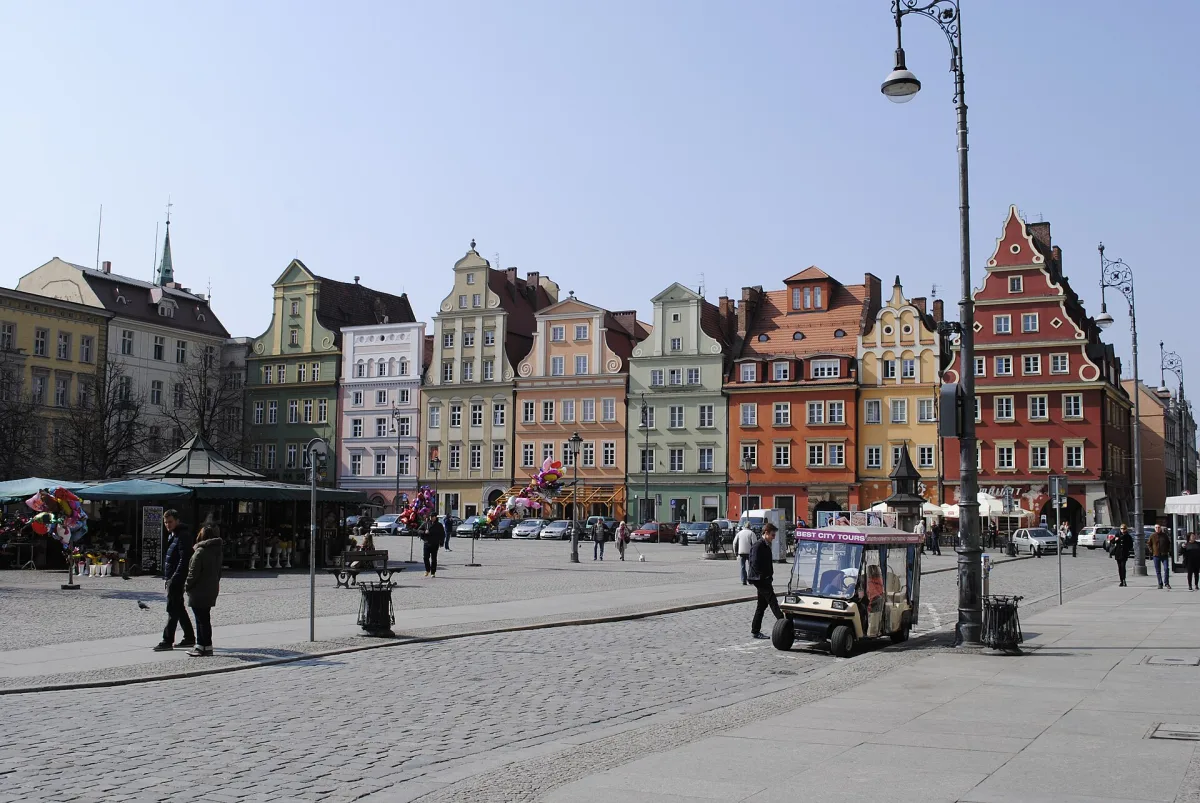
A square secondary market square by Wrocław's Market Square, laid out in 1242, known for its flower market and the Little Spire obelisk.
Solny Square is a square secondary market square of Wrocław's Old Town, laid out in 1242 right next to the Market Square. Unlike it, it remains an undeveloped, open space, known today mainly for its traditional flower market.
The square probably came into being during the re-location of Wrocław in 1242, carried out after the Mongol invasion. It originally measured 84.5 by 94 metres, that is 270 by 300 feet of the time. It was called Polnischer Markt (Polish Market), Salzring (Salt Ring) or Salzplatz (Salt Square), which is where its present name comes from.
In 1827 a monument to the Prussian field marshal Blücher was erected on the square, and for decades the square itself was called Blücherplatz. After the Second World War its historic name, Solny Square, was restored, and the pedestal left after the monument, already dismantled by the Germans, was demolished.
Half of the southern frontage is occupied by the classicist building of the former Stock Exchange, designed in 1822 by Carl Ferdinand Langhans, next to which stand three historicist tenement houses. On the eastern side stands a former department store from the early 20th century. The most varied is the northern wall, with a corner high-rise adjoining the Market Square, built in 1930-1932 to a design by Heinrich Rump, and the former Pod Murzynem pharmacy, remodelled in 1928 by Adolf Rading in the modernist style, which today houses the local editorial office of one of the newspapers. There too stands the baroque Oppenheim House from around 1700, originally built as a Gothic house as early as the 13th century, known today as OP ENHEIM. The western frontage, which gives the impression of being the oldest, is in fact a free reconstruction of its state from two centuries earlier, carried out in 1947-1958.
At the end of the 20th century an obelisk called the Little Spire was erected on the square, with a wavy shape narrowing upward, reminiscent of a flame. It was designed in 1996 by Adam Wyspiański. Its form refers to events of 1453, when, under the influence of sermons by the Franciscan John of Capistrano, Wrocław's burghers burned luxury furniture, clothing and other items considered too extravagant here.
Beneath part of Solny Square lies a shelter with an area of about a thousand square metres, able to hold 300 people. During the war it had its own toilets, sewage system and two exits, one of which is today located in the underground women's toilet. The underground structure was designed by Richard Konwiarz.

Be the first! Add a comment.
You need to log in to add a comment.
Log in