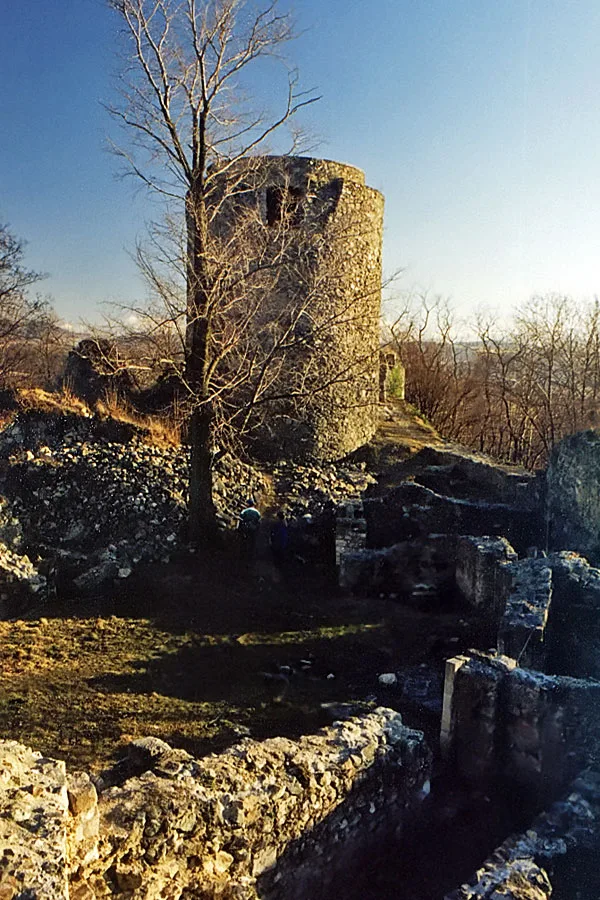
The ruins of the oldest brick castle in Poland, built in Romanesque style on Góra Zamkowa above the Bóbr river, open to visitors after preservation works.
Wleń Castle, also called the Wleń Gródek, stands on Góra Zamkowa above the Bóbr river, in the hamlet of Wleński Gródek near Wleń. It is considered the oldest brick castle in Poland and one of the few built in the Romanesque style.
The castle was built in brick form at the end of the 12th century on the initiative of Duke Bolesław I the Tall, on the site of an earlier timber-and-earth stronghold, which had already been raised to the rank of a castellany in 1108 under the rule of Bolesław III Wrymouth. The building stands at an altitude of 383 metres above sea level.
In the early 13th century, Duke Henry the Bearded and his wife Hedwig, later the patron saint of Silesia, often stayed at the castle. Under their rule the castle was expanded with a residential tower and a chapel 9 metres high. The hexagonal tower was later replaced by a round one, 12 metres in diameter, with walls up to 3 metres thick. It is this tower, 12 metres tall, that has survived to this day.
The castle was also favoured by Bolesław II the Bald ("Rogatka"), who in 1257 imprisoned the Bishop of Wrocław, Thomas I, here. In the mid-14th century, Duke Bolko II the Small led a rebuilding during which the so-called middle castle was built. After 1368 the estate was taken over by the von Zedlitz family, and in 1377 Tymo von Kolditz carried out fortification works. A further rebuilding, in 1567-1574, was overseen by Sebastian Zedlitz with the architect Jerzy der Wahlich.
During the Thirty Years' War the castle was besieged repeatedly by Swedish and imperial troops. After the Swedish surrender on 7 September 1646, General Montecuccoli ordered the fortifications destroyed. The building fell into ruin. The next owner, Colonel Adam von Kaulhaus, who had previously served the French king Louis XIII, built a new palace on the slope instead of rebuilding the castle. Until the Second World War the estate belonged to the von Haugwitz family.
Between 1989 and 1994 the site was studied by an archaeological team from the University of Wrocław, which allowed a better understanding of the stronghold's layout. After years of progressive deterioration of the walls, the ruin was closed in 2005. Preservation works carried out since 2009 have reinforced the walls and the tower, and since 2018 the castle has again been open to visitors.
Close by, at the dam on the Bóbr river, lies the Pilchowice Dam, and right at the foot of the hill stretches the Góra Zamkowa Nature Reserve. It is also worth visiting the Bóbr Valley Landscape Park and the viewpoint in Wleń in the area.

Be the first! Add a comment.
You need to log in to add a comment.
Log in