
The Boy from Bad Salzbrunn Who Became the Voice of Silesian Poverty
Gerhart Hauptmann was born on 15 November 1862 in Bad Salzbrunn, today's Szczawno-Zdrój, into a family running the "Zur Preussischen Krone" hotel. A childhood spent by the hospitable bar, among the most varied guests, gave him the powers of observation that later filled his plays and novels. Hauptmann is counted among the leading representatives of German naturalism, a movement that, instead of drawing rooms and bourgeois romantic dramas, portrayed poverty, exploitation and social injustice as they really looked at the time. Alongside his naturalist plays, his output also included fairy-tale and symbolic works, but it was precisely his raw, documentary realism that brought him European fame and made him one of the most important German-language writers of the turn of the 19th and 20th centuries.
The Weavers and the Revolt Behind It
Hauptmann's most famous work remains the 1892 drama "The Weavers", describing the 1844 uprising of the Silesian weavers, a revolt by workers of the cottage textile industry in the Owl Mountains, driven to despair by starvation wages and competition from machine-powered factories. Hauptmann wrote the play in two versions, one in the Silesian dialect and the other in standard German, and in both showed with stark directness the misery of working-class families and the collective revolt as a response to unbearable living conditions, rather than the action of a single hero. It was precisely this lack of a classic, individual protagonist, with the entire community of weavers taking the place of the main character in the drama, that was a novelty in European dramaturgy at the time. "The Weavers" has left a lasting mark on the history of theatre as one of the most important texts of European naturalism, and for Lower Silesia as a literary testimony to one of the most difficult episodes in the region's industrial history.
The Nobel Prize in 1912
In 1912 Gerhart Hauptmann was awarded the Nobel Prize in Literature, among other things for his dramatic output, in which "The Weavers" played a key role. The Nobel Prize cemented his position as one of the leading German-language writers of his era and brought him renown reaching far beyond Germany. It was in the period before and after the Nobel Prize that Hauptmann grew increasingly attached to the Karkonosze (Giant Mountains), where he moved for extended stays, seeking in the mountain landscape the peace he needed for his work.
Wiesenstein - the House in Jagniątków and the Circle of Karkonosze Artists
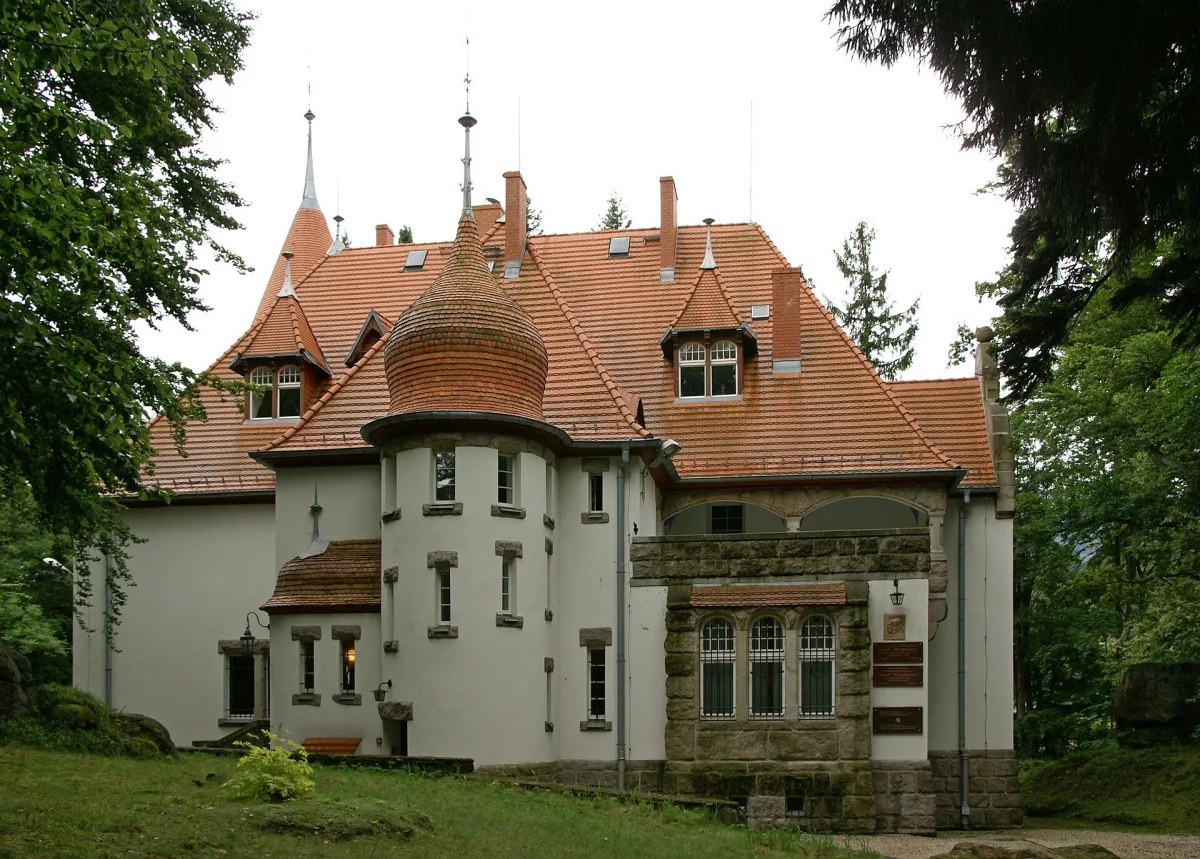
From 1901, Hauptmann divided his time between Jagniątków (former Agnetendorf), Berlin and the Baltic island of Hiddensee. In Jagniątków, in 1900-1901, a house named Wiesenstein ("Meadow Stone") was built for him to a design by architect Hans Grisebach, combining a historicist form with neo-Renaissance elements, with a distinctive tower and a view over the Karkonosze panorama from the surrounding 1.6-hectare park. The writer himself called his residence "a castle of defiance and defence" and a place for "rebuilding one's own soul" - the house was meant to be a peaceful haven, but at the same time buzzed with social and cultural life, bringing together writers, artists and intellectuals who frequented the Karkonosze at the turn of the 19th and 20th centuries. In nearby Szklarska Poręba, a circle formed at the time around Gerhart's brother, Carl Hauptmann, also a writer - today the memory of both brothers is honoured by the local Karkonosze Museum in the House of Carl and Gerhart Hauptmann, a testament to how important a centre of literary life the Karkonosze became at that time.
The 1930s - a Stance Researchers Still Debate
The most difficult chapter in Hauptmann's biography remains his stance after the Nazis came to power in 1933. The writer could not bring himself to publicly criticise the new regime at the time and withdrew from public life, while nonetheless remaining in Germany. His name appeared on the so-called Gottbegnadeten-Liste, a list of artists deemed "irreplaceable" by the Third Reich authorities, which in practice meant exemption from conscription and other duties to the state, and at the same time formal recognition from the regime, something Hauptmann never came to terms with. Literary historians assess this period ambiguously: no evidence has been found of the writer's active involvement in Nazi propaganda or of his personal support for the regime's ideology, but his silence and remaining in the country, at a time when many artists chose emigration or open opposition, is sometimes described as passive consent, a burden on his post-war reputation. The dispute over how harshly to judge this stance continues in Hauptmann research to this day, with no single, universally accepted answer.
The Final Years and Death Shortly After the War
Hauptmann lived to see the end of the war in his house in Jagniątków, which in 1945 came under Polish administration. He died there on 6 June 1946, aged 83. His wife Margarete would not agree to the writer being buried on Polish territory, so a special transport, the so-called Hauptmann Transport, was arranged, which did not carry the coffin to Germany until 19 July 1946, under the escort of Polish and Soviet soldiers. The final funeral took place on 28 July 1946 on the island of Hiddensee, in the village of Kloster, where Hauptmann was laid to rest against earlier plans linked to his house in Jagniątków - a museum dedicated to him had been meant to open there, something the writer's widow opposed.
The House That Became a Museum After All
Despite the post-war dispute over Wiesenstein, the house in Jagniątków eventually got its own institution of memory - since 2005 it has housed the "Gerhart Hauptmann House" City Museum in Jelenia Góra. Visitors can see five rooms, including the Nobel laureate's study, his library, a fireplace room, and the so-called Paradise Hall with its preserved wall paintings. The exhibits include documents, photographs and books left by the writer, and the institution also carries out scholarly and educational activities related to literature and the history of Silesia, organising workshops and conferences. Today the house, which was meant to be a refuge from the world for Hauptmann, is a place where visitors can confront both his literary legacy and the ambiguous chapter of his biography.

Be the first! Add a comment.
You need to log in to add a comment.
Log in