
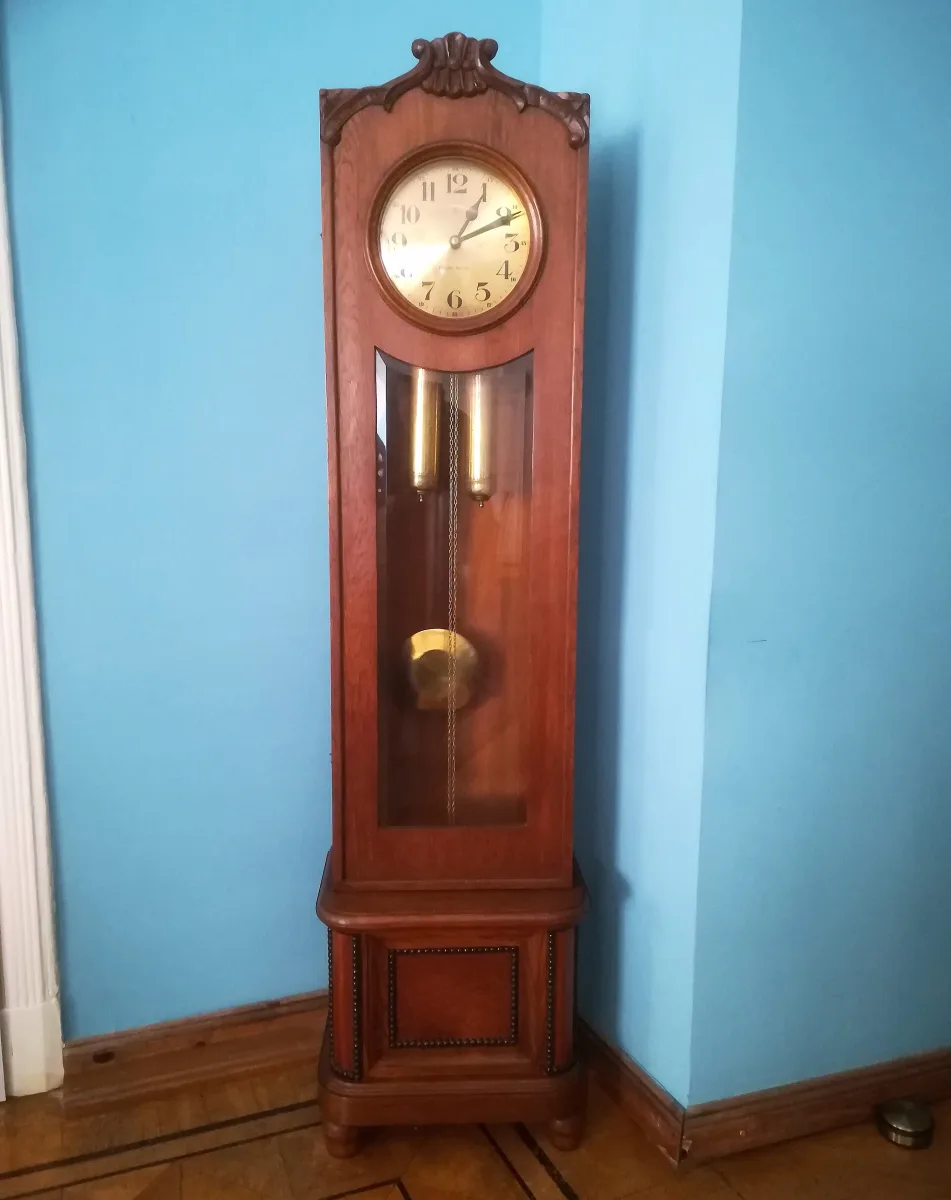
In the second half of the 19th century Świebodzice was known as the Silesian town of clocks. The reason was a single workshop that, over the course of a few decades, grew into one of the largest clock factories in Europe - founded by the clockmaker Gustav Becker.
From a hotel workshop to a factory on the market square
Gustav Becker was born on 2 May 1819 in Oleśnica. He trained in the trade under, among others, master craftsman Happacher, learning the design of Viennese pendulum regulators, which later became the basis of his own production. He came to Świebodzice, then Freiburg in Silesia, at the beginning of 1847, and in May of that same year opened his first, small workshop at the "Golden Lion" hotel. Just three years later, in 1850, he moved to a better-located tenement house on the market square, belonging to the Frey family.
Institutional orders supported the company's growth. In 1854 Becker received a contract to supply the postal service, and among the first prestigious buyers of his clocks were the Prussian king Frederick William IV and his wife. The workshop grew so quickly that, in exchange for support from the authorities, Becker committed to employing and maintaining, at his own expense, eighty boys from poor weaving families - in a region where, after the collapse of the textile industry, there was a shortage of jobs for the youngest workers.
A scale Silesia had not known before
By 1873 there were already five clock factories operating in Świebodzice alone, employing 1,040 workers in total - Becker's factory was the largest of them, and it was the one that earned the town its nickname of the Silesian town of clocks. Production grew at a pace that today allows the factory's history to be traced year by year: by 1873, 75,000 clocks had been produced, by 1875, 100,000, and by 15 May 1885, shortly before the founder's death, the count reached 750,000 units. In 1892 the factory passed the million mark, and over its entire history around three million numbered high-quality clocks were produced in Świebodzice. At its peak Becker's factory alone employed more than 1,200 people.
Awards, contracts and a number on the movement
Becker's clocks won awards at industrial exhibitions in Europe and beyond - among others in London, Paris, Berlin, Amsterdam, as well as Sydney and Melbourne. Sources differ on which of these was the first success: some state that in 1852 the factory received a bronze medal at the Exhibition of Silesian Industrial Products in Wrocław, others speak of a gold medal won that same year at a clockmakers' fair - the documents do not allow today for a clear resolution of which award was actually meant.
A more certain proof of quality lay in the institutional contracts - supplies for the postal service from 1854 required a precision and consistency that improvised workshops could not provide. Every clock leaving the factory received its own serial number. Because the number of units produced by particular years is known, the number on the movement today allows collectors to roughly establish when a given clock was made - the most reliable way of dating a piece, more reliable than the case's appearance alone, which the company changed many times over the decades.
After the founder's death
Gustav Becker died in 1885 in Berchtesgaden. The company was taken over by his sons, and production did not slow down - in the following years it reached the records of a million and further millions of clocks mentioned above. In 1899 the Gustav Becker brand was established as a recognisable trademark, and in 1930 the plant merged with another German clockmaking company, Junghans. The 1930s also brought growing competition from manufacturers in the Black Forest, who mass-produced cheaper clocks.
After 1945 - the end of clock production
After the Second World War and the change of borders, the factory's assets were taken over by the Polish authorities. Clock production ended, and in the former halls production began of an entirely different kind of goods - gas cookers. The plant that arose on the site of the former factory kept in its collection one of the historic pieces, marked with the millionth serial number from the factory's collection - a memento of the days when clocks were sent from this same address in Świebodzice to markets across Europe.
Where to look for traces today
Gustav Becker's clocks themselves can today be found mainly in the hands of collectors and on the antiques market - both simple wall regulators and more elaborate cabinet clocks turn up. Świebodzice has no separate museum devoted to the factory, and a precise list of institutions that today hold its products is difficult to establish. The most reliable clue remains the clock itself - the company's signature and the serial number on the dial or movement, which make it possible to reconstruct the approximate history of a particular piece, even if the town where it was made is today associated with an entirely different industry.

Be the first! Add a comment.
You need to log in to add a comment.
Log in